• Fri frakt över 249 kr
  • •
  • Snabba leveranser
  • •
  • Billiga böcker
Kundservice

Du är på sajten för privatpersoner.

Företag, bibliotek eller offentlig verksamhet?

Du handlar på classic.bokus.com, där alla dina funktioner finns intakta.
Till classic.bokus.com
Bokus logotyp. Gå till startsidan.
  • Erbjudanden
  • Nyheter
  • Student
  • Topplistor
  • Barn & ungdom
  • Bokus Play
  • E-böcker
  • Pocketböcker
  • Spel & pussel

10% rabatt på allt med kod NYSTART10 →

Sidfot

Mina sidor

    Hjälp

    • Kundservice
    • Vanliga frågor och svar
    • Frakt och leverans
    • Retur vid ångerrätt
    • Reklamera vara
    • Betalning
    • Köpvillkor
    • Allmänna villkor
    • Information om webbplatsens tillgänglighet

    Om Bokus

    • Om oss
    • Pressrum
    • För studenter
    • För företag
    • För bibliotek och offentlig verksamhet
    • För leverantörer
    • Hållbarhet

    Populärt

    • Aktuella erbjudanden
    • Presentkort
    • Studentlitteratur
    • Nya böcker
    • Topplistor
    • Signerade böcker
    • Engelska böcker

    Inspiration

    • Boktips
    • BookTok
    • Populära bokserier
    • Barnbokskaraktärer
    • Populära författare
    Logotyp för Bokus
    Följ oss på Facebook (extern länk)Följ oss på Instagram (extern länk)Följ oss på YouTube (extern länk)Följ oss på TikTok (extern länk)
    bokus @ CookiesAnpassa cookiesIntegritetspolicyKöpvillkor
    Till Citymail hemsida (extern länk)Till Budbee hemsida (extern länk)Till Postnord hemsida (extern länk)Till Schenker hemsida (extern länk)Till Early Bird hemsida (extern länk)Till Walleys hemsida (extern länk)
    1. Naturvetenskap och teknik
    2. Teknik och industri
    3. Maskinteknik och material

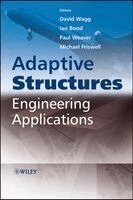
    Adaptive Structures

    Engineering Applications

    AvDavid Wagg,Ian Bond

    Inbunden, Engelska, 2007

    1 553 kr

    Beställningsvara. Skickas inom 11-20 vardagar. Fri frakt över 249 kr.

    Beskrivning

    Adaptive structures have the ability to adapt, evolve or change their properties or behaviour in response to the environment around them. The analysis and design of adaptive structures requires a highly multi-disciplinary approach which includes elements of  structures, materials, dynamics, control, design and inspiration taken from biological systems. Development of adaptive structures has been taking place in a wide range of industrial applications, but is particularly advanced in the aerospace and space technology sector with morphing wings, deployable space structures; piezoelectric devices and vibration control of tall buildings.Bringing together some of the foremost world experts in adaptive structures, this unique text: includes discussions of the application of adaptive structures in the aerospace, military, civil engineering structures, automotive and MEMS.presents the impact of biological inspiration in designing adaptive structures, particularly the use of hierarchy in nature, which typically induces multi-functional behavior.sets the agenda for future research in adaptive structures in one distinctive single volume.Adaptive Structures: Engineering Applications is essential reading for engineers and scientists working in the fields of intelligent materials, structural vibration, control and related smart technologies. It will also be of interest to senior undergraduate and postgraduate research students as well as design engineers working in the aerospace, mechanical, electrical and civil engineering sectors.

    Produktinformation

    • Utgivningsdatum:2007-05-11
    • Mått:164 x 232 x 22 mm
    • Vikt:567 g
    • Format:Inbunden
    • Språk:Engelska
    • Antal sidor:314
    • Förlag:John Wiley & Sons Inc
    • ISBN:9780470056974

    Utforska kategorier

    • Maskinteknik och material inom Naturvetenskap och teknik

    Mer om författaren

    The Editors are from the Departments of Aerospace and Mechanical Engineering at the University of Bristol. Friswell is the Sir George White Professor of Aerospace Engineering and currently a Royal Society-Wolfson Research Merit Award Holder.  Bond, Drinkwater, Wagg and Weaver are all currently EPSRC Advanced Research Fellows. The editors have significant publication records in areas related to adaptive structures, which can be viewed from here: http://www.men.bris.ac.uk/ and http://www.aer.bris.ac.uk/. They are all involved in a significant amount of funded research projects (see http://www.epsrc.ac.uk/) – for example the new Bristol Laboratories for Advanced Dynamic Engineering (BLADE) funded by a recent £15 million JIF award (GR/R51261/01) as well as numerous other research projects funded by the EPRSC and industry. Inman is the George R. Goodson Professor of Mechanical Engineering, and Director of the Center for Intelligent Material Systems and Structures at Virginia Tech, USA. He is also the Benjamin Meaker Visiting Professor at Bristol.

    Innehållsförteckning

    • List of Contributors xiPreface xvii1 Adaptive Structures for Structural Health Monitoring 1Daniel J. Inman and Benjamin L. Grisso1.1 Introduction 11.2 Structural Health Monitoring 41.3 Impedance-Based Health Monitoring 61.4 Local Computing 81.5 Power Analysis 111.6 Experimental Validation 131.7 Harvesting, Storage and Power Management 181.7.1 Thermal Electric Harvesting 191.7.2 Vibration Harvesting with Piezoceramics 221.8 Autonomous Self-healing 251.9 The Way Forward: Autonomic Structural Systems for Threat Mitigation 271.10 Summary 29Acknowledgements 30References 302 Distributed Sensing for Active Control 33Suk-Min Moon, Leslie P. Fowler and Robert L. Clark2.1 Introduction 332.2 Description of Experimental Test Bed 352.3 Disturbance Estimation 362.3.1 Principal Component Analysis 362.3.2 Application of PCA: Case Studies 372.3.3 Combining Active Control and PCA to Identify Secondary Disturbances 402.4 Sensor Selection 432.4.1 Model Estimation 452.4.2 Optimal Sensor Strategy 452.4.3 Experimental Demonstration 482.5 Conclusions 55Acknowledgments 56References 563 Global Vibration Control Through Local Feedback 59Stephen J. Elliott3.1 Introduction 593.2 Centralised Control of Vibration 613.3 Decentralised Control of Vibration 633.4 Control of Vibration on Structures with Distributed Excitation 673.5 Local Control in the Inner Ear 763.6 Conclusions 84Acknowledgements 85References 854 Lightweight Shape-Adaptable Airfoils: A New Challenge for an Old Dream 89L.F. Campanile4.1 Introduction 894.2 Otto Lilienthal and the Flying Machine as a Shape-Adaptable Structural System 914.3 Sir George Cayley and the Task Separation Principle 934.4 Being Lightweight: A Crucial Requirement 954.5 Coupling Mechanism and Structure: Compliant Systems as the Basis of Lightweight Shape-Adaptable Systems 1044.5.1 The Science of Compliant Systems 1044.5.2 Compliant Systems for Airfoil Shape Adaptation 1134.5.3 The Belt-Rib Airfoil Structure 1154.6 Extending Coupling to the Actuator System: Compliant Active Systems 1184.6.1 The Need for a Coupled Approach 1184.6.2 Solid-State Actuation for Solid-State Deformability 1204.6.3 Challenges and Trends of Structure–Actuator Integration 1234.7 A Powerful Distributed Actuator: Aerodynamics 1254.7.1 The Actuator Energy Balance 1254.7.2 Balancing Kinematics by Partially Recovering Energy from the Flow 1254.7.3 Active and Semi-Active Aeroelasticity 1264.8 The Common Denominator: Mechanical Coupling 1274.9 Concluding Remarks 128Acknowledgements 129References 1295 Adaptive Aeroelastic Structures 137Jonathan Cooper5.1 Introduction 1375.2 Adaptive Internal Structures 1425.2.1 Moving Spars 1435.2.2 Rotating Spars 1475.3 Adaptive Stiffness Attachments 1525.4 Conclusions 1595.5 The Way Forward 160Acknowledgements 161References 1626 Adaptive Aerospace Structures with Smart Technologies – A Retrospective and Future View 163Christian Boller6.1 Introduction 1636.2 The Past Two Decades 1656.2.1 SHM 1676.2.2 Shape Control and Active Flow 1706.2.3 Damping of Vibration and Noise 1736.2.4 Smart Skins 1766.2.5 Systems 1776.3 Added Value to the System 1796.4 Potential for the Future 1856.5 A Reflective Summary with Conclusions 186References 1877 A Summary of Several Studies with Unsymmetric Laminates 191Michael W. Hyer, Marie-Laure Dano, Marc R. Schultz, Sontipee Aimmanee and Adel B. Jilani7.1 Introduction and Background 1917.2 Room-Temperature Shapes of Square [02/902]T Cross-Ply Laminates 1937.3 Room-Temperature Shapes of More General Unsymmetric Laminates 1987.4 Moments Required to Change Shapes of Unsymmetric Laminates 2007.5 Use of Shape Memory Alloy for Actuation 2067.6 Use of Piezoceramic Actuation 2107.7 Consideration of Small Piezoceramic Actuators 2167.8 Conclusions 228References 2288 Negative Stiffness and Negative Poisson’s Ratio in Materials which Undergo a Phase Transformation 231T.M. Jaglinski and R.S. Lakes8.1 Introduction 2318.2 Experimental Methods 2348.2.1 Material Preparation 2348.3 Composites 2368.3.1 Theory 2368.3.2 Experiment 2378.4 Polycrystals 2388.4.1 Theory 2388.4.2 Experimental Results 2398.5 Discussion 244References 2449 Recent Advances in Self-Healing Materials Systems 247M.W. Keller, B.J. Blaiszik, S.R. White and N.R. Sottos9.1 Introduction 2479.1.1 Microcapsule-Based Self-Healing 2489.1.2 Critical Issues for Microencapsulated Healing 2509.2 Faster Healing Systems – Fatigue Loading 2519.3 Smaller Size Scales 2539.4 Alternative Materials Systems – Elastomers 2569.5 Microvascular Autonomic Composites 2589.6 Conclusions 259References 26010 Adaptive Structures – Some Biological Paradigms 263Julian F.V. Vincent10.1 Introduction 26310.2 Deployment 26410.3 Turgor-Driven Mechanisms 26610.3.1 The Venus Fly Trap 27010.3.2 Previous Theories 27110.3.3 Background to an Elastic Model 27110.3.4 The Trigger 27310.4 Dead Plant Tissues 27410.5 Morphing and Adapting in Animals 27610.6 Sensing in Arthropods – Campaniform and Slit Sensilla 27710.7 Developing an Interface Between Biology and Engineering 27910.7.1 A Catalogue of Engineering 27910.7.2 Challenging Engineering with Biology 28010.7.3 Adaptive Structures – The TRIZ Route 28210.7.4 Materials and Information 28310.8 Envoi 285Acknowledgements 285References 285Index 289