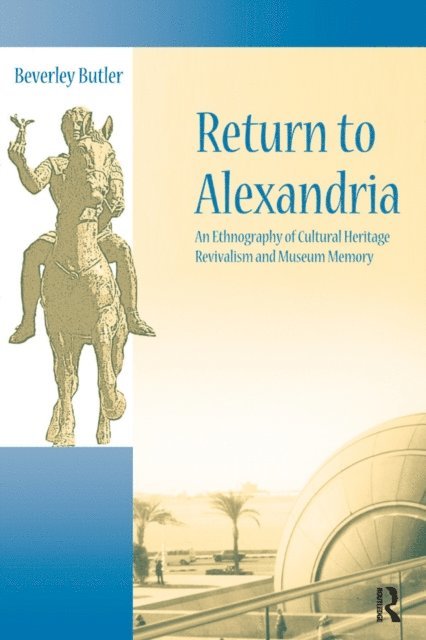
The Bibliotheca Alexandrina was launched with great fanfare in the 1990s, a project of UNESCO and the Egyptian government to recreate the glory of the Alexandria Library and Museion of the ancient world. The project and its timing were curious—it coincided with scholarship moving away from the dominance of the western tradition; it privileged Alexandria’s Greek heritage over 1500 years of Islamic scholarship; and it established an island for the cultural elite in an urban slum. Beverley Butler’s ethnography of the project explores these contradictions, and the challenges faced by Egyptian and international scholars in overcoming them. Her critique of the underlying foundational concepts and values behind the Library is of equal importance, a nuanced postcolonial examination of memory, cultural revival, and homecoming. In this, she draws upon a wide array of thinkers: Freud, Derrida, Said, and Bernal, among others. Butler’s book will be of great value to museologists, historians, archaeologists, cultural scholars, and heritage professionals.
Narrating Heritage critically examines the links among heritage, rights and social justice. This book brings important original ethnographic research and unique case studies together in a coherent and cohesive way to examine patterns and differences of approaches to heritage. It exposes discourses of the uses and abuses of heritage, and provides narratives of persistence, demonstrating the importance of heritage in securing human rights and social justice. Drawing on over ten years of research and ethnographic fieldwork based on six complex case studies from Turkey and comparing them with case studies from across the world, the book explores a variety of social, political, cultural and economic heritage discourses, making explicit the relationship between cultural and natural heritage. This book expands on these discourses by examining the role of violence in heritage, expanding on the concepts of both direct and slow violence. It situates heritage discourse within the sphere of human rights and lays out redistribution, recognition and representation as dimensions of social justice in a heritage context. The case studies in this volume explore multiple themes, from the links between cultural performance and the construction of collective identity and sense of belonging, to the roles of education, learning about other cultures and nationalist use of education. They also discuss the relationship between construction of heritage, space, and access and exclusion, as well as the impact of authoritarianism and heavy neoliberal policies on heritage making.
The Bibliotheca Alexandrina was launched with great fanfare in the 1990s, a project of UNESCO and the Egyptian government to recreate the glory of the Alexandria Library and Museion of the ancient world. The project and its timing were curious—it coincided with scholarship moving away from the dominance of the western tradition; it privileged Alexandria’s Greek heritage over 1500 years of Islamic scholarship; and it established an island for the cultural elite in an urban slum. Beverley Butler’s ethnography of the project explores these contradictions, and the challenges faced by Egyptian and international scholars in overcoming them. Her critique of the underlying foundational concepts and values behind the Library is of equal importance, a nuanced postcolonial examination of memory, cultural revival, and homecoming. In this, she draws upon a wide array of thinkers: Freud, Derrida, Said, and Bernal, among others. Butler’s book will be of great value to museologists, historians, archaeologists, cultural scholars, and heritage professionals.