Birgitta P. Hallager - Böcker
Visar alla böcker från författaren Birgitta P. Hallager. Handla med fri frakt och snabb leverans.
2 produkter
2 produkter
1 004 kr
Skickas inom 5-8 vardagar
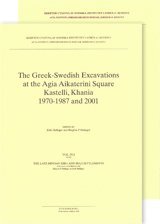
This volume is the fourth in a series of seven presenting the results of the Greek-Swedish Excavations during the years 1970-1987 and 2001 in the Agia Aikaterini Square, Kastelli Khania. The excavations which are situated close to the harbour of the modern town of Khania, western Crete were under the direction of Dr Yannis Tzedakis and Professor Carl-Gustaf Styrenius. During the years of excavation the LM IIIA:2 and LM IIIB:1 period was always considered a unit, called "Level 4". The following detailed studies of stratigraphy, pottery and architecture, however, made it clear that the two chronological phases at the GSE also represented two different stratigraphic units. All excavated units within the LM IIIB:1 and LM IIIA:2 settlements are dealt with in some detail, according to their stratigraphic positions, after which follows the analyses of the architecture, the pottery and the different kinds of small finds. The volume ends with an appendix on statistics. The analyses show that in the LM IIIA:2 and especially the LM IIIB:1 period Khania was an important commercial centre in the Aegean with lively contacts all over the island and to the surrounding Aegean and wider Mediterranean world. This is partly shown by the distribution of the pottery from the Kydonian Workshop, and the production and distribution of transport stirrup jars several of which were inscribed with Linear B. The importance of the settlement as an administrative centre in the Aegean is clearly demonstrated by the finds of Linear B tablets.
469 kr
Skickas inom 5-8 vardagar
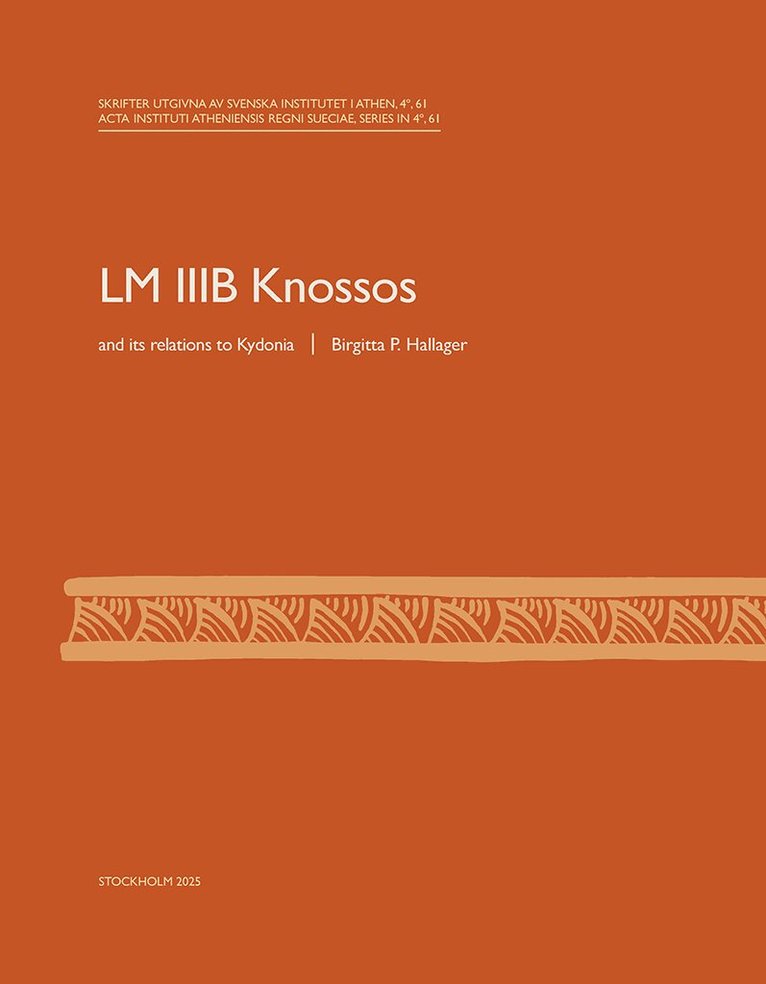
The date of the destruction of the palace at Knossos on Crete has been one of the key problems of Aegean prehistory since the palace was excavated at the beginning of the 20th century. The excavator Arthur Evans argued for an LM II date as he presumed that the inscribed tablets found in the palace destruction layers must have been written by the people who had produced the large and richly adorned Palace Style jars which he dated to the LM II period. After his death Evans’ date has been questioned, keenly debated and finally lowered to early LM IIIA:2. Nobody, however, has studied the amount and distribution of the latest pottery of LM IIIB date found in the palace, its connection to the inscribed tablets and its presence in the surrounding houses, town and cemeteries. The LM IIIB pottery in Knossos is here scrutinized through the Day and Note Books of the excavation, the original excavation reports in the Annual of the British School at Athens and the published sherds and complete vases. Finally the close connections between the two largest LM IIIB towns, Knossos and Kydonia—currently the only ones in Crete with Linear B tablets—are highlighted. Contents Preface, pp. 7–8. The Knossian controversy, pp. 9–10. Introduction, pp. 11–13. The LM IIIB evidence from the palace, pp. 15–71. The LM IIIB pottery from the palace, pp. 73–91. The LM IIIB evidence from the houses surrounding the palace, pp. 93–126. The LM IIIB evidence from the tombs, pp. 127–157. The Knossos–Kydonia relations, pp. 159–168. Conclusions, pp. 169–173. References, pp. 175–184.