B.K Shivamoggi - Böcker
Visar alla böcker från författaren B.K Shivamoggi. Handla med fri frakt och snabb leverans.
4 produkter
4 produkter
1 059 kr
Skickas inom 10-15 vardagar
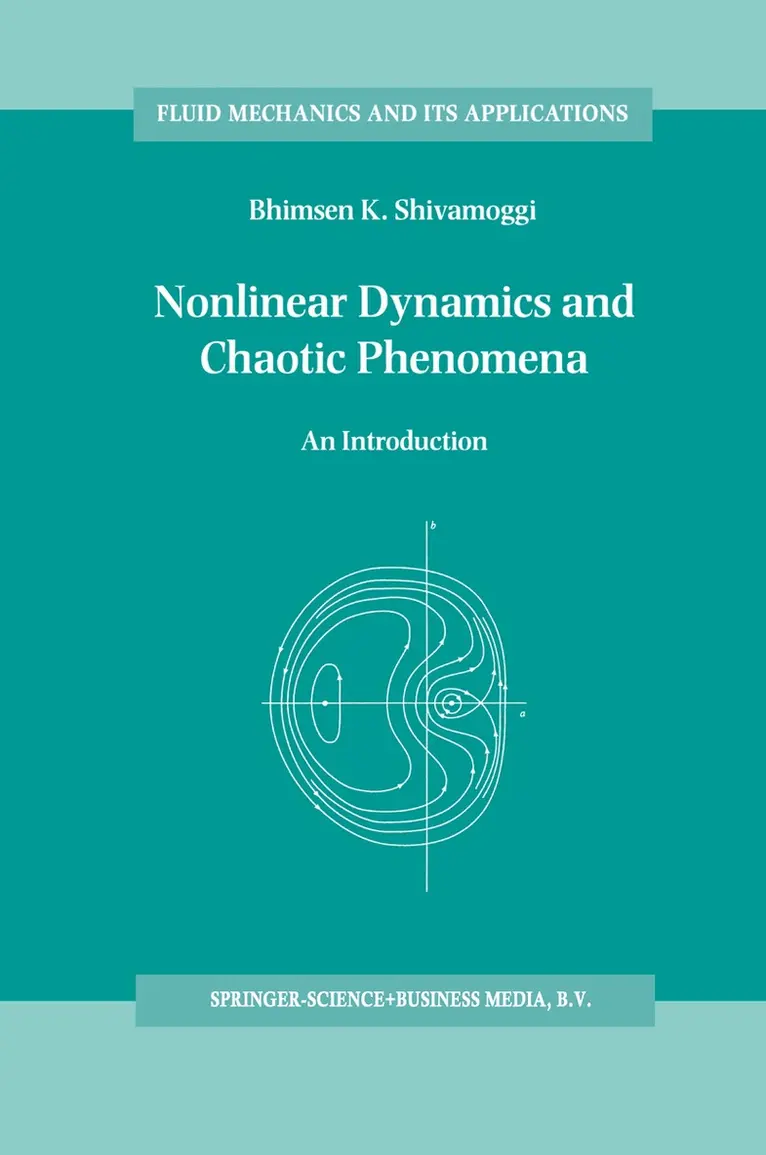
This book was developed from the author's lecture notes for an interdisciplinary graduate-level course on nonlinear dynamics. He describes the basic concepts, language and results of nonlinear dynamical systems. In order to allow for an interdisciplinary readership, an informal style has been adopted and the mathematical formalism kept to a minimum. The book starts with a discussion of nonlinear differential equations, bifurcation theory and Hamiltonian dynamics. It then embarks on a systematic discussion of the traditional topics of modern nonlinear dynamics - integrable systems, Poincare maps, chaos, fractals and strange attractors. Baker's transformation, the logistic map and the Lorenz system are discussed in detail. Finally, there are systematic discussions of the application of fractals to turbulence in fluids, and the Painleve property of nonlinear differential equations. Exercises are given at the end of each chapter. This book is accessible to first-year graduate students in applied mathematics, physics and engineering, and should be useful to any theoretically-inclined researcher in physical sciences and engineering.Among the features of this book are: a strong middle ground between elementary undergraduate texts on the one hand, and advanced level monographs on the other; the presentation of some original developments; a thorough discussion of the application of fractals to turbulence in fluids.
1 059 kr
Skickas inom 10-15 vardagar
A variety of nonlinear effects occur in a plasma. First, there are the wave steepening effects which can occur in any fluid in which the propagation speed depends upon the wave-amplitude. In a dispersive medium this can lead to classes of nonlinear waves which may have stationary solutions like solitons and shocks. Because the plasma also acts like an inherently nonlinear dielectric resonant interactions among waves lead to exchange of energy among them. Further, an electromagnetic wave interacting with a plasma may parametrically excite other waves in the plasma. A large-amplitude Langmuir wave undergoes a modulational instability which arises through local depressions in plasma density and the corresponding increases in the energy density of the wave electric field. Whereas a field collapse occurs in two and three dimensions, in a one-dimensional case, spatially localized stationary field structures called Langmuir solitons can result. Many other plasma waves like upper-hybrid waves, lower-hybrid waves etc. can also undergo a modulational instability and produce localized field structures. A new type of nonlinear effect comes into play when an electromagnetic wave propagating through a plasma is strong enough to drive the electrons to relativistic speeds. This leads to a propagation of an electromagnetic wave in a normally overdense plasma, and the coupling of the electromagnetic wave to a Langmuir wave in the plasma. The relativistic mass variation of the electrons moving in an intense electromagnetic wave can also lead to a modulational instability of the latter.
1 059 kr
Skickas inom 10-15 vardagar
This book has grown out of the author's lecture notes for an interdisciplinary graduate-level course on nonlinear dynamics. The author describes in a clear and coherent way the basic concepts, language and results of nonlinear dynamical systems. In order to allow for an interdisciplinary readership, an informal style has been adopted and the mathematical formalism kept to a minimum. The book starts with a discussion of nonlinear differential equations, bifurcation theory and Hamiltonian dynamics. It then embarks on a systematic discussion of the traditional topics of modern nonlinear dynamics - integrable systems, Poincare maps, chaos, fractals and strange attractors. Baker's transformation, the logistic map and the Lorenz system are discussed in detail. Finally, there are systematic discussions of the application of fractals to turbulence in fluids, and the Painleve property of nonlinear differential equations. Exercises are given at the end of each chapter. This book is accessible to first-year graduate students in applied mathematics, physics and engineering, and is useful to any theoretically inclined researcher in physical sciences and engineering.Among the unique features of this book are: a strong middle ground between elementary undergraduate texts on the one hand, and advanced level monographs on the other the presentation of some original developments a thorough discussion of the application of fractals to turbulence in fluids. GBP/LISTGBP
1 059 kr
Skickas inom 10-15 vardagar
A variety of nonlinear effects occur in a plasma. First, there are the wave steepening effects which can occur in any fluid in which the propagation speed depends upon the wave-amplitude. In a dispersive medium this can lead to classes of nonlinear waves which may have stationary solutions like solitons and shocks. Because the plasma also acts like an inherently nonlinear dielectric resonant interactions among waves lead to exchange of energy among them. Further, an electromagnetic wave interacting with a plasma may parametrically excite other waves in the plasma. A large-amplitude Langmuir wave undergoes a modulational instability which arises through local depressions in plasma density and the corresponding increases in the energy density of the wave electric field. Whereas a field collapse occurs in two and three dimensions, in a one-dimensional case, spatially localized stationary field structures called Langmuir solitons can result. Many other plasma waves like upper-hybrid waves, lower-hybrid waves etc. can also undergo a modulational instability and produce localized field structures. A new type of nonlinear effect comes into play when an electromagnetic wave propagating through a plasma is strong enough to drive the electrons to relativistic speeds. This leads to a propagation of an electromagnetic wave in a normally overdense plasma, and the coupling of the electromagnetic wave to a Langmuir wave in the plasma. The relativistic mass variation of the electrons moving in an intense electromagnetic wave can also lead to a modulational instability of the latter.