Børge Bakken - Böcker
Visar alla böcker från författaren Børge Bakken. Handla med fri frakt och snabb leverans.
6 produkter
6 produkter
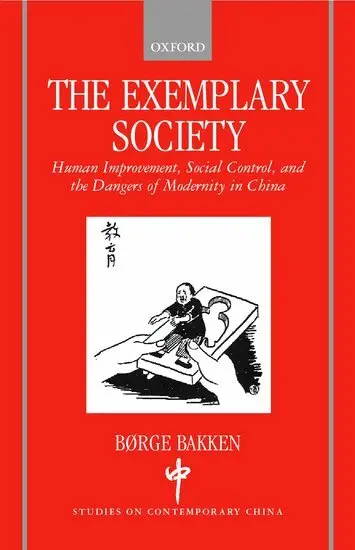
The Exemplary Society
Human Improvement, Social Control, and the Dangers of Modernity in China
Inbunden, Engelska, 2000
4 153 kr
Skickas inom 5-8 vardagar
In modern China, technocratic utopias go side by side with moral panics. The modernization process is seen as creating the `disorders' of criminality, sex, and modern youth culture. The official answer to disorder is an exemplary societyan educative and disciplinary society where `human quality' and model behaviour is advocated. Modern Chinese society, however, resists being reduced to the exemplary discipline of its social engineers, and strategies of `lying' and resisting control are routine. This pathbreaking study analyses traditional and modern Chinese beliefs about and reactions to education, discipline, human improvement, and social control. Although these reactions to modernity have a Chinese colouring, they are not exclusive to the Chinese culture. By describing the terra incognita of China, The Exemplary Society also describes something about ourselves.
1 770 kr
Skickas inom 5-8 vardagar
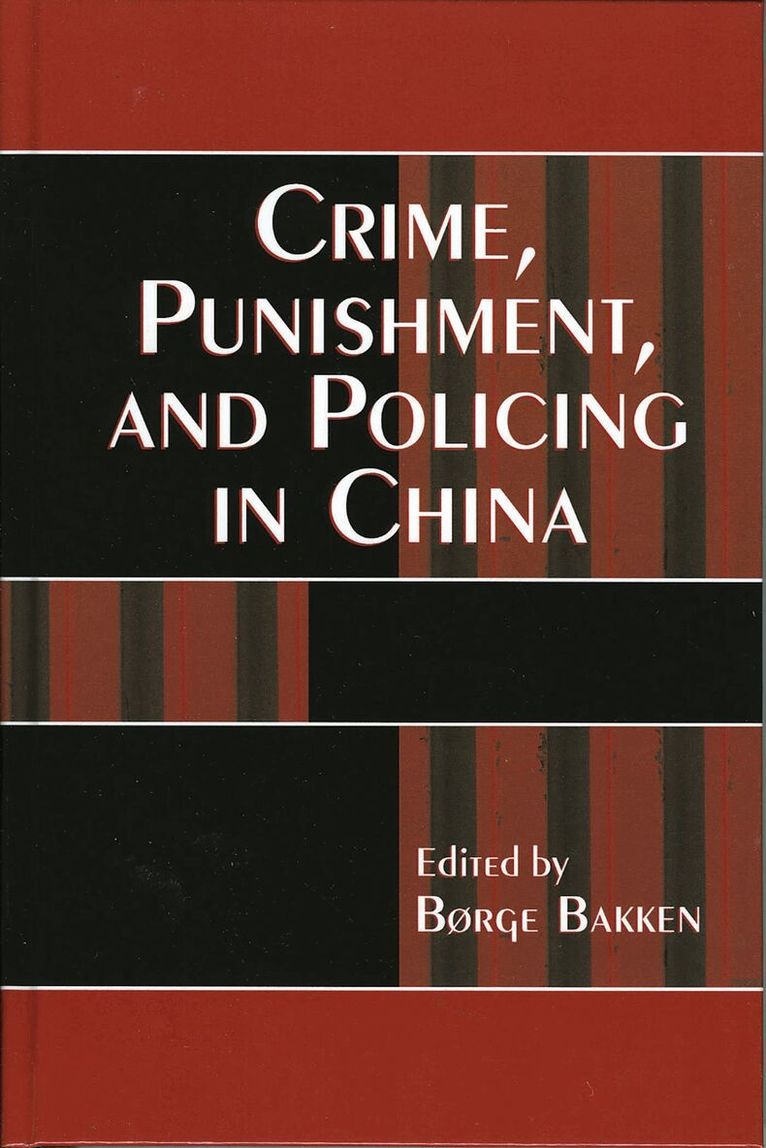
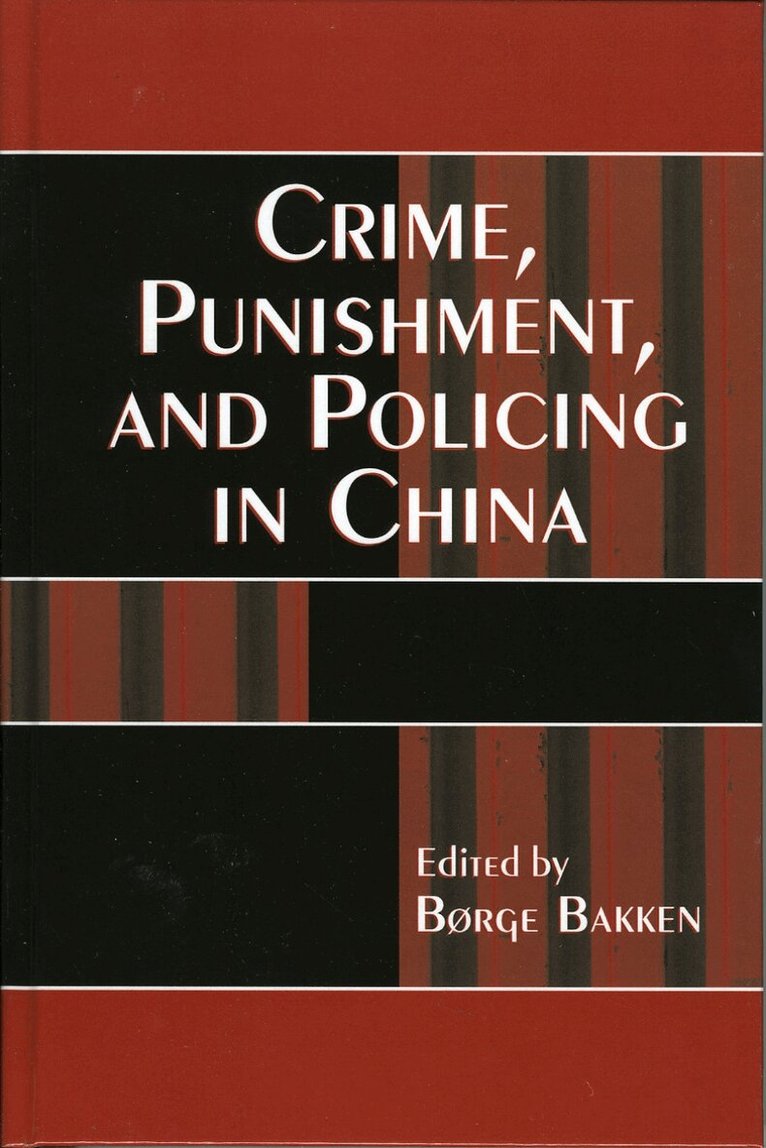
Crime long has been a silent partner in China's march to modernization, leading the regime to make law and order as central a priority as economic growth and the promise of prosperity. This groundbreaking study offers the first comprehensive and up-to-date analysis of Chinese crime, policing, and punishment. A multidisciplinary group of leading scholars draw on a rich body of empirical data and rare archival research to illuminate seldom-explored theoretical dimensions of legal ideology and reform as well as the linkages between crime and control to broader themes of law, modernization, and development. The authors balance comparative perspectives with an understanding of China's unique historical and cultural experience. This context is critical, the authors argue, as crime and control are at the root of modernity and how it is defined. In many ways the PRC is reliving the experiences of other industrializing countries, yet at the same time the practices of China's police and prison system also are painted with thick layers of historical memory. Order has become increasingly important in legitimizing the Chinese regime, but its practices and ideas of policing are often missing from our picture of Chinese social and political development. This important book's discussion of the paradoxes of policing and the problems of order bridges that gap and demystifies developments in China. All those interested in modern and contemporary Chinese politics, law, and society, as well as in comparative criminology and law, will find this work an invaluable resource.Contributions by: Børge Bakken, Frank Dikötter, Michael Dutton, James D. Seymour, Murray Scot Tanner, and Xu Zhangrun.
813 kr
Skickas inom 5-8 vardagar
Crime long has been a silent partner in China's march to modernization, leading the regime to make law and order as central a priority as economic growth and the promise of prosperity. This groundbreaking study offers the first comprehensive and up-to-date analysis of Chinese crime, policing, and punishment. A multidisciplinary group of leading scholars draw on a rich body of empirical data and rare archival research to illuminate seldom-explored theoretical dimensions of legal ideology and reform as well as the linkages between crime and control to broader themes of law, modernization, and development. The authors balance comparative perspectives with an understanding of China's unique historical and cultural experience. This context is critical, the authors argue, as crime and control are at the root of modernity and how it is defined. In many ways the PRC is reliving the experiences of other industrializing countries, yet at the same time the practices of China's police and prison system also are painted with thick layers of historical memory. Order has become increasingly important in legitimizing the Chinese regime, but its practices and ideas of policing are often missing from our picture of Chinese social and political development. This important book's discussion of the paradoxes of policing and the problems of order bridges that gap and demystifies developments in China. All those interested in modern and contemporary Chinese politics, law, and society, as well as in comparative criminology and law, will find this work an invaluable resource.Contributions by: Børge Bakken, Frank Dikötter, Michael Dutton, James D. Seymour, Murray Scot Tanner, and Xu Zhangrun.
633 kr
Skickas inom 7-10 vardagar
China is a transitional society with one of the highest inequality rates in the world. Criminologists would typify this as a highly toxic combination, creating very high levels of crime. Yet China reports extremely low crime rates. How might this be?With this book, Børge Bakken shows that the reality in China does not match the rosy picture of low crime and rule-by-law that the authorities present to the world. Looking beyond the statistics, Bakken discovers that violent crime is a particularly ‘sensitive issue’, deliberately censored by party propaganda and by an unaccountable police force that can ‘vanish’ any type of crime to a degree that makes a ‘crime rate’ a mere formality. As Bakken reveals, official Chinese crime statistics cannot be used to make assumptions about China's crime profile. Even the assumption that crime represents the problem and control its solution is not valid, Bakken argues. Because when control becomes part of the problem, the false assumption of a ‘harmonious society’ evaporates, rendering ‘harmony’ a myth and violence the traumatic reality.This meticulous investigation of crime and justice in China is crucial reading for those interested in the Chinese regime and China's state control, as well as criminologists and sociologists of crime.
223 kr
Skickas inom 7-10 vardagar
China is a transitional society with one of the highest inequality rates in the world. Criminologists would typify this as a highly toxic combination, creating very high levels of crime. Yet China reports extremely low crime rates. How might this be?With this book, Børge Bakken shows that the reality in China does not match the rosy picture of low crime and rule-by-law that the authorities present to the world. Looking beyond the statistics, Bakken discovers that violent crime is a particularly ‘sensitive issue’, deliberately censored by party propaganda and by an unaccountable police force that can ‘vanish’ any type of crime to a degree that makes a ‘crime rate’ a mere formality. As Bakken reveals, official Chinese crime statistics cannot be used to make assumptions about China's crime profile. Even the assumption that crime represents the problem and control its solution is not valid, Bakken argues. Because when control becomes part of the problem, the false assumption of a ‘harmonious society’ evaporates, rendering ‘harmony’ a myth and violence the traumatic reality.This meticulous investigation of crime and justice in China is crucial reading for those interested in the Chinese regime and China's state control, as well as criminologists and sociologists of crime.
456 kr
Tillfälligt slut
Although official propaganda emphasizes the Chinese Dream as the dream of all Chinese, the opportunities of achieving prosperity by legal means are distributed unequally. Crime and the Chinese Dream reveals how people on the margins of Chinese society find their way to the Chinese Dream through illegal or deviant behaviors. The case studies in this book include corrupt doctors in public hospitals in Beijing, fraudsters in a village called "cake uncles," illegal motorcycle taxi drivers in Guangzhou, drug users being "reeducated" in detention centers, and internet addicts who are treated as criminals by the system. Despite the patriotic and collectivistic tint of the official dream metaphor, the contributors to this volume show that the Chinese Dream is essentially a state capitalist dream, which is embedded within the problems and opportunities of capitalism, as well as a dream of control.