Boris Tsygan – författare
Visar alla böcker från författaren Boris Tsygan. Handla med fri frakt och snabb leverans.
6 produkter
6 produkter
Häftad, Engelska, 2026
1 667 kr
Skickas inom 11-20 vardagar
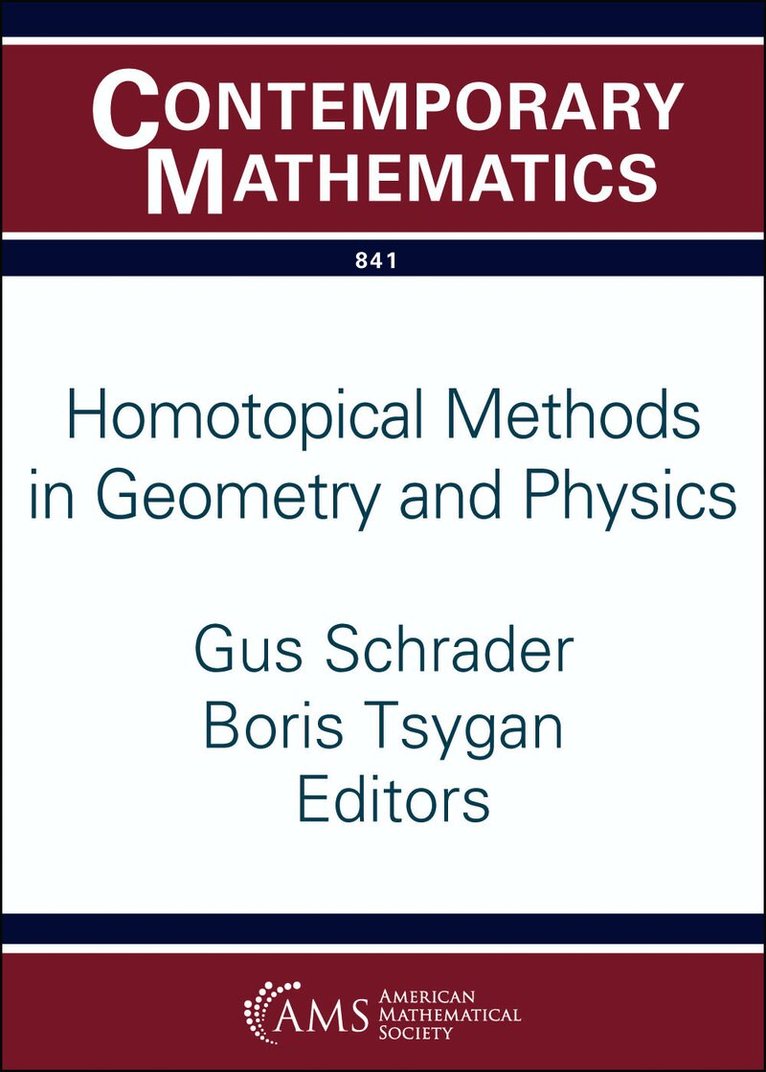
This volume contains the proceedings of the Homotopical Methods in Geometry and Physics Conference in honor of the 60th birthday of Ezra Getzler held at Northwestern University in Evanston, Illinois, on March 21-25, 2022. It includes papers on geometry and topology of moduli spaces and configuration spaces, on theory of operads, and on noncommutative geometry, as well as on various connections between these topics and on their role in mathematical physics. These topics have been extensively studied during the last forty years. One prominent feature of the subject is that various invariants of spaces, noncommutative algebras, etc. carry classical algebraic structures but only up to homotopy. Operations that are part of these structures form topological spaces (from polyhedra to configuration or moduli spaces) whose homotopy theory is of central importance. The same spaces can be viewed as configuration spaces in mathematical physics.
Del 269 - Springer Proceedings in Mathematics & Statistics
Algebraic and Analytic Microlocal Analysis
AAMA, Evanston, Illinois, USA, 2012 and 2013
Inbunden, Engelska, 2018
2 500 kr
Skickas inom 10-15 vardagar
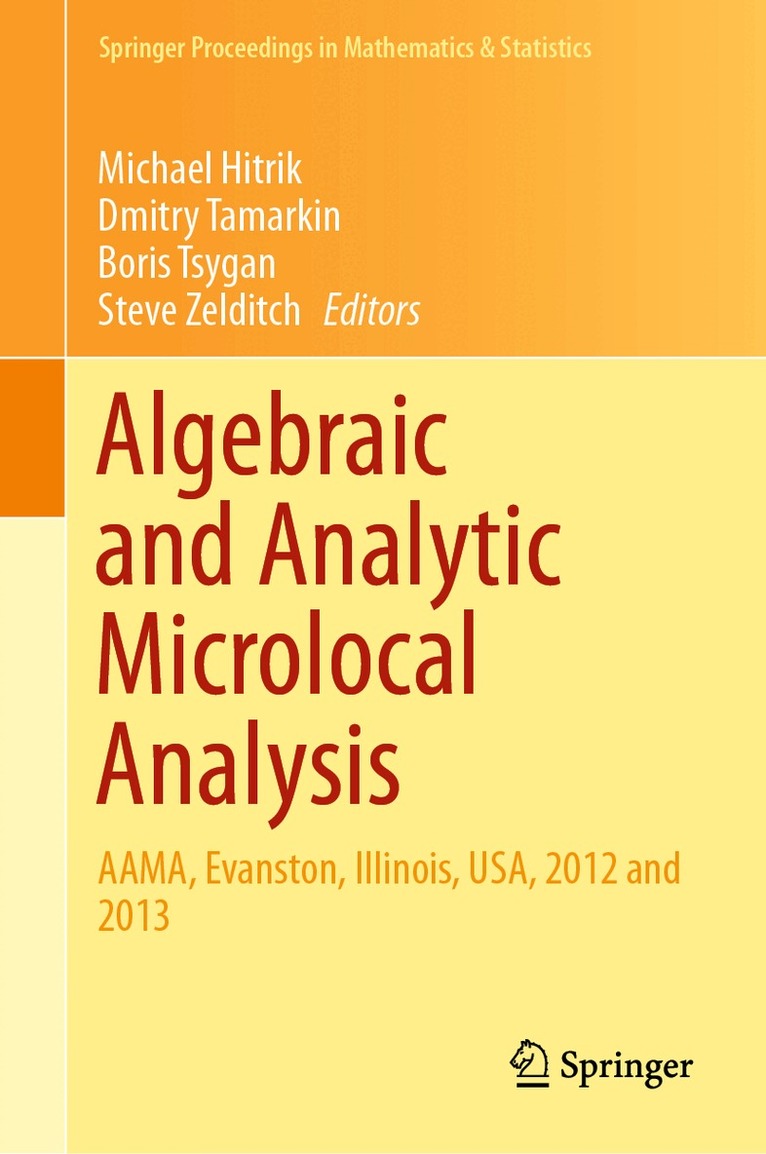
This book presents contributions from two workshops in algebraic and analytic microlocal analysis that took place in 2012 and 2013 at Northwestern University. Featured papers expand on mini-courses and talks ranging from foundational material to advanced research-level papers, and new applications in symplectic geometry, mathematical physics, partial differential equations, and complex analysis are discussed in detail. Topics include Procesi bundles and symplectic reflection algebras, microlocal condition for non-displaceability, polarized complex manifolds, nodal sets of Laplace eigenfunctions, geodesics in the space of Kӓhler metrics, and partial Bergman kernels. This volume is a valuable resource for graduate students and researchers in mathematics interested in understanding microlocal analysis and learning about recent research in the area.
E-bok
Engelska, 20183 046 kr
Läs direkt efter köp
This book presents contributions from two workshops in algebraic and analytic microlocal analysis that took place in 2012 and 2013 at Northwestern University. Featured papers expand on mini-courses and talks ranging from foundational material to advanced research-level papers, and new applications in symplectic geometry, mathematical physics, partial differential equations, and complex analysis are discussed in detail. Topics include Procesi bundles and symplectic reflection algebras, microlocal condition for non-displaceability, polarized complex manifolds, nodal sets of Laplace eigenfunctions, geodesics in the space of Kӓhler metrics, and partial Bergman kernels. This volume is a valuable resource for graduate students and researchers in mathematics interested in understanding microlocal analysis and learning about recent research in the area.
Del 121 - Encyclopaedia of Mathematical Sciences
Cyclic Homology in Non-Commutative Geometry
Inbunden, Engelska, 2003
1 091 kr
Skickas inom 10-15 vardagar
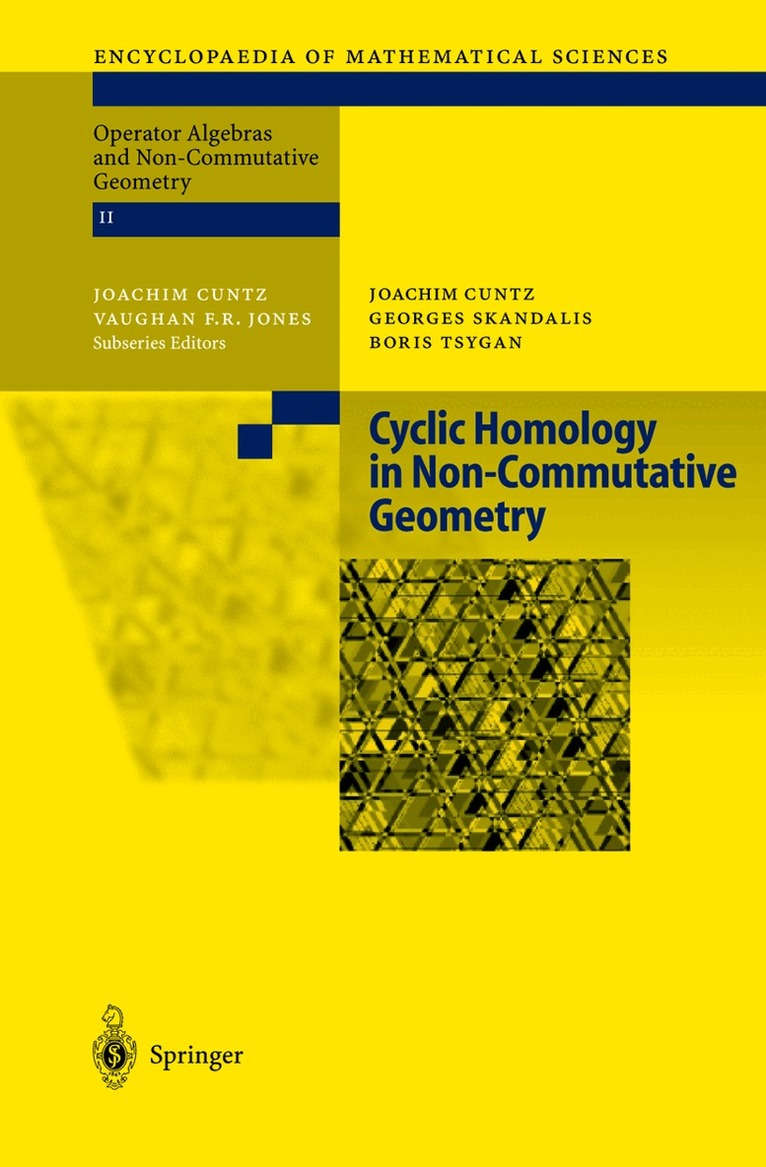
Cyclic homology was introduced in the early eighties independently by Connes and Tsygan. They came from different directions. Connes wanted to associate homological invariants to K-homology classes and to describe the index pair ing with K-theory in that way, while Tsygan was motivated by algebraic K-theory and Lie algebra cohomology. At the same time Karoubi had done work on characteristic classes that led him to study related structures, without however arriving at cyclic homology properly speaking. Many of the principal properties of cyclic homology were already developed in the fundamental article of Connes and in the long paper by Feigin-Tsygan. In the sequel, cyclic homology was recognized quickly by many specialists as a new intriguing structure in homological algebra, with unusual features. In a first phase it was tried to treat this structure as well as possible within the traditional framework of homological algebra. The cyclic homology groups were computed in many examples and new important properties such as prod uct structures, excision for H-unital ideals, or connections with cyclic objects and simplicial topology, were established. An excellent account of the state of the theory after that phase is given in the book of Loday.
Del 121 - Encyclopaedia of Mathematical Sciences
Cyclic Homology in Non-Commutative Geometry
Häftad, Engelska, 2011
1 091 kr
Skickas inom 10-15 vardagar
Cyclic homology was introduced in the early eighties independently by Connes and Tsygan. They came from different directions. Connes wanted to associate homological invariants to K-homology classes and to describe the index pair ing with K-theory in that way, while Tsygan was motivated by algebraic K-theory and Lie algebra cohomology. At the same time Karoubi had done work on characteristic classes that led him to study related structures, without however arriving at cyclic homology properly speaking. Many of the principal properties of cyclic homology were already developed in the fundamental article of Connes and in the long paper by Feigin-Tsygan. In the sequel, cyclic homology was recognized quickly by many specialists as a new intriguing structure in homological algebra, with unusual features. In a first phase it was tried to treat this structure as well as possible within the traditional framework of homological algebra. The cyclic homology groups were computed in many examples and new important properties such as prod uct structures, excision for H-unital ideals, or connections with cyclic objects and simplicial topology, were established. An excellent account of the state of the theory after that phase is given in the book of Loday.
E-bok
PDF, Engelska, 20131 367 kr
Läs direkt efter köp
Cyclic homology was introduced in the early eighties independently by Connes and Tsygan. They came from different directions. Connes wanted to associate homological invariants to K-homology classes and to describe the index pair ing with K-theory in that way, while Tsygan was motivated by algebraic K-theory and Lie algebra cohomology. At the same time Karoubi had done work on characteristic classes that led him to study related structures, without however arriving at cyclic homology properly speaking. Many of the principal properties of cyclic homology were already developed in the fundamental article of Connes and in the long paper by Feigin-Tsygan. In the sequel, cyclic homology was recognized quickly by many specialists as a new intriguing structure in homological algebra, with unusual features. In a first phase it was tried to treat this structure as well as possible within the traditional framework of homological algebra. The cyclic homology groups were computed in many examples and new important properties such as prod uct structures, excision for H-unital ideals, or connections with cyclic objects and simplicial topology, were established. An excellent account of the state of the theory after that phase is given in the book of Loday.