Brad R. Roth - Böcker
Visar alla böcker från författaren Brad R. Roth. Handla med fri frakt och snabb leverans.
6 produkter
6 produkter
1 823 kr
Skickas inom 7-10 vardagar
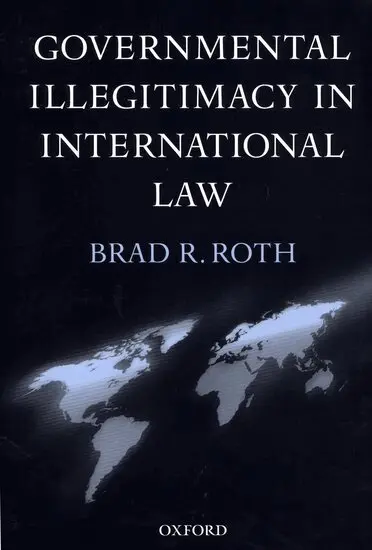
When is a de facto authority not entitled to be considered a `government' for the purposes of International Law? International reaction to the 1991-4 Haitian crisis is only the most prominent in a series of events that suggest a norm of governmental illegitimacy is emerging to challenge more traditional notions of state sovereignty. This challenge has dramatic implications for two fundamental legal strictures: that against the use or threat of force against a state's political independence, and that against interference in matters `essentially' within a state's domestic jurisdiction. Yet although human rights advocates have begun to speak of state sovereignty as an `anachronism', with some expansively proclaiming the emergence of an international `right to democratic governance,' international law literature lacks systematic treatment of governmental illegitimacy. This work seeks to specify the international law of collective non-recognition of governments, so as to enable legal evaluation of cases in which competing factions assert governmental authority. It subjects the recognition controversies of the United Nations era to a systematic examination, informed by theoretical and comparative perspectives on governmental legitimacy. The inquiry establishes that the category of `illegitimate government' now occupies a place in international law, with significant consequences for the legality of intervention in certain instances. The principle of popular sovereignty, hitherto vague and ambiguous, has acquired sufficient determinacy to serve, in some circumstances, as a basis for denial of legal recognition to putative governments. This development does not imply, however, the emergence in international law of a meaningful norm of `democratic governance,' nor would such a norm serve the purposes of the scheme of sovereign equality of states embodied in the United Nations Charter.
1 702 kr
Skickas inom 7-10 vardagar
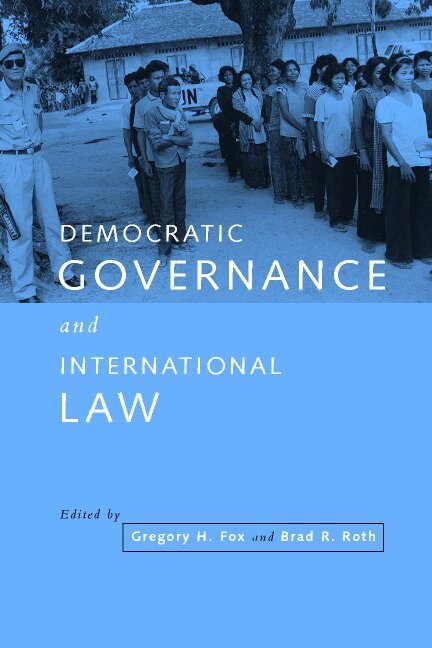
Prior to the end of the Cold War, the word 'democracy' was rarely used by international lawyers. Few international organisations supported democratic governance, and the criteria for recognition of governments took little account of whether regimes enjoyed a popular mandate. But the events of 1989-1991 profoundly shook old assumptions. Democratic Governance and International Law attempts to assess international law's new-found interest in fostering transitions to democracy. Is an entitlement to democratic government now emerging in international law? If so, what are its normative foundations? How have global and regional organisations encouraged transitions to democracy, and are their efforts consistent with their constitutional frameworks? How should international law react to elections in which profoundly anti-democratic parties win the vote? In this volume, leading legal scholars grapple with these and other questions to assess the future of international law on this most domestic of questions.
600 kr
Skickas inom 7-10 vardagar
Prior to the end of the Cold War, the word 'democracy' was rarely used by international lawyers. Few international organisations supported democratic governance, and the criteria for recognition of governments took little account of whether regimes enjoyed a popular mandate. But the events of 1989-1991 profoundly shook old assumptions. Democratic Governance and International Law attempts to assess international law's new-found interest in fostering transitions to democracy. Is an entitlement to democratic government now emerging in international law? If so, what are its normative foundations? How have global and regional organisations encouraged transitions to democracy, and are their efforts consistent with their constitutional frameworks? How should international law react to elections in which profoundly anti-democratic parties win the vote? In this volume, leading legal scholars grapple with these and other questions to assess the future of international law on this most domestic of questions.
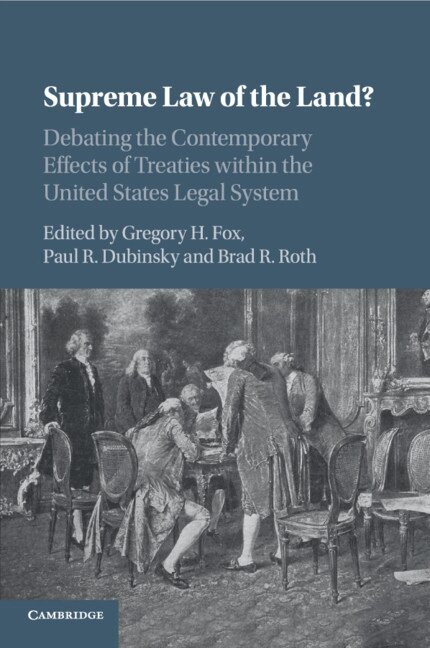
Supreme Law of the Land?
Debating the Contemporary Effects of Treaties within the United States Legal System
Inbunden, Engelska, 2017
808 kr
Skickas
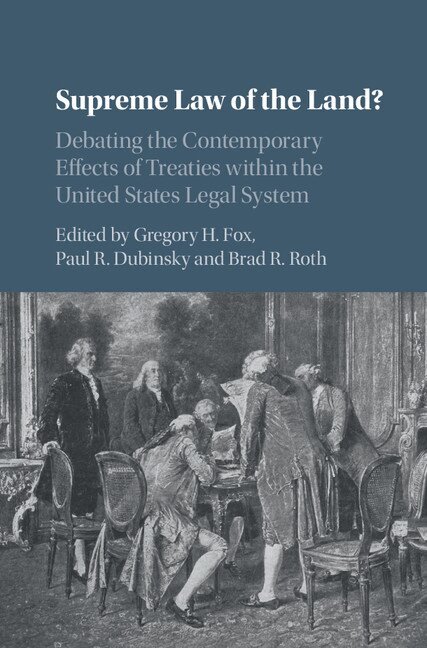
How do treaties function in the American legal system? This book provides a comprehensive analysis of the current status of treaties in American law. Its ten chapters examine major areas of change in treaty law in recent decades, including treaty interpretation, federalism, self-execution, treaty implementing legislation, treaty form, and judicial barriers to treaty enforcement. The book also includes two in-depth case studies: one on the effectiveness of treaties in the regulation of armed conflict and one on the role of a resurgent federalism in complicating US efforts to ratify and implement treaties in private international law. Each chapter asks whether the treaty rules of the 1987 Third Restatement of Foreign Relations Law accurately reflect today's judicial, executive, and legislative practices. This volume is original and provocative, a useful desk companion for judges and practicing lawyers, and an engaging read for the general reader and graduate students.
Supreme Law of the Land?
Debating the Contemporary Effects of Treaties within the United States Legal System
Häftad, Engelska, 2018
540 kr
Skickas inom 7-10 vardagar
How do treaties function in the American legal system? This book provides a comprehensive analysis of the current status of treaties in American law. Its ten chapters examine major areas of change in treaty law in recent decades, including treaty interpretation, federalism, self-execution, treaty implementing legislation, treaty form, and judicial barriers to treaty enforcement. The book also includes two in-depth case studies: one on the effectiveness of treaties in the regulation of armed conflict and one on the role of a resurgent federalism in complicating US efforts to ratify and implement treaties in private international law. Each chapter asks whether the treaty rules of the 1987 Third Restatement of Foreign Relations Law accurately reflect today's judicial, executive, and legislative practices. This volume is original and provocative, a useful desk companion for judges and practicing lawyers, and an engaging read for the general reader and graduate students.
5 810 kr
Skickas inom 7-10 vardagar
At the end of the Cold War, international law scholars engaged in furious debate over whether principles of democratic legitimacy had entered international law. Many argued that a "democratic entitlement" was then emerging. Others were skeptical that international practice in democracy promotion was either consistent or sufficiently widespread and many found the idea of a democratic entitlement dangerous. Those debates, while ongoing, have not been comprehensively revisited in almost twenty years. This research review identifies the leading scholarship of the past two decades on these and other questions. It focuses particular attention on the normative consequences of the recent "democratic recession" in many regions of the world.