Branislav Jaramaz – författare
Visar alla böcker från författaren Branislav Jaramaz. Handla med fri frakt och snabb leverans.
2 produkter
2 produkter
2 799 kr
Skickas inom 7-10 vardagar
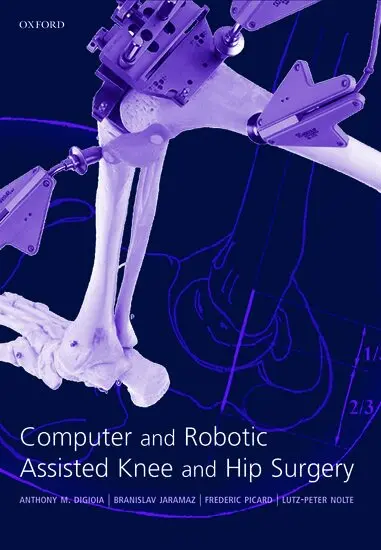
The book presents an overview of available Computer Assisted Orthopaedic Surgery (CAOS) solutions to assist with adult reconstructive hip and knee procedures. The benefits of CAOS in clinical practice include improved planning, increased accuracy, intraoperative information and guidance, and the potential to enable less or minimally invasive surgery without loss of accuracy.The book reflects the current state of the art in computer integrated surgery, with the emphasis on clinically tested systems and procedures. The application of technologies such as surgical navigation and robotic surgery, medical imaging, surgical planning and simulation in total or partial hip and knee reconstruction procedures is presented. The range of currently employed approaches is covered, spanning from active robotics to navigation based medical images - either preoperative or inreoperative, and image-free navigation.The first part of the book offers the clinical rationale for the use of CAOS procedures, and describes the basic technological building blocks of such procedures and systems. The second part of the book describes specific applications in total hip replacement, total and unicompartmental knee replacement, osteotomies around the hip and knee, knee ligament reconstruction and hip and knee trauma. The clinical goal, the technological approach, and the clinical results are outlined for every application.The book is intended for practising orthopaedic surgeons, fellows, residents-in-training and medical students interested in the latest technological developments in computer assisted surgery, as well as for engineers and developers interested in learning more about the interaction of advanced technology with orthopaedic clinical practice.
649 kr
Skickas inom 10-15 vardagar
In previous work [6], we presented a novel information theoretic approach for calculating fMRI activation maps. The information-theoretic approach is - pealing in that it is a principled methodology requiring few assumptions about the structure of the fMRI signal. In that approach, activation was quanti?ed by measuring the mutual information (MI) between the protocol signal and the fMRI time-series at a givenvoxel.This measureis capable of detecting unknown nonlinear and higher-order statistical dependencies. Furthermore, it is relatively straightforward to implement. In practice,activation decisions at eachvoxelareindependent of neighboring voxels. Spurious responses are then removed by ad hoc techniques (e.g. morp- logicaloperators).Inthispaper,wedescribeanautomaticmaximumaposteriori (MAP) detection method where the well-known Ising model is used as a spatial prior.The Isingspatialpriordoes not assumethat the time-seriesofneighboring voxelsareindependentofeachother.Furthermore,removalofspuriousresponses is an implicit component of the detection formulation. In order to formulate the calculation of the activation map using this technique we ?rst demonstrate that the information-theoretic approach has a natural interpretation in the hypo- esis testing framework and that, speci?cally, our estimate of MI approximates the log-likelihood ratio of that hypothesis test. Consequently, the MAP det- tion problem using the Ising model can be formulated and solved exactly in polynomial time using the Ford and Fulkerson method [4]. We compare the results of our approach with and without spatial priors to an approachbased on the general linear model (GLM) popularized by Fristonet al [3]. We present results from three fMRI data sets. The data sets test motor, auditory, and visual cortex activation, respectively.