Branko Milanovic - Böcker
Visar alla böcker från författaren Branko Milanovic. Handla med fri frakt och snabb leverans.
17 produkter
17 produkter
258 kr
Skickas
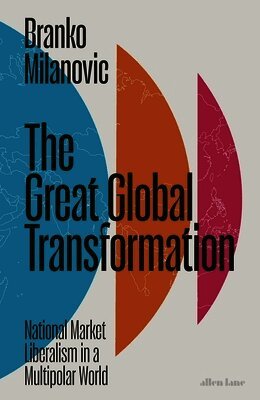
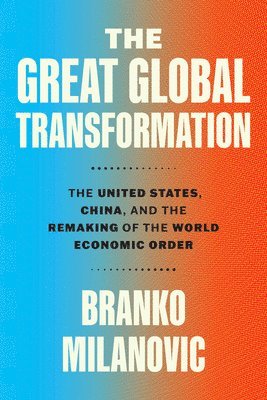
A Financial Times Book of the Year'Milanovic combines his deep knowledge of political economy and philosophy and his mastery of statistics to explain the rise of Asia and the corresponding decline of the West' James K. GalbraithA leading economist economist guides us through the ruins of the current world order: where do we go next?Global neoliberalism is on its last legs, while a new international economic order is taking hold. Trade blocs, tariff wars, economic sanctions, and national champions are in; nationalism, anti-immigration movements and the far-right are on the rise. Liberalism is being rejected by the civic realm, as the status quo of the past fifty years crumbles. What remains in its wake?Drawing on original research, leading economist Branko Milanovic reveals the seismic shifts that are shaping our world. He details the facts: how the rising economic power of Asia is creating a new global ‘middle class’ in the greatest reshuffle of incomes since the Industrial Revolution. He explores our fears: why are we becoming increasingly unhappy, when the world is becoming richer and more equal? And he shows us the fight ahead: as plutocracy returns, global war threatens, and a new system silently shapes our nations, driving malcontent to breaking point. In The Great Global Transformation, Milanovic provides an invaluable guide to the new 21st century.'A must read for anyone concerned about the future of the world order' Gordon Brown'Everyone who wants to understand these titanic changes must read this book' Martin Jacques
299 kr
Skickas
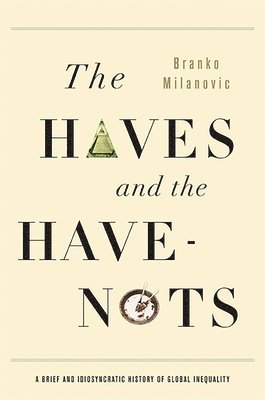
Who is the richest person in the world, ever? Does where you were born affect how much money you'll earn over a lifetime? How would we know? Why- beyond the idle curiosity- do these questions even matter? In The Haves and the Have-Nots , Branko Milanovic, one of the world's leading experts on wealth, poverty, and the gap that separates them, explains these and other mysteries of how wealth is unevenly spread throughout our world, now and through time. Milanovic uses history, literature and stories straight out of today's newspapers, to discuss one of the major divisions in our social lives: between the haves and the have-nots. He reveals just how rich Elizabeth Bennet's suitor Mr. Darcy really was how much Anna Karenina gained by falling in love how wealthy ancient Romans compare to today's super-rich where in Kenyan income distribution was Obama's grandfather how we should think about Marxism in a modern world and how location where one is born determines his wealth. He goes beyond mere entertainment to explain why inequality matters, how it damages our economics prospects, and how it can threaten the foundations of the social order that we take for granted. Bold, engaging, and illuminating, The Haves and the Have-Nots teaches us not only how to think about inequality, but why we should.
175 kr
Skickas inom 7-10 vardagar
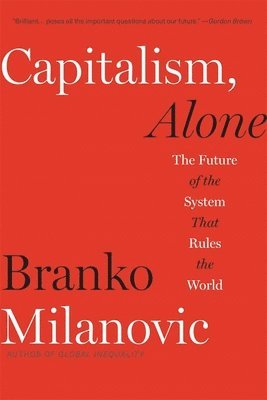
An Economist Book of the YearA Financial Times Book of the YearA Foreign Affairs Best Book of the YearA Prospect Best Book of the YearA ProMarket Book of the YearAn Omidyar Network “8 Storytellers Informing How We’ve been Reimagining Capitalism” Selection“Brilliant…Poses all the important questions about our future.”—Gordon Brown“A scholar of inequality warns that while capitalism may have seen off rival economic systems, the survival of liberal democracies is anything but assured.”—The EconomistWe are all capitalists now. For the first time in human history, the world is dominated by one economic system. At some level capitalism has triumphed because it works: it delivers prosperity and gratifies our desire for autonomy. But this comes at a moral price, pushing us to treat material success as the ultimate goal, and offers no guarantee of stability. While Western liberal capitalism creaks under the strains of inequality and excess, some are flaunting the virtues of political capitalism, exemplified by China, which may be more efficient, but is also vulnerable to corruption and social unrest.One of the outstanding economists of his generation, Branko Milanovic mines the data to tell his ambitious and compelling story. Capitalism gets a lot wrong, he argues, but also much right—and it isn’t going away anytime soon. Our task is to improve it in the hopes that a more equitable capitalism can take hold.“Erudite, illuminating…Engaging to read…As a virtuoso economist, Milanovic is superb when he is compiling and assessing data.”—Robert Kuttner, New York Review of Books“Leaves little doubt that the social contract no longer holds. Whether you live in Beijing or New York, the time for renegotiation is approaching.”—Edward Luce, Financial Times
338 kr
Skickas inom 7-10 vardagar
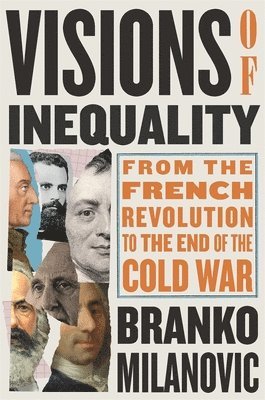
A Financial Times Best Book of the Year.A sweeping and original history of how economists across two centuries have thought about inequality, told through portraits of six key figures.“How do you see income distribution in your time, and how and why do you expect it to change?” That is the question Branko Milanovic imagines posing to six of history's most influential economists: François Quesnay, Adam Smith, David Ricardo, Karl Marx, Vilfredo Pareto, and Simon Kuznets. Probing their works in the context of their lives, he charts the evolution of thinking about inequality, showing just how much views have varied among ages and societies. Indeed, Milanovic argues, we cannot speak of “inequality” as a general concept: any analysis of it is inextricably linked to a particular time and place.Visions of Inequality takes us from Quesnay and the physiocrats, for whom social classes were prescribed by law, through the classic nineteenth-century treatises of Smith, Ricardo, and Marx, who saw class as a purely economic category driven by means of production. It shows how Pareto reconceived class as a matter of elites versus the rest of the population, while Kuznets saw inequality arising from the urban-rural divide. And it explains why inequality studies were eclipsed during the Cold War, before their remarkable resurgence as a central preoccupation in economics today.Meticulously extracting each author’s view of income distribution from their often voluminous writings, Milanovic offers an invaluable genealogy of the discourse surrounding inequality. These intellectual portraits are infused not only with a deep understanding of economic theory but also with psychological nuance, reconstructing each thinker’s outlook given what was knowable to them within their historical contexts and methodologies.
252 kr
Skickas inom 7-10 vardagar
A Financial Times Best Economics Book of the Year“An essential and insightful analysis of the history of economic inequality urgently relevant today…a groundbreaking work, bound to influence the economics profession and our worldview.” —LSE Review of Books“A history of the changing ways economists have broached the subject [of inequality] since the French Revolution…[Milanovic] describes how Western economists were in thrall to an unholy combination of extremely simplistic assumptions and extremely complex mathematical models.” —New York Times“A timely book that brings the weight of the past to bear on one of the most pressing issues of our time…Milanovic is a clear and direct writer, unafraid of making strong judgements and with an idiosyncratic eye for detail. That makes for original, and sometimes amusingly wry, revelations.” —Literary Review“How do you see income distribution in your time, and how and why do you expect it to change?” Branko Milanovic imagines posing this question to six of history’s most influential economists. Probing the works of these key thinkers in the context of their lives, Milanovic charts the evolution of the concept of inequality across the centuries. We cannot speak of inequality in general, he argues: any analysis of it is inextricably linked to a particular time and place.Visions of Inequality takes us from François Quesnay, for whom social classes were prescribed by law, through Adam Smith, David Ricardo, and Karl Marx, who saw class as a purely economic category determined by one’s relation to the means of production. Later, Vilfredo Pareto reconceived class in terms of elites versus the rest, while Simon Kuznets saw inequality arising from the urban-rural divide. Milanovic further explores why inequality receded from scholarship during the Cold War, before gaining renewed attention in economics today.An invaluable intellectual genealogy, Visions of Inequality brings nuanced insight to a hotly contested idea.
300 kr
Tillfälligt slut
191 kr
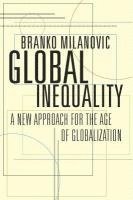
Winner of the Bruno Kreisky Prize, Karl Renner InstitutA Financial Times Best Economics Book of the YearAn Economist Best Book of the YearA Livemint Best Book of the YearOne of the world’s leading economists of inequality, Branko Milanovic presents a bold new account of the dynamics that drive inequality on a global scale. Drawing on vast data sets and cutting-edge research, he explains the benign and malign forces that make inequality rise and fall within and among nations. He also reveals who has been helped the most by globalization, who has been held back, and what policies might tilt the balance toward economic justice.“The data [Milanovic] provides offer a clearer picture of great economic puzzles, and his bold theorizing chips away at tired economic orthodoxies.”—The Economist“Milanovic has written an outstanding book…Informative, wide-ranging, scholarly, imaginative and commendably brief. As you would expect from one of the world’s leading experts on this topic, Milanovic has added significantly to important recent works by Thomas Piketty, Anthony Atkinson and François Bourguignon…Ever-rising inequality looks a highly unlikely combination with any genuine democracy. It is to the credit of Milanovic’s book that it brings out these dangers so clearly, along with the important global successes of the past few decades.—Martin Wolf, Financial Times
247 kr
Skickas inom 7-10 vardagar
A provocative account of capitalism's rise to global dominance and, as different models of capitalism vie for world leadership, a look into what the future may hold.We are all capitalists now. For the first time in human history, the globe is dominated by one economic system. In Capitalism, Alone, leading economist Branko Milanovic explains the reasons for this decisive historical shift since the days of feudalism and, later, communism. Surveying the varieties of capitalism, he asks: What are the prospects for a fairer world now that capitalism is the only game in town? His conclusions are sobering, but not fatalistic. Capitalism gets much wrong, but also much right-and it is not going anywhere. Our task is to improve it.Milanovic argues that capitalism has triumphed because it works. It delivers prosperity and gratifies human desires for autonomy. But it comes with a moral price, pushing us to treat material success as the ultimate goal. And it offers no guarantee of stability. In the West, liberal capitalism creaks under the strains of inequality and capitalist excess. That model now fights for hearts and minds with political capitalism, exemplified by China, which many claim is more efficient, but which is more vulnerable to corruption and, when growth is slow, social unrest. As for the economic problems of the Global South, Milanovic offers a creative, if controversial, plan for large-scale migration. Looking to the future, he dismisses prophets who proclaim some single outcome to be inevitable, whether worldwide prosperity or robot-driven mass unemployment. Capitalism is a risky system. But it is a human system. Our choices, and how clearly we see them, will determine how it serves us.
312 kr
Skickas inom 7-10 vardagar
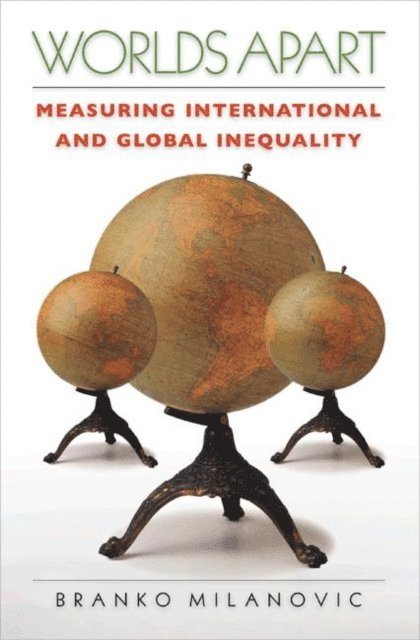
We are used to thinking about inequality within countries--about rich Americans versus poor Americans, for instance. But what about inequality between all citizens of the world? Worlds Apart addresses just how to measure global inequality among individuals, and shows that inequality is shaped by complex forces often working in different directions. Branko Milanovic, a top World Bank economist, analyzes income distribution worldwide using, for the first time, household survey data from more than 100 countries. He evenhandedly explains the main approaches to the problem, offers a more accurate way of measuring inequality among individuals, and discusses the relevant policies of first-world countries and nongovernmental organizations. Inequality has increased between nations over the last half century (richer countries have generally grown faster than poorer countries). And yet the two most populous nations, China and India, have also grown fast. But over the past two decades inequality within countries has increased. As complex as reconciling these three data trends may be, it is clear: the inequality between the world's individuals is staggering.At the turn of the twenty-first century, the richest 5 percent of people receive one-third of total global income, as much as the poorest 80 percent. While a few poor countries are catching up with the rich world, the differences between the richest and poorest individuals around the globe are huge and likely growing.
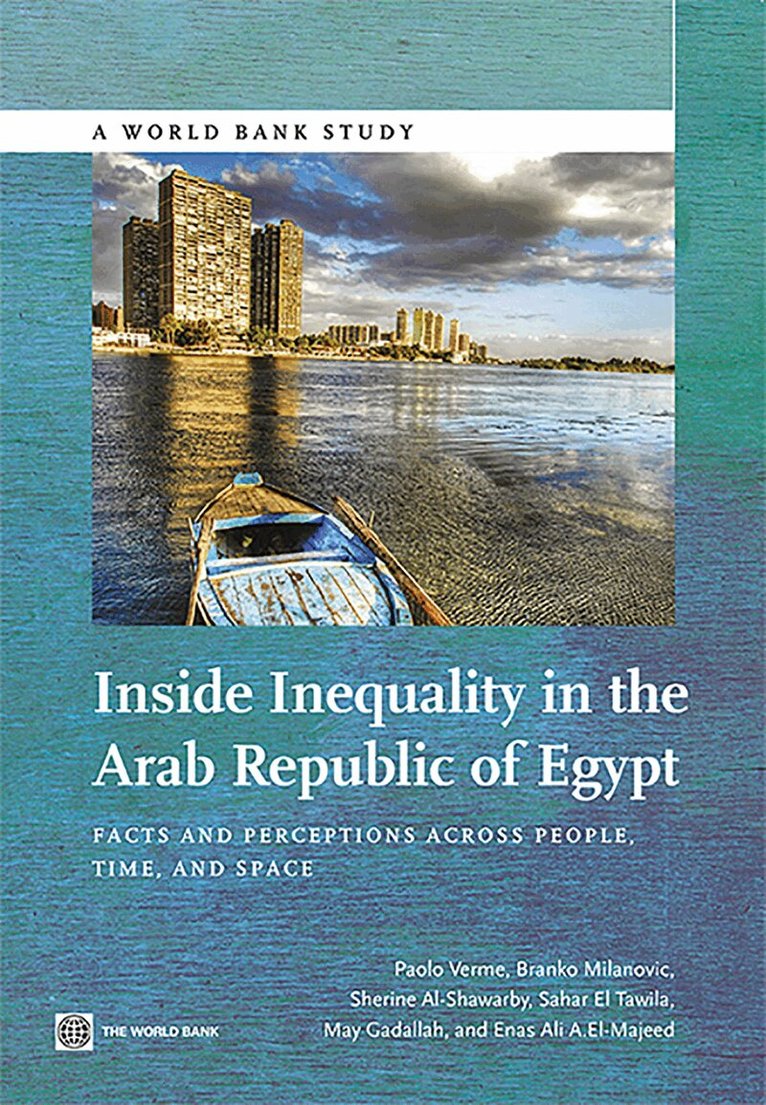
Inside Inequality in the Arab Republic of Egypt
Facts and Perceptions Across People, Time, and Space
Häftad, Engelska, 2014
284 kr
Skickas inom 10-15 vardagar
This book joins four papers prepared in the framework of the Egypt inequality study financed by the World Bank. The first paper prepared by Sherine Al-Shawarby reviews the studies on inequality in Egypt since the 1950s with the double objective of illustrating the importance attributed to inequality through time and of presenting and compare the main published statistics on inequality. To our knowledge, this is the first time that such a comprehensive review is carried. The second paper prepared by Branko Milanovic turns to the global and spatial dimensions of inequality. The objective here is to put Egypt inequality in the global context and better understand the origin and size of spatial inequalities within Egypt using different forms of measurement across regions and urban and rural areas. The Egyptian society remains deeply divided across space and in terms of welfare and this study unveils some of the hidden features of this inequality. The third paper prepared by Paolo Verme studies facts and perceptions of inequality during the period 2000-2009, the period that preceded the Egyptian revolution. The objective of this part is to provide some initial elements that could explain the apparent mismatch between inequality measured with household surveys and inequality aversion measured by values surveys. No such study has been carried out before in the Middle-East and North-Africa (MENA) region and this seemed a particular important and timely topic to address in the light of the unfolding developments in the Arab region. The fourth paper prepared by Sahar El Tawila, May Gadallah and Enas Ali A. El-Majeed assesses the state of poverty and inequality among the poorest villages of Egypt. The paper attempts to explain the level of inequality in an effort to disentangle those factors that derive from household abilities from those factors that derive from local opportunities. This is the first time that such study is conducted in Egypt. The book should be of interest to any observer of the political and economic evolution of the Arab region in the past few years and to poverty and inequality specialists that wish to have a deeper understanding of the distribution of incomes in Egypt and other countries in the MENA region.
World Under Capitalism
Observations on Economics, Politics, History, and Culture
Inbunden, Engelska, 2025
254 kr
Skickas inom 7-10 vardagar
Branko Milanovic is best known as one of the world’s leading experts on global inequality. But he is also an unusually wide-ranging and penetrating commentator on subjects across economics and beyond, in politics, history, and culture. This book brings together his most searching, provocative, and entertaining articles of recent years, providing an abundance of vital insights into the evolution and dynamics of the world under capitalism. The volume features important ideas about the struggle to achieve a more equal and prosperous world against not only the predictable forces of deregulation and distraction but new ideas about shrinking the economy to protect the environment. Further from Milanovic’s speciality, readers will find an extraordinary array of reflections on subjects including migration, globalization, the politics and economics of Russia and China, the crisis of liberal democracy, economic and literary history, and the intellectual giants of economics. The pieces are united by Milanovic’s distinctive voice – humane, wry, and realistic – and by remarkable erudition worn lightly whether the topic is the fall of Constantinople, Jane Austen, or the mores of contemporary soccer. No one can fail to learn from the book, while the sparkling prose, unexpected observations, and sheer importance of the subjects at hand make it a compelling read from start to finish.Now available as an audiobook.
148 kr
Kommande
A Financial Times Book of the YearGlobal neoliberalism is on its last legs, while a new international economic order is taking hold. Trade blocs, tariff wars, economic sanctions, and national champions are in; nationalism, anti-immigration movements and the far-right are on the rise. Liberalism is being rejected by the civic realm, as the status quo of the past fifty years crumbles. What remains in its wake?Drawing on original research, leading economist Branko Milanovic reveals the seismic shifts that are shaping our world. He details the facts: how the rising economic power of Asia is creating a new global ‘middle class’ in the greatest reshuffle of incomes since the Industrial Revolution. He explores our fears: why are we becoming increasingly unhappy, when the world is becoming richer and more equal? And he shows us the fight ahead: as plutocracy returns, global war threatens, and a new system silently shapes our nations, driving malcontent to breaking point. In The Great Global Transformation, Milanovic provides an invaluable guide to the new 21st century.
Del 25 - The Globalization of the World Economy series
Globalization and Inequality
Inbunden, Engelska, 2012
4 884 kr
Skickas inom 7-10 vardagar
This title brings together the most significant modern contributions to the literature on globalization and inequality. The editor's selection, set in context by an authoritative introduction, uses broad analyses and important case studies to illustrate the impact on levels of inequality of previous periods of globalization and of the current era of globalization. The research review further focuses on the issues of openness and inequality, and concludes with several benchmark papers that examine global levels of inequality. This timely book will be an invaluable resource for anyone concerned with this vital relationship, including teachers, doctoral students and researchers.
279 kr
Skickas inom 3-6 vardagar
190 kr
Skickas inom 3-6 vardagar
360 kr
Skickas inom 3-6 vardagar
243 kr
Skickas
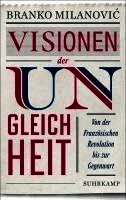
"Inget är givet på förhand i Milanovićs bild av framtiden. Politiken spelar roll. Vi har ett val. Historien är mänskoverk." /Peter Englund i DN"Milanović slutsats är tydlig: Ska vi förstå dagens samhälle måste vi våga prata om motsättningar mellan såväl klasser som platser. Och vi måste förstå att utjämning är det enda som återstår om vi vill skapa en fredligare värld." /Mattias Hagberg i GP "Branko Milanovic, en av världens främsta experter på ekonomisk ojämlikhet, beskriver i denna bok hur ojämlikheten inom och mellan nationer utvecklats i ett långt historiskt perspektiv. Han analyserar drivkrafterna bakom ökad och minskad ojämlikhet och diskuterar de politiska implikationerna av de senaste decenniernas tilltagande inkomstojämlikhet inom de rika nationerna och det faktum att det – trots den samtidiga utjämningen mellan länder – är av avgörande för våra livschanser var vi är födda och lever: det bestämmer kanske så mycket som två tredjedelar av vår livsinkomst. Denna ”medborgarpremie” eller ”medborgarränta” har som konsekvens ett tryck att migrera till rikare länder på jakt efter en bättre framtid. Samtidigt är de rika ländernas folk och regeringar inte villiga öppna sina gränser. Milanovic ställer frågan hur hänsyn till global rättvisa kan tillvaratas i denna politiska verklighet. "Inget är givet på förhand i Milanovićs bild av framtiden. Politiken spelar roll. Vi har ett val. Historien är mänskoverk." /Peter Englund i DN"Milanović slutsats är tydlig: Ska vi förstå dagens samhälle måste vi våga prata om motsättningar mellan såväl klasser som platser. Och vi måste förstå att utjämning är det enda som återstår om vi vill skapa en fredligare värld." /Mattias Hagberg i GP