Brian Harrison - Böcker
Visar alla böcker från författaren Brian Harrison. Handla med fri frakt och snabb leverans.
18 produkter
18 produkter
2 079 kr
Skickas inom 5-8 vardagar
This is the first major study of the personalities, achievements, and tactics of British feminist leaders between the wars. It brings out the breadth and scale of their activities, and explains their contribution towards broadening women's political, occupational, and family roles at home and abroad. Dr Harrison clarifies the organizational context and ancestry of inter-war feminism through creating a portrait gallery of sixteen prominent but very different feminists. Some (Lady Astor and Ellen Wilkinson, for example) are well-known, but are approached from a new angle; others, equally significant and interesting, are now almost forgotten. Overall, the book provides a composite portrait of the reforming personality, and illuminates the tactical and strategic dilemmas that face the reformer who aims to transform a hostile climate by working through democratic institutions.Drawing on interviews as well as a wide range of manuscript and other sources, Prudent Revolutionaries throws new light on the first generation of women to possess the vote in Britain. It makes a valuable contribution to the social and political history of Britain between the wars.
1 656 kr
Skickas inom 7-10 vardagar
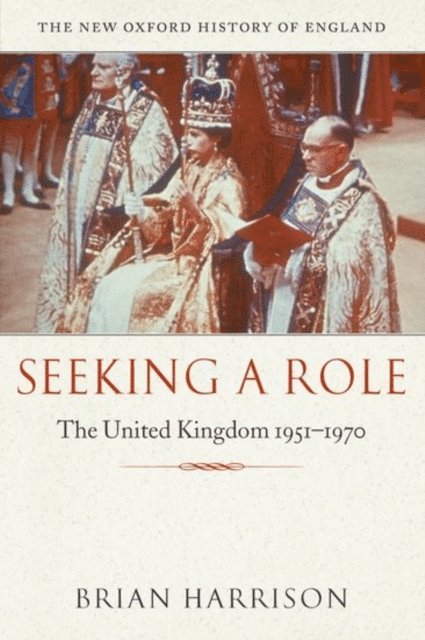
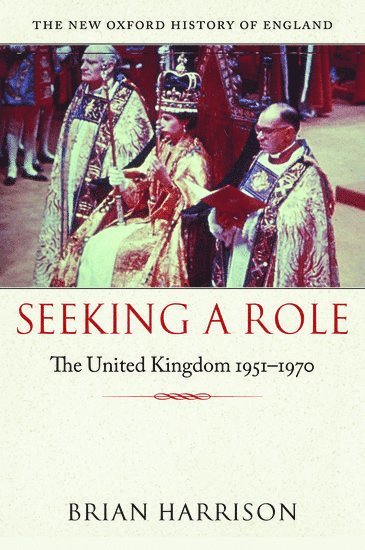
In this, the first of two self-standing volumes bringing The New Oxford History of England up to the present, Brian Harrison begins in 1951 with much of the empire intact and with Britain enjoying high prestige in Europe. The United Kingdom could still then claim to be a great power, whose welfare state exemplified compromise between Soviet planning and the USA's free market. When the volume ends in 1970, no such claims carried conviction. The empire had gone, central planning was in trouble, and even the British political system had become controversial. In an unusually wide-ranging, yet impressively detailed volume, Harrison approaches the period from unfamiliar directions. He explains how British politicians in the 1950s and 1960s responded to this transition by pursuing successive roles for Britain: worldwide as champion of freedom, and in Europe as exemplar of parliamentary government, the multi-racial society, and economic planning. His main focus, though, rests not on the politicians but on the decisions the British people made largely for themselves: on their environment, social structure and attitudes, race relations, family patterns, economic framework, and cultural opportunities. By 1970 the consumer society had supplanted postwar austerity, the socialist vision was fading, and 'the sixties' (the theme of his penultimate chapter) had introduced new and even exotic themes and values. Having lost an empire, Britain was still resourcefully seeking a role: it had yet to find it.
2 716 kr
Skickas inom 5-8 vardagar
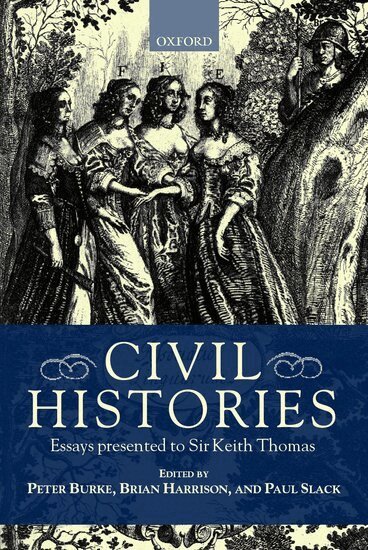
Sir Keith Thomas is one of the most innovative and influential of English historians, and a scholar of unusual range. These essays, presented to him on his retirement as President of Corpus Christi College, Oxford, concentrate on one of the broad themes illuminated by his work - changing notions of civility in the past. From the sixteenth century onwards, civility was a term applied to modes of behaviour as well as to cultural and civic attributes. Its influence extended from styles of language and sexual mores to funeral ceremonies and commercial morality. It was used to distinguish the civil from the barbarous and the English from the Irish and Welsh, and to banish superstition and justify imperialism. The contributors - distinguished historians who have been Keith Thomas's pupils - illustrate the many implications of civility in the early modern period and its shifts of meaning down to the twentieth century.
5 072 kr
Skickas inom 7-10 vardagar
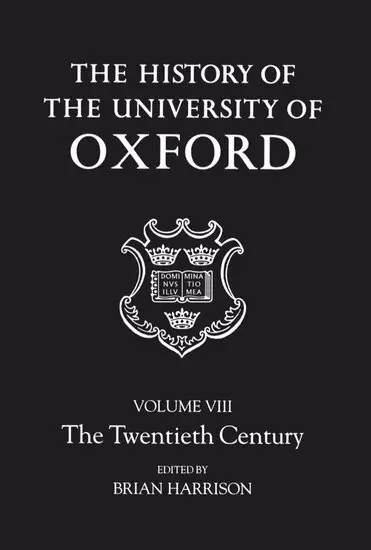
This volume, the eighth in The History of the University of Oxford, is the first study of how one of the world's major universities has responded to the formidable challenges offered by the twentieth century. Because Oxford's response has not taken a revolutionary or dramatic form, outside observers have not always appreciated the scale of its transformation. Focusing on the years from 1914 to 1970, the authors show how misleading is Evelyn Waugh's Brideshead Revisited as a guide to modern Oxford.Full attention is given to the forces making for change: the rapid growth in provision for the natural and social sciences; the advance of professionalism in scholarship, sport, and cultural achievement; the diffusion of international influences through Rhodes scholars, two world wars, and the University's mounting research priorities; the growing impact of government and of public funding; the steady advance of women; and the impact made by Oxford's broadened criteria for undergraduate admission.Yet the continuities are also stressed: the day-to-day realities of college life; the continuous adaptation and extension of ancient buildings; the persistence of Oxford's traditional emphasis on undergraduate study, on the humanities, and on religion; the steady accumulation of books, research materials, objects of art, and scholarly espertise. Although the emphasis rests on the University's national and international role, and how it has interacted with outside influences, changes in Oxford's internal structure are not neglected, and an epilogue links the volume's historical material with the most recent developments.With its concern for the interaction between ideas and their environment, this generously illustrated and scholarly study contributes significantly to the history of ideas and culture in twentieth-century Britain. It sheds light on the training given to an important section of the nation's political and cultural opinion-formers. And, given the University's distinctive structure and the authors' efforts to avoid undue introspection or self-congratulation, the volume also provides valuable background material for the discussion of educational policy. In short, its presents the reader with a rich cornucopia of insight into many aspects of British life.Contributors: J.M. Winter, Pembroke College, Cambridge; John Prest, Balliol College, Oxford; Dan Greenstein, University of Glasgow; Brian Harrison, K.V. Thomas, and Valentine Cunningham, all of Corpus Christi College, Oxford; Robert Currie, Wadham College, Oxford; J.B. Morrell, Emeritus Professor, University of Bradford; Paul Addison University of Edinburgh; Jose Harris, St Catherine's College, Oxford; John Roche Linacre College, Oxford; Frank Turner, Yale University; Charles Webster, All Souls College, Oxford; Janet Howarth, St Hilda's College, Oxford;R.A. Denniston, G.G. Barber, C.J. White, Diane Kay, D.J. Wenden, R.C. Whiting, A.H. Halsey, J.G. Darwin, J.P.D. Dunbabin, and M. Brock.
Oxford Dictionary of National Biography
In Association with the British Academy
Inbunden, Engelska, 2004
27 521 kr
Skickas inom 5-8 vardagar
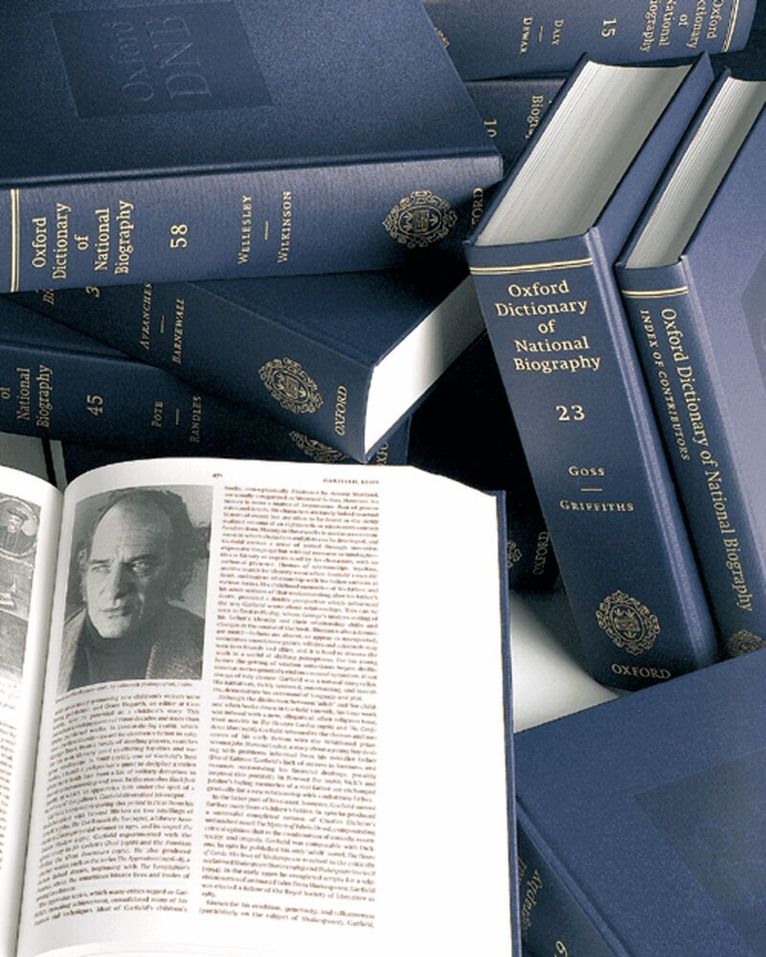
The Oxford Dictionary of National Biography is a collection of 50,000 specially written biographies of men and women who have shaped all aspects of the British past, from the earliest times to the end of the year 2000. The stories of these lives - told in substantial, authoritative, and readable articles - have been published simultaneously in 60 print volumes and online. Inclusive - Authoritative - UniqueThe original DNB was conceived in 1882 by George Smith, publisher of the Brontës and Trollope, and first edited by Virginia Woolf's father, Sir Leslie Stephen. The editorial policy of the original DNB was remarkably inclusive: any person of note could be included who had lived in, or had a significant connection with the British Isles. The Oxford DNB takes a similarly inclusive approach: subjects range from the great and the good to the popular, pioneering, eccentric, notorious, and downright criminal.In 'national' scope the pragmatic approach of the original DNB has been retained. The Oxford DNB covers people born in the British Isles; it also includes inhabitants of the USA and Commonwealth countries before independence, many British-born people whose main impact was made overseas, and many who were born elsewhere but whose impact within the United Kingdom was substantial.Everyone included in the old dictionary is in the Oxford DNB but all their biographies have been revised or completely rewritten to reflect modern scholarship. A further 13,500 lives of new subjects broadens the coverage of previously neglected areas in all periods. These include many articles on women and twentieth-century subjects as well as previously under-represented fields such as business and science. Over 1800 people who died between 1991 and 2000 have also been included for the first time. In order to ensure a well-balanced view of a subject we do not include any biographies of people that are still living.Owing to its accessible and authoritative coverage, the Oxford DNB will appeal to a wide readership: from scholarly researchers to university, college, and school students, professional writers to general readers of biography, local and family historians to librarians, archivists, and curators. It is the essential biographical and historical resource for all major libraries.Editorial excellenceLike the Oxford English Dictionary the project springs from a remarkable partnership between publisher and scholars. The Oxford DNB is constituted as a research and publishing project of the University of Oxford, with research funding from the British Academy, and all other funding and resources from Oxford University Press. The editor is Professor Brian Harrison (Professor of Modern British History, University of Oxford) who succeeded the founding editor, the late Professor H. C. G. Matthew FBA, in January 2000. Over 30 in-house research scholars, 12 external consultant editors and 400 associate editors made recommendations about new subjects and specialist authors, and reviewed completed work for academic quality. The large community of people contributing to the Oxford DNB is spread around the world and made up of 10,000 academic and non-academic authors.The largest selection of national portraiture ever publishedThe Oxford DNB contains 10,000 portrait illustrations, each shown next to the relevant biography. This special project was completed in partnership with the National Portrait Gallery in London. Drawing on the National Portrait Gallery's own collections and a wide range of other sources, a specialist research team has assembled the largest selection of national portraiture ever published. Images chosen for reproduction range from paintings, drawings, and sculpture to photographs, medals, and death masks.
Oxford Dictionary of National Biography: Oxford Dictionary of National Biography Index of Contributors
Inbunden, Engelska, 2004
1 108 kr
Skickas inom 7-10 vardagar
This volume provides an alphabetical list of the 10,000 contributors to the Oxford Dictionary of National Biography, and gives details of the articles they have contributed to the work.
433 kr
Skickas inom 7-10 vardagar
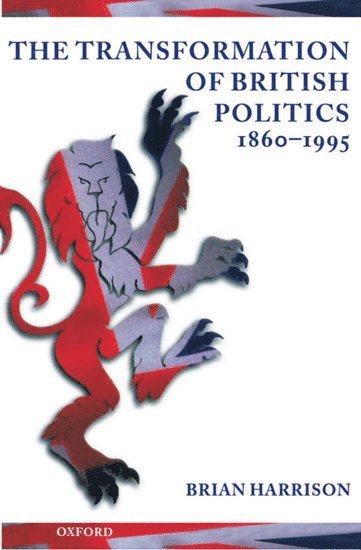
The British political system, though often criticised, has been the model and the inspiration for many national governments world-wide. Yet it is now at the centre of controversial debate within Britain itself. Over the 130 years since Bagehot wrote his English Constitution, no historian has investigated in depth how it has evolved in all its dimensions, and few political scientists have looked further back than the Second World War. This is the first book to provide a detailed explanation of how the British political system came to acquire the form it has today. Brian Harrison's broad-ranging, authorative analysis runs continuously from the 1860s to the 1990s. He investigates such topics as civil liberties, pressure groups, parliament, elections and the parties, central and local government, cabinet, and monarchy. He examines the international and cultural influences on the working of the political system, and concludes by surveying current proposals for reform. With an ample guide to further reading, and a full chronology of leading events, this book will be essential reading for students of politics and history.
1 128 kr
Skickas inom 5-8 vardagar
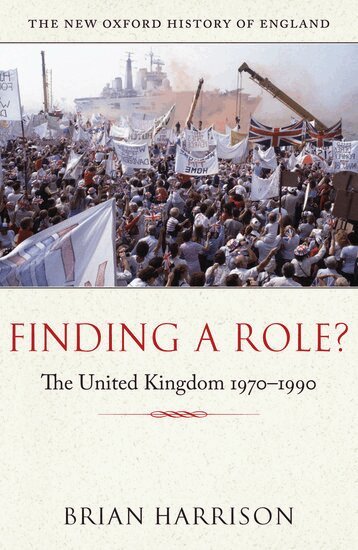
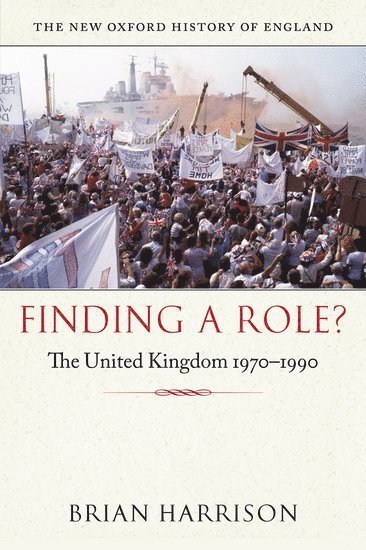
In 1970 the 'cold war' was still cold, Northern Ireland's troubles were escalating, the UK's relations with the EEC were unclear, and corporatist approaches to the economy precariously persisted. By 1990 Communism was crumbling world-wide, Thatcher's economic revolution had occurred, terrorism in Northern Ireland was waning, 'multi-culturalism' was in place, family structures were changing fast, and British political institutions had become controversial. Seven analytic chapters pursue these changes and accumulate rich detail on changes in international relations, landscape and townscape, social framework, family and welfare structures, economic policies and realities, intellect and culture, politics and government. The concluding chapter ranges chronologically even more widely to bring out the interaction of past and present, then asks how far the UK had by 1990 identified its world role. Like Harrison's Seeking a Role: The United Kingdom 1951-1970 (2009) - the immediately preceding volume in this series - Finding a Role? includes a full chronological table and an ample index of names and themes.This, the first thorough, wide-ranging, and synoptic study of the UK so far published on this period, has two overriding aims: to show how British institutions evolved, but also to illuminate changes in the British people: their hopes and fears, values and enjoyments, failures and achievements. It therefore equips its readers to understand events since 1990, and so to decide for themselves where the UK should now be going.
647 kr
Skickas inom 7-10 vardagar
In this, the first of two self-standing volumes bringing The New Oxford History of England up to the present, Brian Harrison begins in 1951 with much of the empire intact and Britain enjoying high prestige in Europe. The United Kingdom could still then claim to be a great power whose welfare state exemplified compromise between Soviet planning and the USA's free market. When the volume ends in 1970, no such claims carried conviction. The empire had gone, central planning was in trouble, and even the British political system had become controversial. In an unusually wide-ranging, yet impressively detailed volume, Harrison approaches the period from unfamiliar directions. He explains how British politicians in the 1950s and 1960s responded to this transition by pursuing successive roles for Britain: worldwide as champion of freedom, and in Europe as exemplar of parliamentary government, the multi-racial society, and economic planning. His main focus, though, rests not on the politicians but on the decisions the British people made largely for themselves: on their environment, social structure and attitudes, race relations, family patterns, economic framework, and cultural opportunities. By 1970 the consumer society had supplanted postwar austerity, the socialist vision was fading, and 'the sixties' (the theme of his penultimate chapter) had introduced new and even exotic themes and values. Having lost an empire, Britain was still resourcefully seeking a role: it had yet to find it.
734 kr
Skickas inom 7-10 vardagar
In 1970 the 'cold war' was still cold, Northern Ireland's troubles were escalating, the UK's relations with the EEC were unclear, and corporatist approaches to the economy precariously persisted. By 1990 Communism was crumbling world-wide, Thatcher's economic revolution had occurred, terrorism in Northern Ireland was waning, 'multi-culturalism' was in place, family structures were changing fast, and British political institutions had become controversial. Seven analytic chapters pursue these changes and accumulate rich detail on changes in international relations, landscape and townscape, social framework, family and welfare structures, economic policies and realities, intellect and culture, politics and government. The concluding chapter ranges chronologically even more widely to bring out the interaction of past and present, then asks how far the UK had by 1990 identified its world role. Like Harrison's Seeking a Role: The United Kingdom 1951-1970 (2009) - the immediately preceding volume in this series - Finding a Role? includes a full chronological table and an ample index of names and themes.This, the first thorough, wide-ranging, and synoptic study of the UK so far published on this period, has two overriding aims: to show how British institutions evolved, but also to illuminate changes in the British people: their hopes and fears, values and enjoyments, failures and achievements. It therefore equips its readers to understand events since 1990, and so to decide for themselves where the UK should now be going.
2 103 kr
Skickas inom 10-15 vardagar
The British feminist movement has often been studied, but so far nobody has written about its opponents. Dr Harrison argues that British feminism cannot be understood without appreciating the strength and even the contemporary plausibility of ‘the Antis’, as the opponents of women’s suffrage were called.In a fully documented approach which combines political with social history, he unravels the complex politics, medical, diplomatic and social components of the anti-suffrage mind, and clarifies the Antis’ central commitment to the idea of separate but complementary spheres for the two sexes.Dr Harrison then analyses the history of organised anti-suffragism between 1908 and 1918, and argues that anti-suffragism is important for shedding light on the Edwardian feminists. The Antis also introduce us to important Victorian and Edwardian attitudes which are often forgotten and which differ markedly from the attitudes to women which are now familiar; on the other hand, his concluding chapter – which surveys the period from 1918 to 1978 – claims that many of these attitudes, though less frequently voiced in public, still influence present-day conduct. His book, published originally in 1978, therefore makes an important contribution towards the history of the British women’s movement and towards understanding Britain in the nineteenth- and twentieth-centuries.
676 kr
Skickas inom 10-15 vardagar
The British feminist movement has often been studied, but so far nobody has written about its opponents. Dr Harrison argues that British feminism cannot be understood without appreciating the strength and even the contemporary plausibility of ‘the Antis’, as the opponents of women’s suffrage were called.In a fully documented approach which combines political with social history, he unravels the complex politics, medical, diplomatic and social components of the anti-suffrage mind, and clarifies the Antis’ central commitment to the idea of separate but complementary spheres for the two sexes.Dr Harrison then analyses the history of organised anti-suffragism between 1908 and 1918, and argues that anti-suffragism is important for shedding light on the Edwardian feminists. The Antis also introduce us to important Victorian and Edwardian attitudes which are often forgotten and which differ markedly from the attitudes to women which are now familiar; on the other hand, his concluding chapter – which surveys the period from 1918 to 1978 – claims that many of these attitudes, though less frequently voiced in public, still influence present-day conduct. His book, published originally in 1978, therefore makes an important contribution towards the history of the British women’s movement and towards understanding Britain in the nineteenth- and twentieth-centuries.
309 kr
Skickas inom 5-8 vardagar
485 kr
Kommande
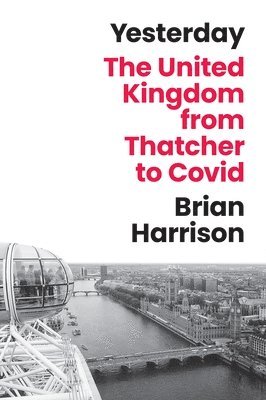
The first major account of this transformative period in the history of Great BritainBetween 1990 and 2020, the United Kingdom experienced tension between unparalleled social change and a pragmatic political culture which sought continuity, compromise and gradualism. Thatcher’s legacy was slowly digested, Blair’s ‘New Labour’ thoroughly scrutinized and the decision was made after forty-seven years to leave the European Union. The UK’s long-established major institutions—monarchy, parliament and the union between England, Scotland, Wales and Northern Ireland—were sorely tested. Yesterday provides the first fully documented history of this pivotal time in Great Britain.Was the UK in decline? Brian Harrison points to Britain’s unsuccessful adventures in Iraq and Afghanistan and its relative economic decline, underfunded hospitals, sink schools, over-filled prisons and terrorism of both Irish and Islamic varieties. Yet there were successes. Harrison shows how the UK’s participatory institutions outmanoeuvred terrorism and precariously surmounted regional, intergenerational, ethnic and social-class tensions. This vibrant, creative society saw major improvements in time, place and recruitment for work, as well as growth and innovation in conservation, digitization, tourism, consumerism, sport and the arts. Some changes were revolutionary: in family life and relations between the generations, and in the ever-changing electronic media. And if religious observance was in decline, immigrants were introducing new faiths and even a revived religious fervour while attitudes to health and death were changing fast.A panoramic and wide-ranging analysis by a scholar at the height of his powers, Yesterday paints an evocative, richly textured portrait of a people who were shedding their complacency and insularity and bracing themselves to face a very different but promising future.
182 kr
Skickas inom 5-8 vardagar
171 kr
Skickas inom 5-8 vardagar
206 kr
Skickas inom 5-8 vardagar
191 kr
Skickas inom 5-8 vardagar