Brian Matthew Jordan - Böcker
Visar alla böcker från författaren Brian Matthew Jordan. Handla med fri frakt och snabb leverans.
7 produkter
7 produkter
612 kr
Skickas inom 10-15 vardagar
In recent years, Civil War veterans have emerged from historical obscurity. Inspired by recent interest in memory studies and energised by the ongoing neorevisionist turn, a vibrant new literature has given the lie to the once-obligatory lament that the postbellum lives of Civil War soldiers were irretrievable. Despite this flood of historical scholarship, fundamental questions about the essential character of Civil War veteranhood remain unanswered. Moreover, because work on veterans has often proceeded from a preoccupation with cultural memory, the Civil War's ex-soldiers have typically been analysed as either symbols or producers of texts. In The War Went On: Reconsidering the Lives of Civil War Veterans, fifteen of the field's top scholars provide a more nuanced and intimate look at the lives and experiences of these former soldiers.Essays in this collection approach Civil War veterans from oblique angles, including theater, political, and disability history, as well as borderlands and memory studies. Contributors examine the lives of Union and Confederate veterans, African American veterans, former prisoners of war, amputees, and ex-guerrilla fighters. They also consider postwar political elections, veterans' business dealings, and even literary contests between onetime enemies and among former comrades.
1 844 kr
Skickas inom 3-6 vardagar
Final Resting Places brings together some of the most important and innovative scholars of the Civil War era to reflect on what death and memorialization meant to the Civil War generation—and how those meanings still influence Americans today. In each essay, a noted historian explores a different type of gravesite—including large marble temples, unmarked graves beneath the waves, makeshift markers on battlefields, mass graves on hillsides, neat rows of military headstones, university graveyards, tombs without bodies, and small family plots. Each burial place tells a unique story of how someone lived and died; how they were mourned and remembered. Together, they help us reckon with the most tragic period of American history. CONTRUBUTORS: Terry Alford, Melodie Andrews, Edward L. Ayers, DeAnne Blanton, Michael Burlingame, Katherine Reynolds Chaddock, John M. Coski, William C. Davis, Douglas R. Egerton, Stephen D. Engle, Barbara Gannon, Michael P. Gray, Hilary Green, Allen C. Guelzo, Anna Gibson Holloway, Vitor Izecksohn, Caroline E. Janney, Michelle A. Krowl, Glenn W. LaFantasie, Jennifer M. Murray, Barton A. Myers, Timothy J. Orr, Christopher Phillips, Mark S. Schantz, Dana B. Shoaf, Walter Stahr, Michael Vorenberg, and Ronald C. White
578 kr
Skickas inom 7-10 vardagar
Final Resting Places brings together some of the most important and innovative scholars of the Civil War era to reflect on what death and memorialization meant to the Civil War generation—and how those meanings still influence Americans today. In each essay, a noted historian explores a different type of gravesite—including large marble temples, unmarked graves beneath the waves, makeshift markers on battlefields, mass graves on hillsides, neat rows of military headstones, university graveyards, tombs without bodies, and small family plots. Each burial place tells a unique story of how someone lived and died; how they were mourned and remembered. Together, they help us reckon with the most tragic period of American history. CONTRUBUTORS: Terry Alford, Melodie Andrews, Edward L. Ayers, DeAnne Blanton, Michael Burlingame, Katherine Reynolds Chaddock, John M. Coski, William C. Davis, Douglas R. Egerton, Stephen D. Engle, Barbara Gannon, Michael P. Gray, Hilary Green, Allen C. Guelzo, Anna Gibson Holloway, Vitor Izecksohn, Caroline E. Janney, Michelle A. Krowl, Glenn W. LaFantasie, Jennifer M. Murray, Barton A. Myers, Timothy J. Orr, Christopher Phillips, Mark S. Schantz, Dana B. Shoaf, Walter Stahr, Michael Vorenberg, and Ronald C. White
261 kr
Tillfälligt slut
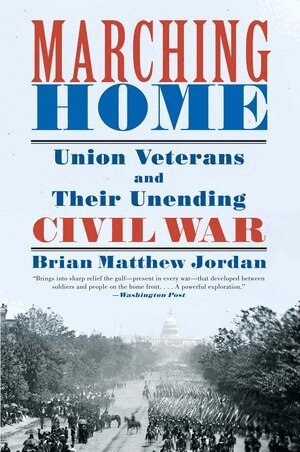
For well over a century, traditional Civil War histories have concluded in 1865, with a bitterly won peace and Union soldiers returning triumphantly home. In a landmark work that challenges sterilized portraits accepted for generations, Civil War historian Brian Matthew Jordan creates an entirely new narrative. These veterans— tending rotting wounds, battling alcoholism, campaigning for paltry pensions— tragically realized that they stood as unwelcome reminders to a new America eager to heal, forget, and embrace the freewheeling bounty of the Gilded Age. Mining previously untapped archives, Jordan uncovers anguished letters and diaries, essays by amputees, and gruesome medical reports, all deeply revealing of the American psyche.In the model of twenty-first-century histories like Drew Gilpin Faust’s This Republic of Suffering or Maya Jasanoff ’s Liberty’s Exiles that illuminate the plight of the common man, Marching Home makes almost unbearably personal the rage and regret of Union veterans. Their untold stories are critically relevant today.
189 kr
Kommande
The Civil War ended more than 150 years ago, yet our nation remains fiercely divided over its enduring legacies. In A Thousand May Fall, Pulitzer Prize finalist Brian Matthew Jordan returns us to the war itself, bringing us closer than perhaps any prior historian to the chaos of battle and the trials of military life. Creating an intimate, absorbing chronicle from the ordinary soldier’s perspective, he allows us to see the Civil War anew—and through unexpected eyes.At the heart of Jordan’s vital account is the 107th Ohio Volunteer Infantry, which was at once representative and exceptional. Its ranks weathered the human ordeal of war in painstakingly routine ways, fighting in two defining battles, Chancellorsville and Gettysburg, each time in the thick of the killing. But the men of the 107th were not lauded as heroes for their bravery and their suffering. Most of them were ethnic Germans, set apart by language and identity, and their loyalties were regularly questioned by a nativist Northern press. We so often assume that the Civil War was a uniquely American conflict, yet Jordan emphasizes the forgotten contributions made by immigrants to the Union cause. An incredible one quarter of the Union army was foreign born, he shows, with 200,000 native Germans alone fighting to save their adopted homeland and prove their patriotism.In the course of its service, the 107th Ohio was decimated five times over, and although one of its members earned the Medal of Honor for his daring performance in a skirmish in South Carolina, few others achieved any lasting distinction. Reclaiming these men for posterity, Jordan reveals that even as they endured the horrible extremes of war, the Ohioans contemplated the deeper meanings of the conflict at every turn—from personal questions of citizenship and belonging to the overriding matter of slavery and emancipation.Based on prodigious new research, including diaries, letters, and unpublished memoirs, A Thousand May Fall is a pioneering, revelatory history that restores the common man and the immigrant striver to the center of the Civil War. In our age of fractured politics and emboldened nativism, Jordan forces us to confront the wrenching human realities, and often-forgotten stakes, of the bloodiest episode in our nation’s history.
More Great “What Ifs” of the American Civil War
Historians Tackle More of the Conflict’s Most Intriguing Possibilities
Inbunden, Engelska, 2026
344 kr
Kommande
To ask “What If” about great moments of history is to simultaneously unleash imagined possibilities and embrace the rigorous confines of fact.Every armchair general asks “What If,” but serious students of the war avoid making assumptions when they ask it. They go beyond wishful thinking and use “What If” as a springboard to explore not only what happened but also their own assumptions about what happened. A serious inquiry sparks rigorous exploration, demands critical thinking, and unlocks important insights.More Great “What Ifs” of the American Civil War: Historians Tackle More of the Conflict’s Most Intriguing Possibilities picks up where volume one left off: with historians at Emerging Civil War tackling more of the war’s most enduring questions.Each essay focuses on a key event of the war and, much like an army staff ride, examines the options of the moment. To understand what happened, we must look at what could have happened, with the full multitude of choices before us and a clear and objective eye. “What if” becomes a tool for illumination.This is not a collection of alternate histories or counterfactual scenarios. Rather, it is an invitation to ask, to learn, and to wonder, “What if…?”
343 kr
Skickas inom 5-8 vardagar
For well over a century, traditional Civil War histories have concluded in 1865, with a bitterly won peace and Union soldiers returning triumphantly home. In a landmark work that challenges sterilized portraits accepted for generations, Civil War historian Brian Matthew Jordan creates an entirely new narrative. These veterans— tending rotting wounds, battling alcoholism, campaigning for paltry pensions— tragically realized that they stood as unwelcome reminders to a new America eager to heal, forget, and embrace the freewheeling bounty of the Gilded Age. Mining previously untapped archives, Jordan uncovers anguished letters and diaries, essays by amputees, and gruesome medical reports, all deeply revealing of the American psyche.In the model of twenty-first-century histories like Drew Gilpin Faust’s This Republic of Suffering or Maya Jasanoff ’s Liberty’s Exiles that illuminate the plight of the common man, Marching Home makes almost unbearably personal the rage and regret of Union veterans. Their untold stories are critically relevant today.