Chris Mackowski - Böcker
Visar alla böcker från författaren Chris Mackowski. Handla med fri frakt och snabb leverans.
10 produkter
10 produkter
286 kr
Skickas inom 11-20 vardagar
Although most Americans believe that the Battle of Gettysburg was the only turning point of the Civil War, the war actually turned repeatedly. Events unfolded in completely unexpected ways and had unintended consequences. Turning Points of the American Civil War examines key shifts and the context surrounding them, demonstrating that the war was a continuum of watershed events.The contributors show that many chains of events caused the course of the war to change: the Federal defeats at First Bull Run and Ball’s Bluff, the wounding of Joseph Johnston at Seven Pines and the Confederate victory at Chancellorsville, the issuance of the Emancipation Proclamation, the Federal victory at Vicksburg, Grant’s decision to move on to Richmond rather than retreat from the Wilderness, the naming of John B. Hood as commander of the Army of Tennessee, and the 1864 presidential election. In their conclusion, editors Mackowski and White suggest that the assassination of Abraham Lincoln might have been the war’s final turning point.Presenting essays by public historians with experience at Civil War battle sites, this provocative collection offers fresh perspectives on political and military events in the eastern and western theaters.
258 kr
Skickas inom 11-20 vardagar
Popular media can spark the national consciousness in a way that captures people’s attention, interests them in history, and inspires them to visit battlefields, museums, and historic sites. This lively collection of essays and feature stories celebrates the novels, popular histories, magazines, movies, television shows, photography, and songs that have enticed Americans to learn more about our most dramatic historical era.From Ulysses S. Grant’s Memoirs to Abraham Lincoln: Vampire Hunter, from Roots to Ken Burns’s The Civil War, from “Dixie” to “Ashokan Farewell,” and from Civil War photography to the Gettysburg Cyclorama, trendy and well-loved depictions of the Civil War are the subjects of twenty contributors who tell how they and the general public have been influenced by them. Sarah Kay Bierle examines the eternal appeal of Gone with the Wind and asks how it is that a protagonist who so opposed the war has become such a figurehead for it. H. R. Gordon talks with New York Times–bestselling novelist Jeff Shaara to discuss the power of storytelling. Paul Ashdown explores ColdMountain’s value as a portrait of the war as national upheaval, and Kevin Pawlak traces a shift in cinema’s depiction of slavery epitomized by 12 Years a Slave. Tony Horwitz revisits his iconic Confederates in the Attic twenty years later.The contributors’ fresh analysis articulates a shared passion for history’s representation in the popular media. The variety of voices and topics in this collection coalesces into a fascinating discussion of some of the most popular texts in the genres. In keeping with the innovative nature of this series, web-exclusive material extends the conversation beyond the book.
Last Days of Stonewall Jackson
The Mortal Wounding of the Confederacy’s Greatest Icon
Häftad, Engelska, 2013
108 kr
Tillfälligt slut
May 1863. The Civil War was in its third spring, and Confederate Lt. Gen. Thomas Jonathan Jackson stood at the peak of his fame. He had arisen from obscurity to become “Old Stonewall,” adored across the South and feared and respected throughout the North. On the night of May 2, however, just hours after Jackson executed the most audacious manoeuvre of his career and delivered a crushing blow against an unsuspecting Union army at Chancellorsville, disaster struck.The Last Days of Stonewall Jackson recounts the events of that fateful night—considered one of the most pivotal moments of the war—and the tense vigil that ensued as Jackson struggled with a foe even he could not defeat. From Guinea Station, where Jackson crosses the river to rest under the shade of the trees, the story follows Jackson’s funeral and burial, the strange story of his amputated arm, and the creation and restoration of the building where he died (now known as the Stonewall Jackson Shrine). This newly revised and expanded second edition features more than 50 pages of fresh material, including almost 200 illustrations, maps, and eye-catching photos.New appendices allow readers to walk in Jackson’s pre-war footsteps through his adopted hometown of Lexington, Virginia; consider the ways Jackson’s memory has been preserved through monuments, memorials, and myths; and explore the misconceptions behind the Civil War’s great What-If: “What if Stonewall had survived his wounds?”With the engaging prose of master storytellers, Chris Mackowski and Kristopher White make The Last Days of Stonewall Jackson a must-read for Civil War novices and buffs alike.
More Great “What Ifs” of the American Civil War
Historians Tackle More of the Conflict’s Most Intriguing Possibilities
Inbunden, Engelska, 2026
344 kr
Kommande
To ask “What If” about great moments of history is to simultaneously unleash imagined possibilities and embrace the rigorous confines of fact.Every armchair general asks “What If,” but serious students of the war avoid making assumptions when they ask it. They go beyond wishful thinking and use “What If” as a springboard to explore not only what happened but also their own assumptions about what happened. A serious inquiry sparks rigorous exploration, demands critical thinking, and unlocks important insights.More Great “What Ifs” of the American Civil War: Historians Tackle More of the Conflict’s Most Intriguing Possibilities picks up where volume one left off: with historians at Emerging Civil War tackling more of the war’s most enduring questions.Each essay focuses on a key event of the war and, much like an army staff ride, examines the options of the moment. To understand what happened, we must look at what could have happened, with the full multitude of choices before us and a clear and objective eye. “What if” becomes a tool for illumination.This is not a collection of alternate histories or counterfactual scenarios. Rather, it is an invitation to ask, to learn, and to wonder, “What if…?”
371 kr
Tillfälligt slut
Ulysses S. Grant stood at the center of the American Civil Ware maelstrom. The Ohio nature answered his nation’s call to service and finished the war as a lieutenant general in command of the U. S. Army. Three years later he ascended to the presidency in an attempt to better secure the peace he had helped win on the battlefield. Despite his major achievements in war and peace, political and sectional enemies battered his reputation. For nearly a century his military and political career remained deeply misunderstood. Since the Civil War centennial, however, Grant’s reputation has blossomed into a full renaissance. His military record garners new respect and, more recently, an appreciation for his political career—particularly his strong advocacy for civil rights—is quickly catching up. Throughout these decades his personal memoirs, marking him as a significant American “Man of Letters,” have never gone out of print. Grant at 200: Reconsidering the Life and Legacy of Ulysses S. Grant celebrates the bicentennial of the birth of a man whose towering impact on American history has often been overshadowed and in many cases, ignored. This collection of essays by some of today’s leading Grant scholars offers fresh perspectives on Grant’s military career and presidency, as well as underexplored personal topics such as his faith and his family life. Proceeds from this volume will go to support the Ulysses S. Grant Association and the Grant Monument Association.
297 kr
Tillfälligt slut
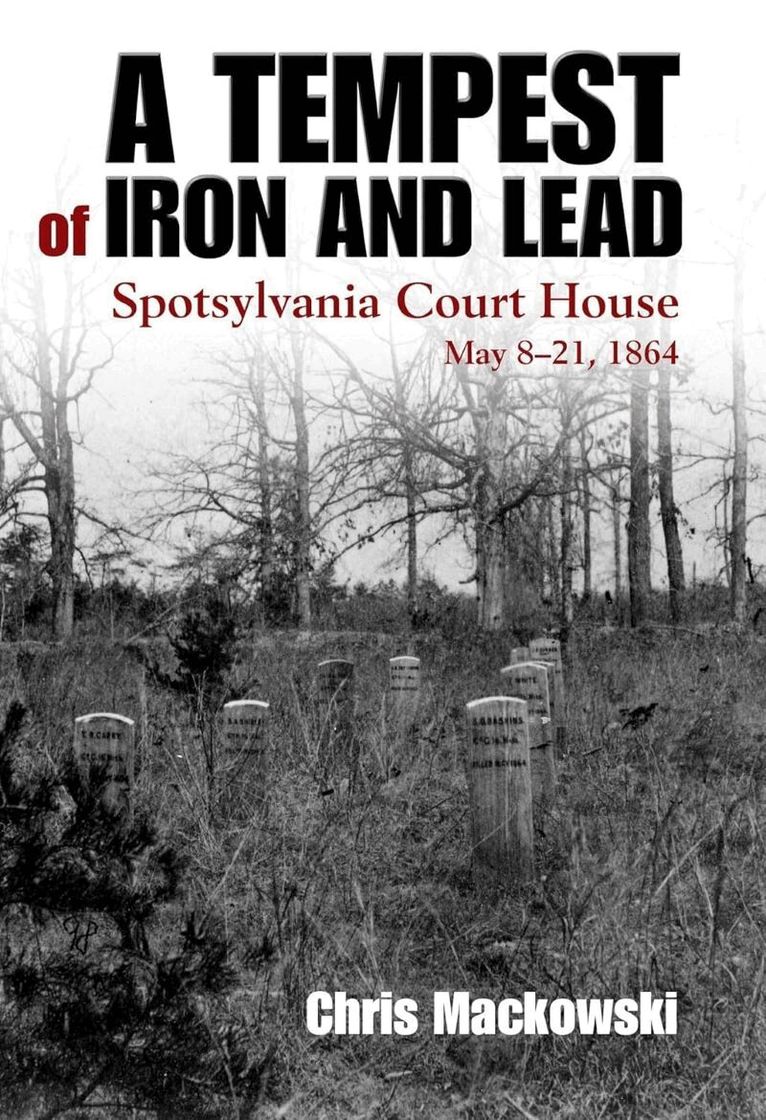
May 1864\. The Army of the Potomac and the Army of Northern Virginia spent three days in brutal close-quarter combat in the Wilderness that left the tangled thickets aflame. No one could imagine a more infernal battlefield. Then they marched down the road to Spotsylvania Court House.Even the march itself was unprecedented. For three years, the armies had fought and disengaged. That changed on the night of May 7\. Instead of leaving the Wilderness to regroup, Lt. Gen. Ulysses S. Grant led the Federal army southward, skirmishing with Confederates all the way. “There will be no turning back,” he had declared. He lived up to his word. By dawn on May 8, the armies had tangled their way ten miles down the road and opened another large-scale fight that would last until May 21\. “One thing is certain of this campaign thus far,” explained Dr. Daniel Holt of the 121st New York: “more blood has been shed, more lives lost, and more human suffering undergone than ever before in a season.”The fighting launched a score of new place names and events that would sear themselves into the American consciousness, including Laurel Hill, Upton’s assault, the Mule Shoe, the Bloody Angle, and Harris Farm. The casualties exacted at Spotsylvania would exceed those of the Wilderness by thousands. The fighting would severely test the offensive capabilities of Confederate commander Gen. Robert E. Lee’s army, just as the defensive posture his men embraced would, in turn, test the limits of Federal endurance.In A Tempest of Iron and Lead: Spotsylvania Court House, May 8-21, 1864, author Chris Mackowski has crafted a meticulous and comprehensible study of this endlessly fascinating campaign. Mackowski, long-familiar with the battle of Spotsylvania Court House, is a former historian at Fredericksburg and Spotsylvania National Military Park. Chris continues to give tours of the battlefield as the historian in residence at Stevenson Ridge, a historic property on the battlefield’s eastern front.His intimate knowledge of the landscape and nearly two decades of insight, together with primary source materials, outstanding maps, and helpful images, combine to create a readable and satisfying single-volume account the campaign has so richly deserved.
310 kr
Skickas inom 3-6 vardagar
Decisions at Fredericksburg
The Fourteen Critical Decisions That Defined the Battle
Häftad, Engelska, 2021
269 kr
Skickas inom 10-15 vardagar
In the fall of 1862, after a leadership shake-up initiated by Lincoln, Gen. Ambrose Burnside assumed command of the Army of the Potomac and developed an aggressive plan to attack the Confederate capital of Richmond. However, in order to reach Richmond, Burnside had to march through Fredericksburg, where Gen. Robert E. Lee’s Army of Northern Virginia was well entrenched. After crossing the Rappahannock River under enemy fire, Burnside and his troops engaged Lee’s army within the city, then launched a futile frontal assault against a heavily fortified ridge west of Fredericksburg. The end result was a decisive victory for the Confederacy, as the Union army suffered more than double the number of casualties as its foes. Burnside would resign a month later but would resurface as war in the Western Theater grew heated.Decisions at Fredericksburg explores the critical decisions made by Confederate and Union commanders during the battle and how these decisions shaped its outcome. Rather than offering a history of the battle, Chris Mackowski hones in on a sequence of critical decisions made by commanders on both sides of the contest to provide a blueprint of the Battle of Fredericksburg at its tactical core. Identifying and exploring the critical decisions in this way allows students of the battle to progress from knowledge of what happened to a mature grasp of why events happened.Complete with maps and a driving tour, Decisions at Fredericksburg is an indispensable primer, and readers looking for a concise introduction to the battle can tour this sacred ground—or read about it at their leisure—with key insights into the campaign and a deeper understanding of the Civil War itself.Decisions at Fredericksburg is the eleventh in a series of books that will explore the critical decisions of major campaigns and battles of the Civil War.
301 kr
Skickas inom 3-6 vardagar
The 14-month campaign to regain the control of Mississippi River by capturing Vicksburg, Mississippi, stands as the prime example of how the Civil War would be fought and won. The Federal government’s policy of blockading the southern ports and controlling the inland waterways would only be successful with total control of the country’s largest river. Technological advances created by the war itself and used by progressive-thinking Federal and Confederate commanders ensured that this vital Southern supply and logistics base would be the focal point of the war on the western waters.Ulysses S. Grant, who had risen to fame as one of the North’s prominent heroes early in the war, boldly concluded that Vicksburg would be the next nut to crack in the Federal policy for control of the Mississippi River. Understanding that only a strong relationship with US Navy could ensure the success of Vicksburg’s surrender, Grant found a man as bold and daring as himself in David Dixon Porter and his Mississippi Squadron of ironclad gunboats and fleet of vessels. These two commanders and their trusted subordinates would frustrate John C. Pemberton’s attempts to defend Mississippi and eastern Louisiana for the Confederacy. A lack of experience in commanding such an important assignment, limited resources, poor staffing, and a Confederate government consumed with the war in the east ensured Pemberton’s position would be insurmountable as the Confederacy’s tenuous hold on the Mississippi River began to fall apart.
266 kr
Skickas
By the end of March 1863, Major General Ulysses S. Grant was at a crossroads in his military career. His bold attempts in the late fall 1862 and winter of 1862/63 had all come up fall short of his objective: get his army on high ground north and east of Vicksburg and capture the last major obstacle on the Mississippi River.Grant had been stymied by the difficult region’s swampy bayous as well as Confederate resistance at key locations that thwarted his advances and prolonged his army’s miserable dispositions in the sickly camps of Louisiana bottomland. Confederate Lieutenant General John C. Pemberton had performed well using his interior rail lines and intelligence networks to place blocking forces or obstructions that delayed or derailed Grant’s movements.Realizing his career was on the line, Grant chose the riskiest operation he could have concocted. In a joint military operation, Grant marched two of his army corps down the roads and along the bayous of Louisiana, repairing them as they progressed, while Acting Rear Admiral David Dixon Porter led his ironclad gunboats with transports past the Confederate heavy artillery defending Vicksburg’s riverfront. It was Grant’s hope to get enough boats below the city to enable a crossing of the Mississippi River, a forced march into the state, and arriving at Vicksburg’s doorsteps from the east–west approach. In doing this, Grant would sever his main line of logistics and supply, something his subordinate officers thought was a disastrous mistake. Grant would take the risk in a zero-sum game: he would capture Vicksburg or destroy himself and his army doing so.Realizing his career was on the line, Grant chose the riskiest operation he could have concocted. In a joint military operation, Grant marched two of his army corps down the roads and along the bayous of Louisiana, repairing them as they progressed, while Acting Rear Admiral David Dixon Porter led his ironclad gunboats with transports past the Confederate heavy artillery defending Vicksburg’s riverfront. Grant hoped to get enough boats below the city to enable a crossing of the Mississippi River. Then, he would force a march into the state and arrive at Vicksburg’s back door from the east. In doing this, Grant would sever his main line of logistics and supply, something his subordinate officers thought was a disastrous mistake. Grant would take the risk in a zero-sum game: he would capture Vicksburg or destroy himself and his army doing so.