Britta Wahren - Böcker
Visar alla böcker från författaren Britta Wahren. Handla med fri frakt och snabb leverans.
3 produkter
3 produkter
1 074 kr
Skickas
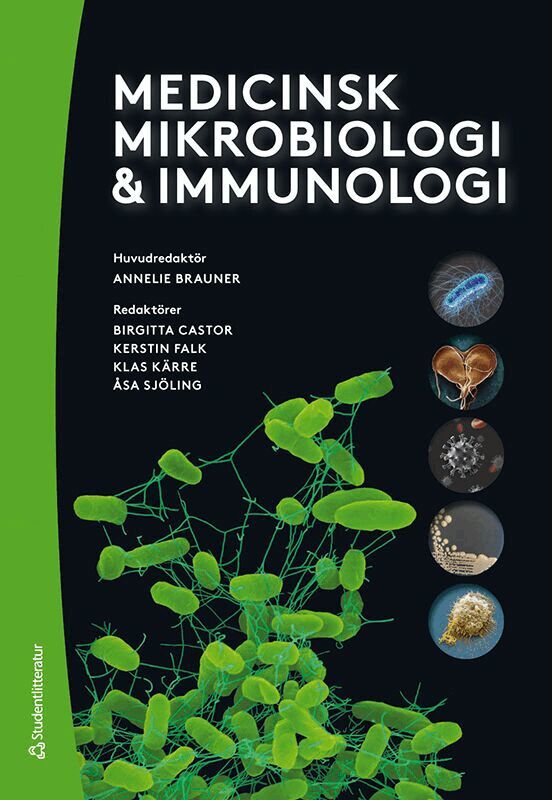
Infektionssjukdomar är det globalt största hälsoproblemet och kunskap om mikrobiologi, immunologi och vårdhygien är allt viktigare för att behandla patienterna optimalt. I denna andra upplaga av läroboken har samtliga kapitel uppdaterats, och dessutom har boken utökats med ett kapitel om klinisk immunologi och transfusionsmedicin.Boken ger förståelse för hur kroppens immunförsvar arbetar för att motverka infektion. Den beskriver även mikroorganismernas struktur och de väsentliga virulensmekanismer de använder för att orsaka infektion. De bakteriearter, virus, svampar och parasiter som är kliniskt relevanta är ingående beskrivna, liksom de metoder som används på laboratoriet för att diagnostisera dem.Bokens kliniska kapitel utgår från organ- och sjukdomsbilder. Här introduceras olika sjukdomstillstånd samt patogenesen vid dessa, provtagning och särskilda observandum vid tolkning av provsvaren, både inom klinisk mikrobiologi och klinisk immunologi.Medicinsk mikrobiologi & immunologi riktar sig i första hand till studenter inom läkar-, biomedicin- och biomedicinska analytikerprogrammen. Även studenter med intresse för mikrobiologi och immunologi kan ha stor nytta av den. Boken är också lämplig för läkare och andra yrkesgrupper verksamma inom mikrobiologi, immunologi och infektionsmedicin.
1 093 kr
Skickas inom 10-15 vardagar
The ability to diagnose cancer by simple measurement of a serum or tissue' 'marker" has been a goal of medical science for many years. There is ample evidence that tumor cells are different from normal cells and pro duce substances that can be detected by currently available immuno chemical or biochemical methods. These "cancer markers" may be se creted proteins, enzymes, hormones, fetal serum components, monoclonal immunoglobulins, cell surface components, or cytoplasmic constituents. The purpose of this book is to present the current status of our knowledge of such cancer markers. The first tumor marker identified by laboratory means was Bence Jones protein. In a series of lectures delivered to the Royal College of Phy sicians in London in 1846, Dr. H. Bence Jones described studies on a urine sample sent to him with the following note: "Dear Dr. Jones-The tube contains urine of very high specific gravity. When boiled it becomes slightly opaque . . . . etc. " Dr. Jones found that heating of the urine after addition of nitric acid resulted in formation of a heavy precipitate; acid ad dition may have been required to bring the urine to pH 4-6 at which Bence Jones proteins are more likely to precipitate when heated. This urinary pre cipitate was associated with a bone disease termed "mollities ossium. " [H. Bence Jones, Papers on Chemical Pathology, Lecture III. Lancet 2, 269-274 (1847)].
1 093 kr
Skickas inom 10-15 vardagar
The ability to diagnose cancer by simple measurement of a serum or tissue' 'marker" has been a goal of medical science for many years. There is ample evidence that tumor cells are different from normal cells and pro duce substances that can be detected by currently available immuno chemical or biochemical methods. These "cancer markers" may be se creted proteins, enzymes, hormones, fetal serum components, monoclonal immunoglobulins, cell surface components, or cytoplasmic constituents. The purpose of this book is to present the current status of our knowledge of such cancer markers. The first tumor marker identified by laboratory means was Bence Jones protein. In a series of lectures delivered to the Royal College of Phy sicians in London in 1846, Dr. H. Bence Jones described studies on a urine sample sent to him with the following note: "Dear Dr. Jones-The tube contains urine of very high specific gravity. When boiled it becomes slightly opaque . . . . etc. " Dr. Jones found that heating of the urine after addition of nitric acid resulted in formation of a heavy precipitate; acid ad dition may have been required to bring the urine to pH 4-6 at which Bence Jones proteins are more likely to precipitate when heated. This urinary pre cipitate was associated with a bone disease termed "mollities ossium. " [H. Bence Jones, Papers on Chemical Pathology, Lecture III. Lancet 2, 269-274 (1847)].