Bruce Bimber - Böcker
Visar alla böcker från författaren Bruce Bimber. Handla med fri frakt och snabb leverans.
5 produkter
5 produkter
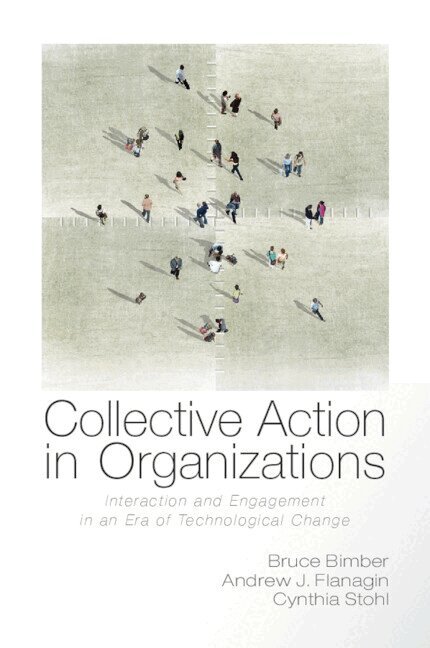
Collective Action in Organizations
Interaction and Engagement in an Era of Technological Change
Häftad, Engelska, 2012
322 kr
Skickas inom 7-10 vardagar
Challenging the notion that digital media render traditional, formal organizations irrelevant, this book offers a new theory of collective action and organizing. Based on extensive surveys and interviews with members of three influential and distinctive organizations in the United States - The American Legion, AARP and MoveOn - the authors reconceptualize collective action as a phenomenon in which technology enhances people's ability to cross boundaries in order to interact with one another and engage with organizations. By developing a theory of Collective Action Space, Bimber, Flanagin and Stohl explore how people's attitudes, behaviors, motivations, goals and digital media use are related to their organizational involvement. They find that using technology does not necessarily make people more likely to act collectively, but contributes to a diversity of 'participatory styles', which hinge on people's interaction with one another and the extent to which they shape organizational agendas. In the digital media age, organizations do not simply recruit people into roles, they provide contexts in which people are able to construct their own collective experiences.
Collective Action in Organizations
Interaction and Engagement in an Era of Technological Change
Inbunden, Engelska, 2012
995 kr
Skickas inom 7-10 vardagar
Challenging the notion that digital media render traditional, formal organizations irrelevant, this book offers a new theory of collective action and organizing. Based on extensive surveys and interviews with members of three influential and distinctive organizations in the United States - The American Legion, AARP and MoveOn - the authors reconceptualize collective action as a phenomenon in which technology enhances people's ability to cross boundaries in order to interact with one another and engage with organizations. By developing a theory of Collective Action Space, Bimber, Flanagin and Stohl explore how people's attitudes, behaviors, motivations, goals and digital media use are related to their organizational involvement. They find that using technology does not necessarily make people more likely to act collectively, but contributes to a diversity of 'participatory styles', which hinge on people's interaction with one another and the extent to which they shape organizational agendas. In the digital media age, organizations do not simply recruit people into roles, they provide contexts in which people are able to construct their own collective experiences.
Information and American Democracy
Technology in the Evolution of Political Power
Inbunden, Engelska, 2003
1 034 kr
Skickas inom 7-10 vardagar
This book assesses the consequences of new information technologies for American democracy in a way that is theoretical and also historically grounded. The author argues that new technologies have produced the fourth in a series of 'information revolutions' in the US, stretching back to the founding. Each of these, he argues, led to important structural changes in politics. After re-interpreting historical American political development from the perspective of evolving characteristics of information and political communications, the author evaluates effects of the Internet and related new media. The analysis shows that the use of new technologies is contributing to 'post-bureaucratic' political organization and fundamental changes in the structure of political interests. The author's conclusions tie together scholarship on parties, interest groups, bureaucracy, collective action, and political behavior with new theory and evidence about politics in the information age.
Information and American Democracy
Technology in the Evolution of Political Power
Häftad, Engelska, 2003
309 kr
Skickas inom 7-10 vardagar
This book assesses the consequences of new information technologies for American democracy in a way that is theoretical and also historically grounded. The author argues that new technologies have produced the fourth in a series of 'information revolutions' in the US, stretching back to the founding. Each of these, he argues, led to important structural changes in politics. After re-interpreting historical American political development from the perspective of evolving characteristics of information and political communications, the author evaluates effects of the Internet and related new media. The analysis shows that the use of new technologies is contributing to 'post-bureaucratic' political organization and fundamental changes in the structure of political interests. The author's conclusions tie together scholarship on parties, interest groups, bureaucracy, collective action, and political behavior with new theory and evidence about politics in the information age.
Politics of Expertise in Congress
The Rise and Fall of the Office of Technology Assessment
Häftad, Engelska, 1996
524 kr
Skickas inom 3-6 vardagar
Examines the relationship between technical experts and elected officials, challenging the prevailing view about how experts become politicized by the policy process.CHOICE 1997 Outstanding Academic BooksNowhere in the U.S. government is the marriage between expertise and politics more normatively troublesome and empirically obscure than in Congress. The legislature is asked to be both expert and representative, to act on the best available information and judgment about policy problems while being responsive to, and reflective of, constituents' demands. This book examines the relationship betweentechnical experts and elected officials, challenging the prevailing view about how experts become politicized by the policy process.Bimber presents a theory about the connections between institutional structure and the strategies of experts who participate in politics. He tests this theory by tracing the interaction between Congress and the Office of Technology Assessment (OTA), a recently abolished legislative branch agency created in 1972 to estimate the consequences of new technologies and free Congress from complete dependence on the executive branch for information and policy analysis. In addition, he provides comparative portraits of Congress's remaining support agencies—the Congressional Budget Office, the Congressional Research Office, and the General Accounting Office—and argues that the legislative context for the politics of expertise reveals patterns that have been overlooked in studies of expert knowledge and executive-branch policymaking.