Bruce H. Kirmmse - Böcker
Visar alla böcker från författaren Bruce H. Kirmmse. Handla med fri frakt och snabb leverans.
12 produkter
12 produkter
464 kr
Skickas inom 10-15 vardagar
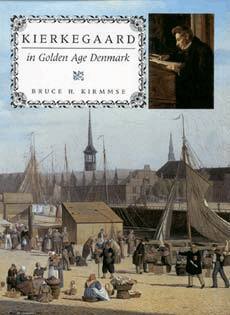
" . . . the most important contribution to Kierkegaard studies to be published in English in recent years. . . . Not only is it a fascinating, surprising, and perceptive study of Kierkegaard within his time and world, Kirmmse has produced a research resource, a reference work, that is simply without parallel or equal." —Michael Plekon"It is a rare work of philosophy that not only clarifies its subject but also places it within an intellectual and historical context. In his study of 19th-century Danish philosopher Kierkegaard, Kirmmse accomplishes both, setting a standard . . . " —Library Journal" . . . an outstanding contribution to Kierkegaard research . . . The book is intellectual history of the highest calibre." —So[slash]ren Kierkegaard Newsletter"This excellent book is recommended for all collections on Kierkegaard . . . For all readers." —Choice"This richly researched and readable book supplies an important contribution to the widespread reappropriation of Kierkegaard's thought currently taking place." —Theology Today"This book is a tour de force in intellectual history." —Review of Metaphysics"Kirmmse's book is a major work of scholarship that confers on Kierkegaard's social and intellectual universe a depth and a richness of detail that will permanently alter the familiar stereotypes about Kierkegaard's isolation from his fellow Danes and his supposedly fanatical campaign against philistine Denmark and its corrupt state church." —American Historical ReviewAgainst the background of Denmark's evolution from a mercantile economy to a broad-based agricultural economy, Kirmmse reinterprets Kierkegaard's thought as a reaction to the tensions within his society.
542 kr
Skickas inom 7-10 vardagar
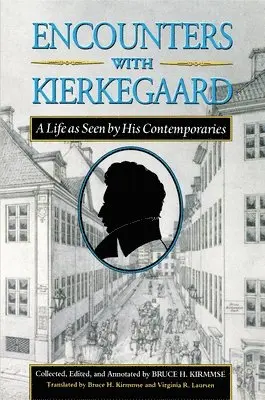
Encounters with Kierkegaard is a collection of every known eyewitness account of the great Danish thinker. Through many sharp observations of family members, friends and acquaintances, supporters and opponents, the life story of this elusive and remarkable figure comes into focus, offering a rare portrait of Kierkegaard the man. Often viewed by his contemporaries as a person who deliberately cultivated an air of mystery and eccentricity, Soren Kierkegaard (1813-1855) has been, then and now, a subject of great speculation. His startling attack on the established church, his broken engagement with a young woman from a respected family, and his searing criticisms of literary figures--from the editors of The Corsair to Hans Christian Andersen--are among the acts that brought him much notoriety during his short lifetime. Yet arriving at a sense of the philosopher's personality and motives behind his behavior has been a difficult task. He left no memoirs of autobiography, but in the enormous cannon of his published writings, the author and the person Soren Kierkegaard is problematically present in a welter of disguises.An indispensable path to understanding what he was like as a person, maintains Bruce Kirmmse, is through the observations of his contemporaries. These accounts, ranging from the writings of Meir Aron Goldschmidt, editor of The Corsair, to the recollections of Kierkegaard's fiancee, are organized around the major episodes of the philosopher's life. They enable us to glimpse, among many things, his spiritual and intellectual development, to get a sense of what it was like to be the object of his friendship or his wrath, and to examine various persons' opinions about his relationship with his young fiancee. The memories of this woman, Regine Olsen, who later married Fritz Schlegel, are among the most moving passages: they reveal her profound suffering, her personal understanding of Kierkegaard, and the satisfaction she ultimately felt, knowing that "he took her with him into history." This collection of first-hand accounts invites the reader to compare and interpret a wealth of fascinating stories, and in the end forms an intriguing "do-it-yourself" biography for both the scholar and general reader.
1 591 kr
Skickas inom 7-10 vardagar
I would like to write a novel in which the main character would be a man who got a pair of glasses, one lens of which reduced images as powerfully as an oxyhydrogen microscope, and the other of which magnified on the same scale, so that he perceived everything relatively. A flight of fancy by an aspiring science fiction writer? While it may sound as such, this wistful musing is one of the little-discussed personal reflections of nineteenth-century philosopher Soren Kierkegaard, whose remarkable journals and notebooks, unpublished during his lifetime, are presented here. The first of an eleven-volume series produced by Copenhagen's Soren Kierkegaard Research Centre, this volume is the first English translation and commentary of Kierkegaard's journals based on up-to-date scholarship. It offers new insight into Kierkegaard's inner life. In addition to early drafts of his published works, the journals contain his thoughts on current events and philosophical and theological matters, notes on books he was reading, miscellaneous jottings, and ideas for future literary projects.Kierkegaard wrote his journals in a two-column format, one for his initial entries and the second for the marginal comments he added later. The new edition of the journals reproduces this format and contains photographs of original manuscript pages, as well as extensive scholarly commentary. Translated by leading experts on Kierkegaard, Journals and Notebooks will become the benchmark for all future Kierkegaard scholarship.
1 591 kr
Skickas inom 7-10 vardagar
Soren Kierkegaard (1813-55) published an extraordinary number of works during his lifetime, but he left behind nearly as much unpublished writing, most of which consists of what are called his "journals and notebooks." Volume 2 of this 11-volume edition of Kierkegaard's Journals and Notebooks includes materials from 1836 to 1846, a period that takes Kierkegaard from his student days to the peak of his activity as an author. In addition to containing hundreds of Kierkegaard's reflections on philosophy, theology, literature, and his own personal life, these journals are the seedbed of many ideas and passages that later surfaced in Either/Or, Repetition, Fear and Trembling, Philosophical Fragments, The Concept of Anxiety, Stages on Life's Way, Concluding Unscientific Postscript, and a number of Edifying Discourses.
1 591 kr
Skickas inom 7-10 vardagar
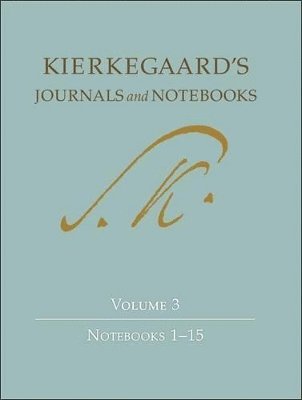
Soren Kierkegaard (1813-55) published an extraordinary number of works during his lifetime, but he left behind nearly as much unpublished writing, most of which consists of what are called his "journals and notebooks." Volume 3 of this 11-volume edition of Kierkegaard's Journals and Notebooks includes Kierkegaard's extensive notes on lectures by the Danish theologian H. N. Clausen and by the German philosopher Schelling, as well as a great many other entries on philosophical, theological, and literary topics. In addition, the volume includes many personal reflections by Kierkegaard, notably those in which he provides an account of his love affair with Regine Olsen, his onetime fiancee.
1 591 kr
Skickas inom 7-10 vardagar
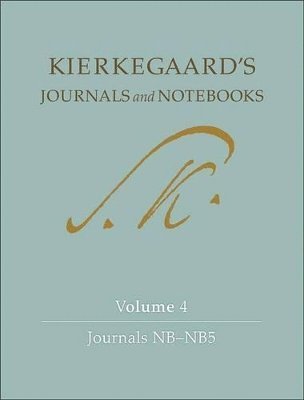
For over a century, the Danish thinker Soren Kierkegaard (1813-55) has been at the center of a number of important discussions, concerning not only philosophy and theology, but also, more recently, fields such as social thought, psychology, and contemporary aesthetics, especially literary theory. Despite his relatively short life, Kierkegaard was an extraordinarily prolific writer, as attested to by the 26-volume Princeton University Press edition of all of his published writings. But Kierkegaard left behind nearly as much unpublished writing, most of which consists of what are called his "journals and notebooks." Kierkegaard has long been recognized as one of history's great journal keepers, but only rather small portions of his journals and notebooks are what we usually understand by the term "diaries." By far the greater part of Kierkegaard's journals and notebooks consists of reflections on a myriad of subjects--philosophical, religious, political, personal. Studying his journals and notebooks takes us into his workshop, where we can see his entire universe of thought.We can witness the genesis of his published works, to be sure--but we can also see whole galaxies of concepts, new insights, and fragments, large and small, of partially (or almost entirely) completed but unpublished works. Kierkegaard's Journals and Notebooks enables us to see the thinker in dialogue with his times and with himself. Volume 4 of this 11-volume series includes the first five of Kierkegaard's well-known "NB" journals, which contain, in addition to a great many reflections on his own life, a wealth of thoughts on theological matters, as well as on Kierkegaard's times, including political developments and the daily press. Kierkegaard wrote his journals in a two-column format, one for his initial entries and the second for the extensive marginal comments that he added later. This edition of the journals reproduces this format, includes several photographs of original manuscript pages, and contains extensive scholarly commentary on the various entries and on the history of the manuscripts being reproduced.
1 591 kr
Skickas inom 7-10 vardagar
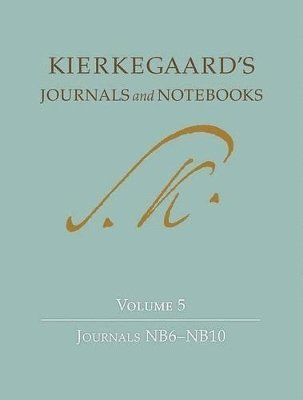
For over a century, the Danish thinker Soren Kierkegaard (1813-55) has been at the center of a number of important discussions, concerning not only philosophy and theology, but also, more recently, fields such as social thought, psychology, and contemporary aesthetics, especially literary theory. Despite his relatively short life, Kierkegaard was an extraordinarily prolific writer, as attested to by the 26-volume Princeton University Press edition of all of his published writings. But Kierkegaard left behind nearly as much unpublished writing, most of which consists of what are called his "journals and notebooks." Kierkegaard has long been recognized as one of history's great journal keepers, but only rather small portions of his journals and notebooks are what we usually understand by the term "diaries." By far the greater part of Kierkegaard's journals and notebooks consists of reflections on a myriad of subjects--philosophical, religious, political, personal. Studying his journals and notebooks takes us into his workshop, where we can see his entire universe of thought.We can witness the genesis of his published works, to be sure--but we can also see whole galaxies of concepts, new insights, and fragments, large and small, of partially (or almost entirely) completed but unpublished works. Kierkegaard's Journals and Notebooks enables us to see the thinker in dialogue with his times and with himself. Volume 5 of this 11-volume series includes five of Kierkegaard's important "NB" journals (Journals NB6 through NB10), covering the months from summer 1848 through early May 1849. This was a turbulent period both in the history of Denmark--which was experiencing the immediate aftermath of revolution and the fall of absolutism, a continuing war with the German states, and the replacement of the State Church with the Danish People's Church--and for Kierkegaard personally. The journals in the present volume include Kierkegaard's reactions to the political upheaval, a retrospective account of his audiences with King Christian VIII, deliberations about publishing an autobiographical explanation of his writings, and an increasingly harsh critique of the Danish Church.These journals also reflect Kierkegaard's deep concern over his collision with the satirical journal Corsair, an experience that helped radicalize his view of "essential Christianity" and caused him to ponder the meaning of martyrdom. Kierkegaard wrote his journals in a two-column format, one for his initial entries and the second for the extensive marginal comments that he added later. This edition of the journals reproduces this format, includes several photographs of original manuscript pages, and contains extensive scholarly commentary on the various entries and on the history of the manuscripts being reproduced.
1 591 kr
Skickas inom 7-10 vardagar
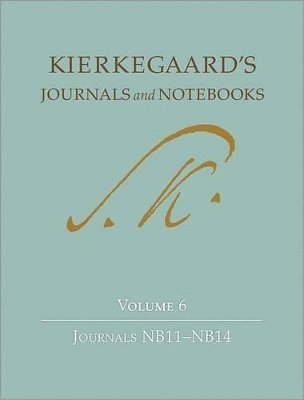
For over a century, the Danish thinker Soren Kierkegaard (1813-55) has been at the center of a number of important discussions, concerning not only philosophy and theology, but also, more recently, fields such as social thought, psychology, and contemporary aesthetics, especially literary theory. Despite his relatively short life, Kierkegaard was an extraordinarily prolific writer, as attested to by the 26-volume Princeton University Press edition of all of his published writings. But Kierkegaard left behind nearly as much unpublished writing, most of which consists of what are called his "journals and notebooks." Kierkegaard has long been recognized as one of history's great journal keepers, but only rather small portions of his journals and notebooks are what we usually understand by the term "diaries." By far the greater part of Kierkegaard's journals and notebooks consists of reflections on a myriad of subjects--philosophical, religious, political, personal. Studying his journals and notebooks takes us into his workshop, where we can see his entire universe of thought.We can witness the genesis of his published works, to be sure--but we can also see whole galaxies of concepts, new insights, and fragments, large and small, of partially (or almost entirely) completed but unpublished works. Kierkegaard's Journals and Notebooks enables us to see the thinker in dialogue with his times and with himself. Volume 6 of this 11-volume series includes four of Kierkegaard's important "NB" journals (Journals NB11 through NB14), covering the months from early May 1849 to the beginning of 1850. At this time Denmark was coming to terms with the 1848 revolution that had replaced absolutism with popular sovereignty, while the war with the German states continued, and the country pondered exactly what replacing the old State Church with the Danish People's Church would mean. In these journals Kierkegaard reflects at length on political and, especially, on ecclesiastical developments. His brooding over the ongoing effects of his fight with the satirical journal Corsair continues, and he also examines and re-examines the broader personal and religious significance of his broken engagement with Regine Olsen.These journals also contain reflections by Kierkegaard on a number of his most important works, including the two works written under his "new" pseudonym Anti-Climacus (The Sickness unto Death and Practice in Christianity) and his various attempts at autobiographical explanations of his work. And, all the while, the drumbeat of his radical critique of "Christendom" continues and escalates. Kierkegaard wrote his journals in a two-column format, one for his initial entries and the second for the extensive marginal comments that he added later. This edition of the journals reproduces this format, includes several photographs of original manuscript pages, and contains extensive scholarly commentary on the various entries and on the history of the manuscripts being reproduced.
1 591 kr
Skickas inom 7-10 vardagar
For over a century, the Danish thinker Soren Kierkegaard (1813-55) has been at the center of a number of important discussions, concerning not only philosophy and theology, but also, more recently, fields such as social thought, psychology, and contemporary aesthetics, especially literary theory. Despite his relatively short life, Kierkegaard was an extraordinarily prolific writer, as attested to by the 26-volume Princeton University Press edition of all of his published writings. But Kierkegaard left behind nearly as much unpublished writing, most of which consists of what are called his "journals and notebooks." Kierkegaard has long been recognized as one of history's great journal keepers, but only rather small portions of his journals and notebooks are what we usually understand by the term "diaries." By far the greater part of Kierkegaard's journals and notebooks consists of reflections on a myriad of subjects--philosophical, religious, political, personal. Studying his journals and notebooks takes us into his workshop, where we can see his entire universe of thought.We can witness the genesis of his published works, to be sure--but we can also see whole galaxies of concepts, new insights, and fragments, large and small, of partially (or almost entirely) completed but unpublished works. Kierkegaard's Journals and Notebooks enables us to see the thinker in dialogue with his times and with himself. Volume 7 of this 11-volume series includes six of Kierkegaard's important "NB" journals (Journals NB15 through NB20), covering the months from early January 1850 to mid-September of that year. By this time it had become clear that popular sovereignty, ushered in by the revolution of 1848 and ratified by the Danish constitution of 1849, had come to stay, and Kierkegaard now intensified his criticism of the notion that everything, even matters involving the human soul, could be decided by "balloting." He also continued to direct his barbs at the established Danish Church and its clergy (particularly Bishop J. P. Mynster and Professor H. L. Martensen), at the press, and at the attempt by modern philosophy to comprehend the incomprehensibility of faith.Kierkegaard's reading notes include entries on Augustine, the Stoics, German mystics, Luther, pietist authors, and Rousseau, while his autobiographical reflections circle around the question of which, if any, of several essays explaining his life and works he ought to publish. Perhaps unsurprisingly, Kierkegaard's more personal reflections return once again to his public feud with M. A. Goldschmidt and his broken engagement to Regine Olsen. Kierkegaard wrote his journals in a two-column format, one for his initial entries and the second for the extensive marginal comments that he added later. This edition of the journals reproduces this format, includes several photographs of original manuscript pages, and contains extensive scholarly commentary on the various entries and on the history of the manuscripts being reproduced.
Del 1 - Kierkegaard's Journals and Notebooks
Kierkegaard's Journals and Notebooks, Volume 9
Journals NB26–NB30
Inbunden, Engelska, 2017
1 563 kr
Skickas inom 7-10 vardagar
For over a century, the Danish thinker Soren Kierkegaard (1813-55) has been at the center of a number of important discussions, concerning not only philosophy and theology, but also, more recently, fields such as social thought, psychology, and contemporary aesthetics, especially literary theory. Despite his relatively short life, Kierkegaard was an extraordinarily prolific writer, as attested to by the 26-volume Princeton University Press edition of all of his published writings. But Kierkegaard left behind nearly as much unpublished writing, most of which consists of what are called his "journals and notebooks." Kierkegaard has long been recognized as one of history's great journal keepers, but only rather small portions of his journals and notebooks are what we usually understand by the term "diaries." By far the greater part of Kierkegaard's journals and notebooks consists of reflections on a myriad of subjects--philosophical, religious, political, personal. Studying his journals and notebooks takes us into his workshop, where we can see his entire universe of thought.We can witness the genesis of his published works, to be sure--but we can also see whole galaxies of concepts, new insights, and fragments, large and small, of partially (or almost entirely) completed but unpublished works. Kierkegaard's Journals and Notebooks enables us to see the thinker in dialogue with his times and with himself. Kierkegaard wrote his journals in a two-column format, one for his initial entries and the second for the extensive marginal comments that he added later. This edition of the journals reproduces this format, includes several photographs of original manuscript pages, and contains extensive scholarly commentary on the various entries and on the history of the manuscripts being reproduced. Volume 9 of this 11-volume series includes five of Kierkegaard's important "NB" journals (Journals NB26 through NB30), which span from June 1852 to August 1854.This period was marked by Kierkegaard's increasing preoccupation with what he saw as an unbridgeable gulf in Christianity--between the absolute ideal of the religion of the New Testament and the official, state-sanctioned culture of "Christendom," which, embodied by the Danish People's Church, Kierkegaard rejected with increasing vehemence. Crucially, Kierkegaard's nemesis, Bishop Jakob Peter Mynster, died during this period and, in the months following, Kierkegaard can be seen moving inexorably toward the famous "attack on Christendom" with which he ended his life.
Kierkegaard's Journals and Notebooks, Volume 11, Part 1
Loose Papers, 1830-1843
Inbunden, Engelska, 2019
1 563 kr
Skickas inom 7-10 vardagar
For over a century, the Danish thinker Søren Kierkegaard (1813–55) has been at the center of a number of important discussions, concerning not only philosophy and theology but also, more recently, fields such as social thought, psychology, and contemporary aesthetics, especially literary theory.Despite his relatively short life, Kierkegaard was an extraordinarily prolific writer, as attested to by the 26-volume Princeton University Press edition of all of his published writings. But Kierkegaard left behind nearly as much unpublished writing, most of which consists of what are called his “journals and notebooks.” Kierkegaard has long been recognized as one of history’s great journal keepers, but only rather small portions of his journals and notebooks are what we usually understand by the term “diaries.” By far the greater part of Kierkegaard’s journals and notebooks consists of reflections on a myriad of subjects—philosophical, religious, political, personal. Studying his journals and notebooks takes us into his workshop, where we can see his entire universe of thought. We can witness the genesis of his published works, to be sure—but we can also see whole galaxies of concepts, new insights, and fragments, large and small, of partially (or almost entirely) completed but unpublished works. Kierkegaard’s Journals and Notebooks enables us to see the thinker in dialogue with his times and with himself.Kierkegaard wrote his journals in a two-column format, one for his initial entries and the second for the extensive marginal comments that he added later. This edition of the journals reproduces this format, includes several photographs of original manuscript pages, and contains extensive scholarly commentary on the various entries and on the history of the manuscripts being reproduced.Volume 11, Part 1, and Volume 11, Part 2, present an exciting, enlightening, and enormously varied treasure trove of papers that were found, carefully sorted and stored by Kierkegaard himself, in his apartment after his death. These papers—many of which have never before been published in English—provide a window into many different aspects of Kierkegaard’s life and creativity. Volume 11, Part 1, includes items from his earliest, formative years, through his extensive studies at the university, and up to the publication of Either/Or. These materials include Kierkegaard’s studies in biblical exegesis; his reading of theologians such as Schleiermacher and Baader; his concern with aesthetic matters, including a lengthy consideration of the Faust legend; his first, trial sermon, delivered at the Pastoral Seminary; his views on the burgeoning field of political journalism in the 1830s; and a group of papers he titled “The First Rudiments of Either/Or. The Green Book. Some Particulars that were not Used.”
Kierkegaard's Journals and Notebooks, Volume 11, Part 2
Loose Papers, 1843-1855
Inbunden, Engelska, 2020
1 563 kr
Skickas inom 7-10 vardagar
For over a century, the Danish thinker Søren Kierkegaard (1813–55) has been at the center of a number of important discussions, concerning not only philosophy and theology, but also, more recently, fields such as social thought, psychology, and contemporary aesthetics, especially literary theory.Despite his relatively short life, Kierkegaard was an extraordinarily prolific writer, as attested to by the 26-volume Princeton University Press edition of all of his published writings. But Kierkegaard left behind nearly as much unpublished writing, most of which consists of what are called his "journals and notebooks." Kierkegaard has long been recognized as one of history's great journal keepers, but only rather small portions of his journals and notebooks are what we usually understand by the term "diaries." By far the greater part of Kierkegaard's journals and notebooks consists of reflections on a myriad of subjects—philosophical, religious, political, personal. Studying his journals and notebooks takes us into his workshop, where we can see his entire universe of thought. We can witness the genesis of his published works, to be sure—but we can also see whole galaxies of concepts, new insights, and fragments, large and small, of partially (or almost entirely) completed but unpublished works. Kierkegaard's Journals and Notebooks enables us to see the thinker in dialogue with his times and with himself.Kierkegaard wrote his journals in a two-column format, one for his initial entries and the second for the extensive marginal comments that he added later. This edition of the journals reproduces this format, includes several photographs of original manuscript pages, and contains extensive scholarly commentary on the various entries and on the history of the manuscripts being reproduced.Volume 11, Parts 1 and 2, present an exciting, enlightening, and enormously varied treasure trove of papers that were found, carefully sorted and stored by Kierkegaard himself, in his apartment after his death. These papers—many of which have never before been published in English—provide a window into many different aspects of Kierkegaard's life and creativity. Volume 11, Part 2, includes writings from the period between 1843, the year in which he published his breakthrough Either/Or, and late September 1855, a few weeks before his death, when he recorded his final reflections on "Christendom." Among the highlights are Kierkegaard's famous description of the "Great Earthquake" that shaped his life; his early reflections on becoming an author; his important, though never-delivered, lectures on "The Dialectic of Ethical and Ethical-Religious Communication"; and his final, incandescent assault on the tendency—new in his time—to harness Christianity in support of a specific social and political order.