Bruce H. Mann - Böcker
Visar alla böcker från författaren Bruce H. Mann. Handla med fri frakt och snabb leverans.
3 produkter
3 produkter
296 kr
Skickas inom 10-15 vardagar
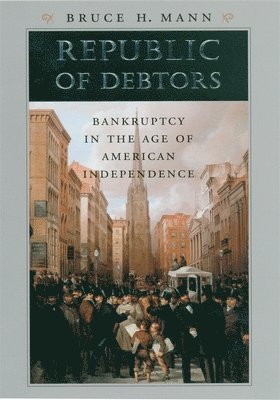
Debt was an inescapable fact of life in early America. At the beginning of the eighteenth century, its sinfulness was preached by ministers and the right to imprison debtors was unquestioned. By 1800, imprisonment for debt was under attack and insolvency was no longer seen as a moral failure, merely an economic setback. In Republic of Debtors, Bruce H. Mann illuminates this crucial transformation in early American society.From the wealthy merchant to the backwoods farmer, Mann tells the personal stories of men and women struggling to repay their debts and stay ahead of their creditors. He opens a window onto a society undergoing such fundamental changes as the growth of a commercial economy, the emergence of a consumer marketplace, and a revolution for independence. In addressing debt Americans debated complicated questions of commerce and agriculture, nationalism and federalism, dependence and independence, slavery and freedom. And when numerous prominent men—including the richest man in America and a justice of the Supreme Court—found themselves imprisoned for debt or forced to become fugitives from creditors, their fate altered the political dimensions of debtor relief, leading to the highly controversial Bankruptcy Act of 1800.Whether a society forgives its debtors is not just a question of law or economics; it goes to the heart of what a society values. In chronicling attitudes toward debt and bankruptcy in early America, Mann explores the very character of American society.
462 kr
Skickas inom 10-15 vardagar
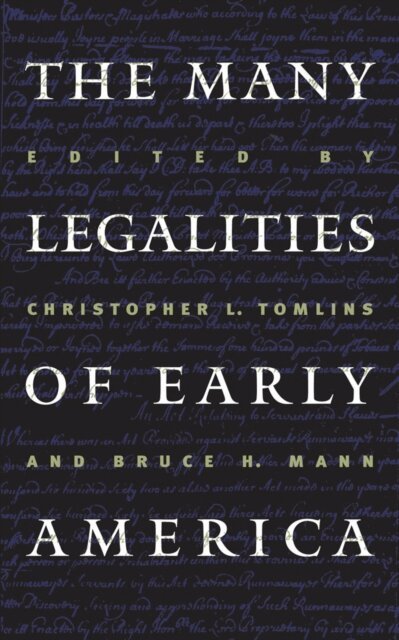
This collection of seventeen original essays reshapes the field of early American legal history not by focusing simply on law, or even on the relationship between law and society, but by using the concept of ""legality"" to explore the myriad ways in which the people of early America ordered their relationships with one another, whether as individuals, groups, classes, communities, or states. Addressing issues of gender, ethnicity, family, patriarchy, culture, and dependence, contributors explore the transatlantic context of early American law, the negotiation between European and indigenous legal cultures, the multiple social contexts of the rule of law, and the transformation of many legalities into an increasingly uniform legal culture. Taken together, these essays reveal the extraordinary diversity and complexity of the roots of early America's legal culture. Contributors are Mary Sarah Bilder, Holly Brewer, James F. Brooks, Richard Lyman Bushman, Christine Daniels, Cornelia Hughes Dayton, David Barry Gaspar, Katherine Hermes, John G. Kolp, David Thomas Konig, James Muldoon, William M. Offutt Jr., Ann Marie Plane, A. G. Roeber, Terri L. Snyder, and Linda L. Sturtz. |Seventeen essays use the concept of ""legality"" to explore ways in which early Americans ordered their relationships as individuals, groups, classes, communities, and states. Addressing issues of gender, ethnicity, family, patriarchy, culture, and dependence, contributors explore the transatlantic context of early American law, the negotiation between European and indigenous cultures, and the transformation of many legalities to a uniform legal culture.
530 kr
Skickas inom 10-15 vardagar
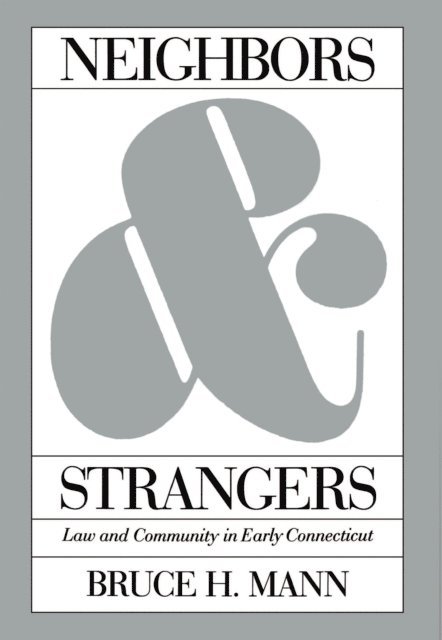
Combining legal and social history, Bruce Mann explores the relationship between law and society from the mid-seventeenth century to the eve of the Revolution. Analyzing a sample of more than five thousand civil cases from the records of local courts in Connecticut, he shows how once-neighborly modes of disputing yielded to a legal system that treated neighbors and strangers alike. During the colonial period population growth, immigration, economic development, war, and religious revival transformed the nature and context of official and economic relations in Connecticut. Towns lost the insularity and homogeneity that made them the embodiment of community. Debt litigation was transformed from a communal model of disputing in which procedures were based on the individual disagreements to a system of mechanical rules that homogenized law. Pleading grew more technical, and the civil jury faded from predominance to comparative insignificance. Arbitration and church disciplinary proceedings, the usual alternatives to legal process, became more formal and legalistic and, ultimately, less communal. Using a computer-assisted analysis of court records and insights drawn from anthropology and sociology, Mann concludes that changes in the law and its applications were tied to the growing commercialization of the economy. They also can be attributed to the fledgling legal profession's approach to law as an autonomous system rather than as a communal process. These changes marked the advent of a legal system that valued predictability and uniformity of legal relations more than responsiveness to individual communities. Mann shows that by the eve of the Revolution colonial law had become less identified with community and more closely associated with society.