Bruce J. Dickson - Böcker
Visar alla böcker från författaren Bruce J. Dickson. Handla med fri frakt och snabb leverans.
10 produkter
10 produkter
292 kr
Skickas
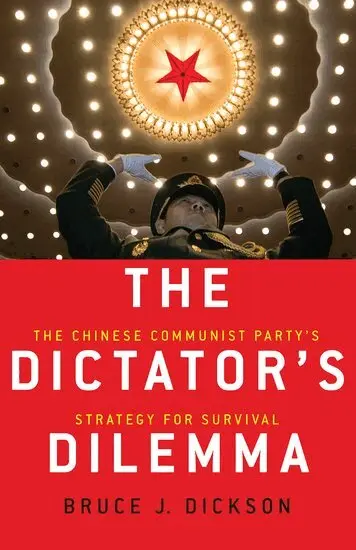
Many observers predicted the collapse of the Chinese Communist Party following the Tiananmen Square crackdown in 1989, and again following the serial collapse of communist regimes behind the Iron Curtain. Their prediction, however, never proved true. Despite minor setbacks, China has experienced explosive economic growth and relative political stability ever since 1989. In The Dictator's Dilemma, eminent China scholar Bruce Dickson provides a comprehensive explanation for regime's continued survival and prosperity. Dickson contends that the popular media narrative of the party's impending implosion ignores some basic facts. The regime's policies may generate resentment and protest, but the CCP still enjoys a surprisingly high level of popular support. Nor is the party is not cut off from the people it governs. It consults with a wide range of specialists, stakeholders, and members of the general public in a selective yet extensive manner. Further, it tolerates and even encourages a growing and diverse civil society, even while restricting access to it. Today, the majority of Chinese people see the regime as increasingly democratic even though it does not allow political competition and its leaders are not accountable to the electorate. In short, while the Chinese people may prefer change, they prefer that it occurs within the existing political framework. In reaching this conclusion, Dickson draws upon original public opinion surveys, interviews, and published materials to explain why there is so much popular support for the regime. This basic stability is a familiar story to China specialists, but not to those whose knowledge of contemporary China is limited to the popular media. The Dictator's Dilemma, an engaging synthesis of how the CCP rules and its future prospects, will enlighten both audiences, and will be essential for anyone interested in understanding China's increasing importance in world politics.
2 103 kr
Skickas inom 10-15 vardagar
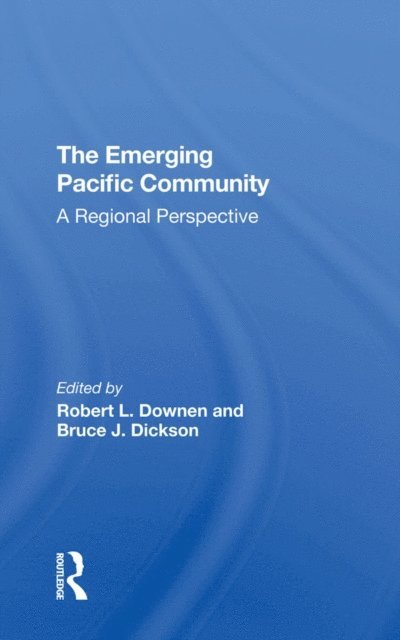
As the nations of the Pacific Ocean region experience rapid economic growth, they have begun to recognize the vast potential benefits of regional interdependence. Recent threats of economic nationalism, according to many specialists, have only strengthened the need for organized regional cooperation.
621 kr
Skickas inom 10-15 vardagar
As the nations of the Pacific Ocean region experience rapid economic growth, they have begun to recognize the vast potential benefits of regional interdependence. Recent threats of economic nationalism, according to many specialists, have only strengthened the need for organized regional cooperation. The relative success of the Association of South
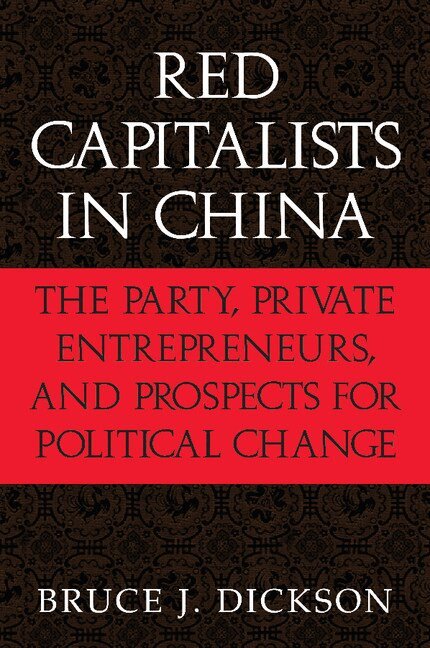
Red Capitalists in China
The Party, Private Entrepreneurs, and Prospects for Political Change
Häftad, Engelska, 2003
428 kr
Skickas inom 7-10 vardagar
It has become a truism that continued economic reform in China will contribute to political change. Policy makers as well as many scholars expect that formation of a private sector will lead, directly or indirectly through the emergence of a civil society, to political change and ultimately democratization. The rapidly growing numbers of private entrepreneurs, the formation of business associations, and the cooperative relationships between entrepreneurs and local officials are seen as initial indicators of a transition from China's still nominally communist political system. This book, first published in 2003, focuses on two related issues: whether the Chinese Communist Party is willing and able to adapt to the economic environment its reforms are bringing about, and whether China's 'red capitalists', private entrepreneurs who also belong to the communist party, are likely to be agents of political change.
347 kr
Skickas inom 7-10 vardagar
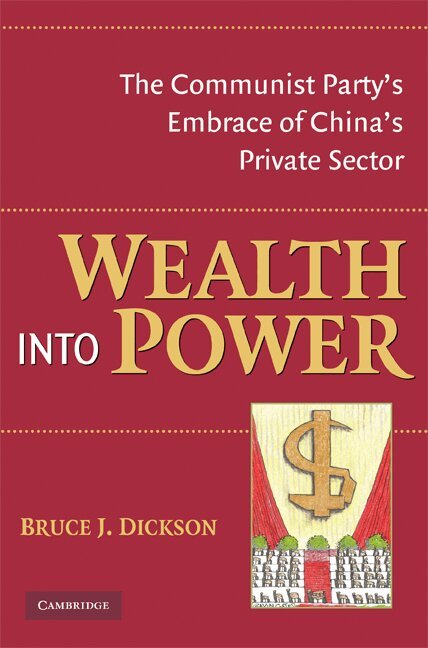
In Wealth into Power, Bruce Dickson challenges the notion that economic development is leading to political change in China, or that China's private entrepreneurs are helping to promote democratization. Instead, they have become partners with the ruling Chinese Communist Party to promote economic growth while maintaining the political status quo. Dickson's research illuminates the Communist Party's strategy for incorporating China's capitalists into the political system and how the shared interests, personal ties, and common views of the party and the private sector are creating a form of 'crony communism'. Rather than being potential agents of change, China's entrepreneurs may prove to be a key source of support for the party's agenda. Based on years of research and original survey data, this book will be of interest to all those interested in China's political future and in the relationship between economic wealth and political power.
Red Capitalists in China
The Party, Private Entrepreneurs, and Prospects for Political Change
Inbunden, Engelska, 2003
1 245 kr
Skickas inom 7-10 vardagar
It has become a truism that continued economic reform in China will contribute to political change. Policy makers as well as many scholars expect that formation of a private sector will lead, directly or indirectly through the emergence of a civil society, to political change and ultimately democratization. The rapidly growing numbers of private entrepreneurs, the formation of business associations, and the cooperative relationships between entrepreneurs and local officials are seen as initial indicators of a transition from China's still nominally communist political system. This book, first published in 2003, focuses on two related issues: whether the Chinese Communist Party is willing and able to adapt to the economic environment its reforms are bringing about, and whether China's 'red capitalists', private entrepreneurs who also belong to the communist party, are likely to be agents of political change.
1 034 kr
Skickas inom 7-10 vardagar
In Wealth into Power, Bruce Dickson challenges the notion that economic development is leading to political change in China, or that China's private entrepreneurs are helping to promote democratization. Instead, they have become partners with the ruling Chinese Communist Party to promote economic growth while maintaining the political status quo. Dickson's research illuminates the Communist Party's strategy for incorporating China's capitalists into the political system and how the shared interests, personal ties, and common views of the party and the private sector are creating a form of 'crony communism'. Rather than being potential agents of change, China's entrepreneurs may prove to be a key source of support for the party's agenda. Based on years of research and original survey data, this book will be of interest to all those interested in China's political future and in the relationship between economic wealth and political power.
397 kr
Skickas inom 10-15 vardagar
Jie Chen and Bruce J. Dickson draw on extensive fieldwork as they explore the extent to which China’s private sector supports democracy, surveying more than 2,000 entrepreneurs in five coastal provinces with over 70 percent of China’s private enterprises.The authors examine who the private entrepreneurs are, how the party-state shapes this group, and what their relationship to the state is. China’s entrepreneurs are closely tied to the state through political and financial relationships, and these ties shape their views toward democracy. While most entrepreneurs favor multi-candidate elections under the current one-party system, they do not support a system characterized by multi-party competition and political liberties, including the right to demonstrate. The key to regime support lies in the capitalists’ political beliefs and their assessment of the government’s policy performance. China’s capitalists tend to be conservative and status-quo oriented, not likely to serve as agents of democratization.This is a valuable contribution not only to the debates over the prospects for democracy in China but also to understanding the process of democratization around the globe.
354 kr
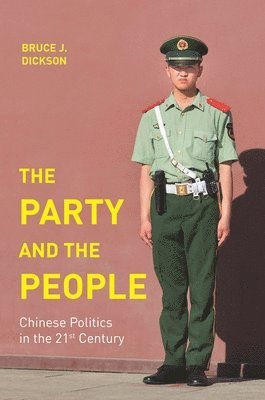
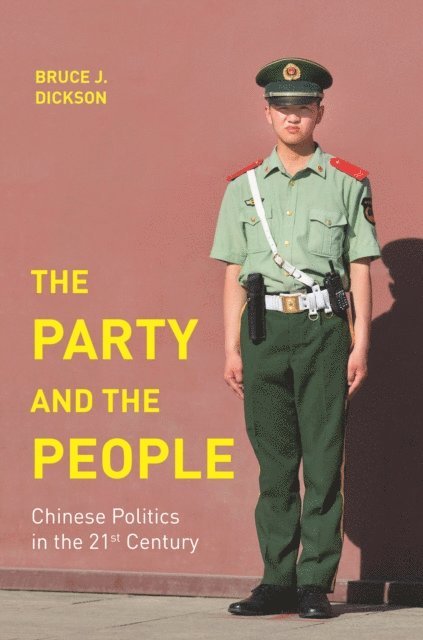
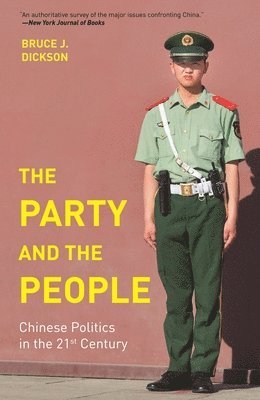
How the Chinese Communist Party maintains its power by both repressing and responding to its peopleSince 1949, the Chinese Communist Party (CCP) has maintained unrivaled control over the country, persisting even in the face of economic calamity, widespread social upheaval, and violence against its own people. Yet the party does not sustain dominance through repressive tactics alone—it pairs this with surprising responsiveness to the public. The Party and the People explores how this paradox has helped the CCP endure for decades, and how this balance has shifted increasingly toward repression under the rule of President Xi Jinping.Delving into the tenuous binary of repression and responsivity, Bruce Dickson illuminates numerous questions surrounding the CCP’s rule: How does it choose leaders and create policies? When does it allow protests? Will China become democratic? Dickson shows that the party’s dual approach lies at the core of its practices—repression when dealing with existential, political threats or challenges to its authority, and responsiveness when confronting localized economic or social unrest. The state answers favorably to the demands of protesters on certain issues, such as local environmental hazards and healthcare, but deals harshly with others, such as protests in Tibet, Xinjiang, or Hong Kong. With the CCP’s greater reliance on suppression since Xi Jinping’s rise to power in 2012, Dickson considers the ways that this tipping of the scales will influence China’s future.Bringing together a vast body of sources, The Party and the People sheds new light on how the relationship between the Chinese state and its citizens shapes governance.
191 kr
Skickas inom 7-10 vardagar
How the Chinese Communist Party maintains its power by both repressing and responding to its peopleSince 1949, the Chinese Communist Party (CCP) has maintained unrivaled control over the country, persisting even in the face of economic calamity, widespread social upheaval, and violence against its own people. Yet the party does not sustain dominance through repressive tactics alone—it pairs this with surprising responsiveness to the public. The Party and the People explores how this paradox has helped the CCP endure for decades, and how this balance has shifted increasingly toward repression under the rule of President Xi Jinping.Delving into the tenuous binary of repression and responsivity, Bruce Dickson illuminates numerous questions surrounding the CCP’s rule: How does it choose leaders and create policies? When does it allow protests? Will China become democratic? Dickson shows that the party’s dual approach lies at the core of its practices—repression when dealing with existential, political threats or challenges to its authority, and responsiveness when confronting localized economic or social unrest. The state answers favorably to the demands of protesters on certain issues, such as local environmental hazards and healthcare, but deals harshly with others, such as protests in Tibet, Xinjiang, or Hong Kong. With the CCP’s greater reliance on suppression since Xi Jinping’s rise to power in 2012, Dickson considers the ways that this tipping of the scales will influence China’s future.Bringing together a vast body of sources, The Party and the People sheds new light on how the relationship between the Chinese state and its citizens shapes governance.