Bruce Lyons - Böcker
Visar alla böcker från författaren Bruce Lyons. Handla med fri frakt och snabb leverans.
6 produkter
6 produkter
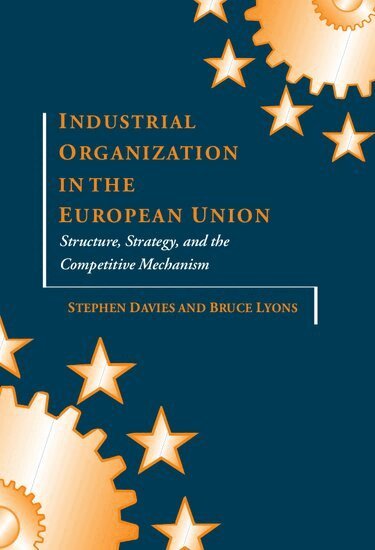
Industrial Organization in the European Union
Structure, Strategy, and the Competitive Mechanism
Inbunden, Engelska, 1996
641 kr
Skickas inom 3-6 vardagar
This book fills an important gap in our knowledge of the organization of EU manufacturing industry. At the empirical level, it draws on a newly constructed micro-level database (the European market share matrix) to present the first ever comprehensive picture of the concentration, integration, multinationality, and diversification of EU industry and firms. However, its purpose is not primarily descriptive. At the theoretical level, it develops a new way of integrating the insights of international trade, industrial organization, international business, and corporate strategy.A central thesis is that by understanding the reasons for the industrial structure we observe, much can be understood about the underlying competitive process that generated this structure in the context of current European integration. In this, R&D, advertising, and government intervention each play important and pervasive roles. The insights from an econometric analysis of the various dimensions of industrial structure are applied to address policy-relevant questions such as: is the industrial organization of the member states integrated at the EU level? Are diversification and multinationality random, or do they follow an industrial logic? Which industries and firms pose the most serious potential problems for competition policy? How do the largest EU firms achieve their size? Do certain member states dominate the ownership or location of production?
4 958 kr
Skickas inom 7-10 vardagar
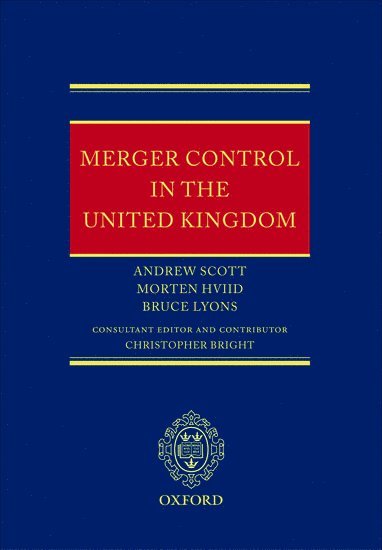
Merger control in the United Kingdom has recently entered a new phase in its development. The advent of the relevant aspects of the Enterprise Act 2002 has been welcomed as a 'depoliticisation' of the regime. The role of the Secretary of State has been all but excised, and the substantive criteria against which mergers are assessed have been revised to offer formally a competition-based standard. Together with guidance published subsequently, the reforms also prescribe a range of new procedural guarantees for those parties affected under the regime. In addition, the EC merger control regime and in particular the nature of its relationship with the competent authorities of the Member States has been significantly revised.It is against this backdrop that the authors - leading experts with first rate regulatory, practical and academic experience - offer a comprehensive statement of the law, architecture, and procedure of merger control in the United Kingdom; explain the factors pertinent to the economic appraisal of mergers in a manner accessible to a legal audience; and give invaluable practical guidance on managing the transactional process and regulatory risk.
617 kr
Skickas inom 7-10 vardagar
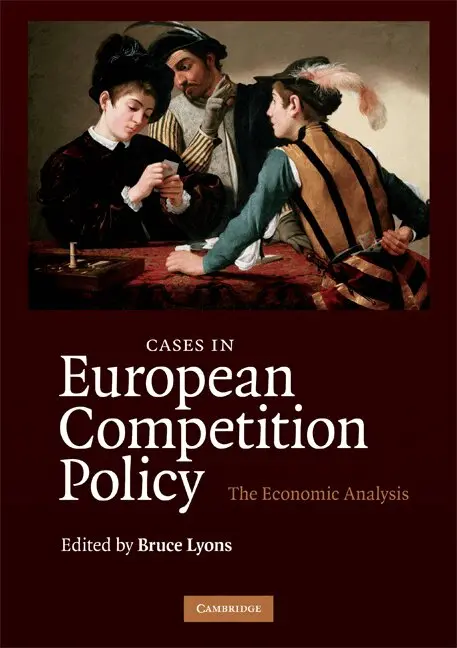
Competition between firms is usually the most effective way of delivering economic efficiency and what consumers want. However, there is a balance to be struck. Firms must not be over-regulated and so hampered in their development of innovative products and new strategies to compete for customers. Nor must they be completely free to satisfy a natural preference for monopoly, which would give them higher profits and a quieter life. The economic role of competition policy (control of anticompetitive agreements, mergers and abusive practices) is to maintain this balance, and an effective policy requires a nuanced understanding of the economics of industrial organization. Cases in European Competition Policy demonstrates how economics is used (and sometimes abused) in competition cases in practical competition policy across Europe. Each chapter summarizes a real case investigated by the European Commission or a national authority, and provides a critique of key aspects of the economic analysis.
1 702 kr
Skickas inom 7-10 vardagar
Competition between firms is usually the most effective way of delivering economic efficiency and what consumers want. However, there is a balance to be struck. Firms must not be over-regulated and so hampered in their development of innovative products and new strategies to compete for customers. Nor must they be completely free to satisfy a natural preference for monopoly, which would give them higher profits and a quieter life. The economic role of competition policy (control of anticompetitive agreements, mergers and abusive practices) is to maintain this balance, and an effective policy requires a nuanced understanding of the economics of industrial organization. Cases in European Competition Policy demonstrates how economics is used (and sometimes abused) in competition cases in practical competition policy across Europe. Each chapter summarizes a real case investigated by the European Commission or a national authority, and provides a critique of key aspects of the economic analysis.
743 kr
Skickas inom 7-10 vardagar
The book is in three parts with a section of keywords. Part I covers individual choice , Part II examines interactive choice . The final part covers interactive choice .
Mergers and Merger Remedies in the EU
Assessing the Consequences for Competition
Inbunden, Engelska, 2007
1 718 kr
Skickas inom 7-10 vardagar
Headlines are made when the European Commission prohibits a merger, but this is actually very rare. Clearances subject to conditions (i.e. remedies) happen ten times as frequently, but have received far less attention in academic literature. This book provides an empirical assessment of the effectiveness of merger remedies, employing a novel simulation methodology based on formal economic theory. The authors were given unprecedented access to data available to case handlers, concerning a range of remedied mergers covering 21 markets. Using this they have adapted simple simulation techniques to appraise the competitive effects of these mergers and the impact of potential and actual remedies. Ex-ante results are then compared with ex-post impact to examine the actual effectiveness of remedies. The results provide a critique of both simple market share analysis and remedy design. This research thus contributes to economics research and practical merger policy.This rare empirical assessment of the efficacy of remedies in competition policy will be of great significance and interest to policy makers, as well as to economists, lawyers, practitioners and students in competition law.