Bruce Reed – författare
Visar alla böcker från författaren Bruce Reed. Handla med fri frakt och snabb leverans.
6 produkter
6 produkter
Häftad, Engelska, 2002
264 kr
Skickas inom 5-8 vardagar
Inbunden, Engelska, 2001
1 560 kr
Skickas inom 10-15 vardagar
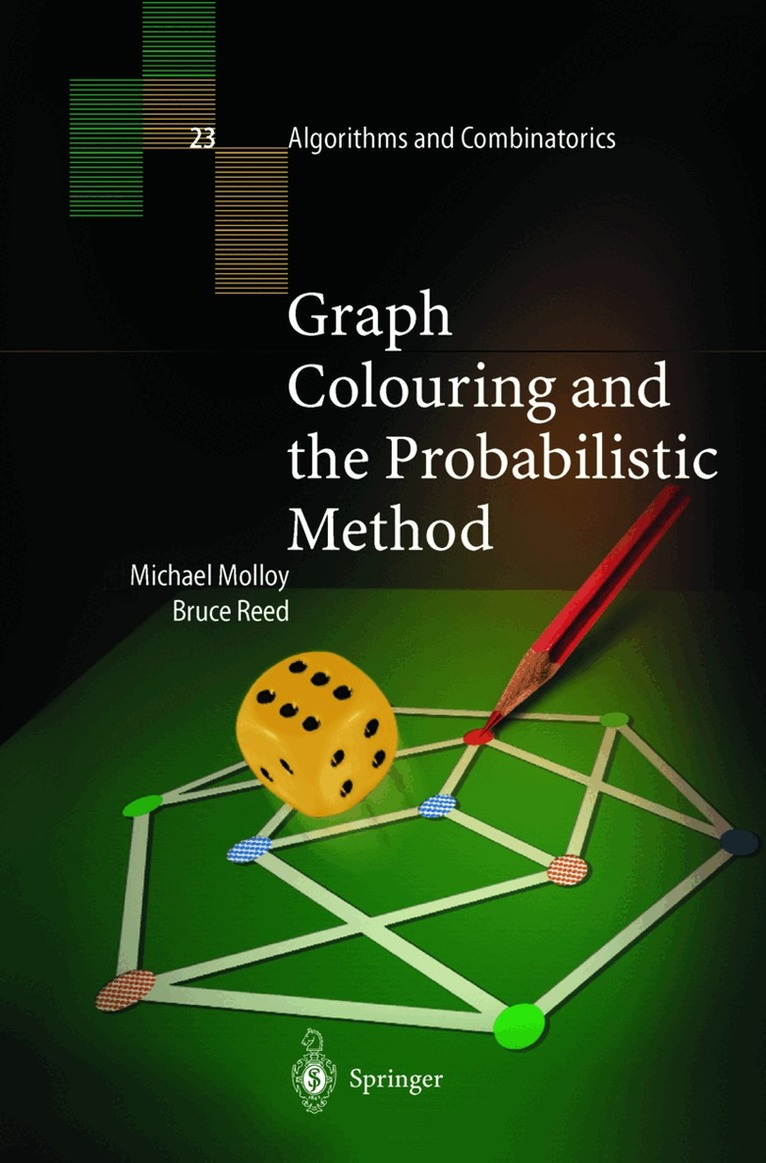
Over the past decade, many major advances have been made in the field of graph colouring via the probabilistic method. This monograph provides an accessible and unified treatment of these results, using tools such as the Lovasz Local Lemma and Talagrand's concentration inequality.The topics covered include: Kahn's proofs that the Goldberg-Seymour and List Colouring Conjectures hold asymptotically; a proof that for some absolute constant C, every graph of maximum degree Delta has a Delta+C total colouring; Johansson's proof that a triangle free graph has a O(Delta over log Delta) colouring; algorithmic variants of the Local Lemma which permit the efficient construction of many optimal and near-optimal colourings.This begins with a gentle introduction to the probabilistic method and will be useful to researchers and graduate students in graph theory, discrete mathematics, theoretical computer science and probability.
Del 16 - Algorithms and Combinatorics
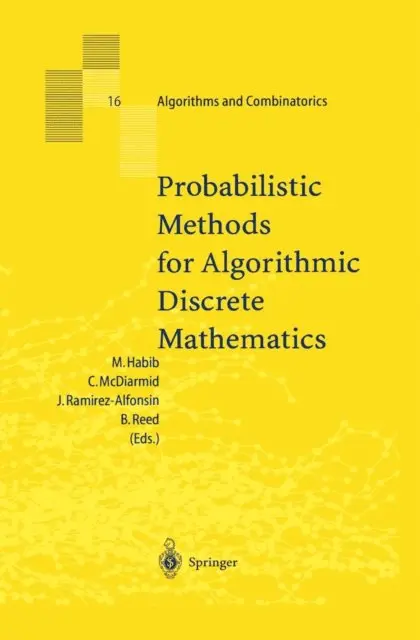
Probabilistic Methods for Algorithmic Discrete Mathematics
Inbunden, Engelska, 1998
1 084 kr
Skickas inom 10-15 vardagar
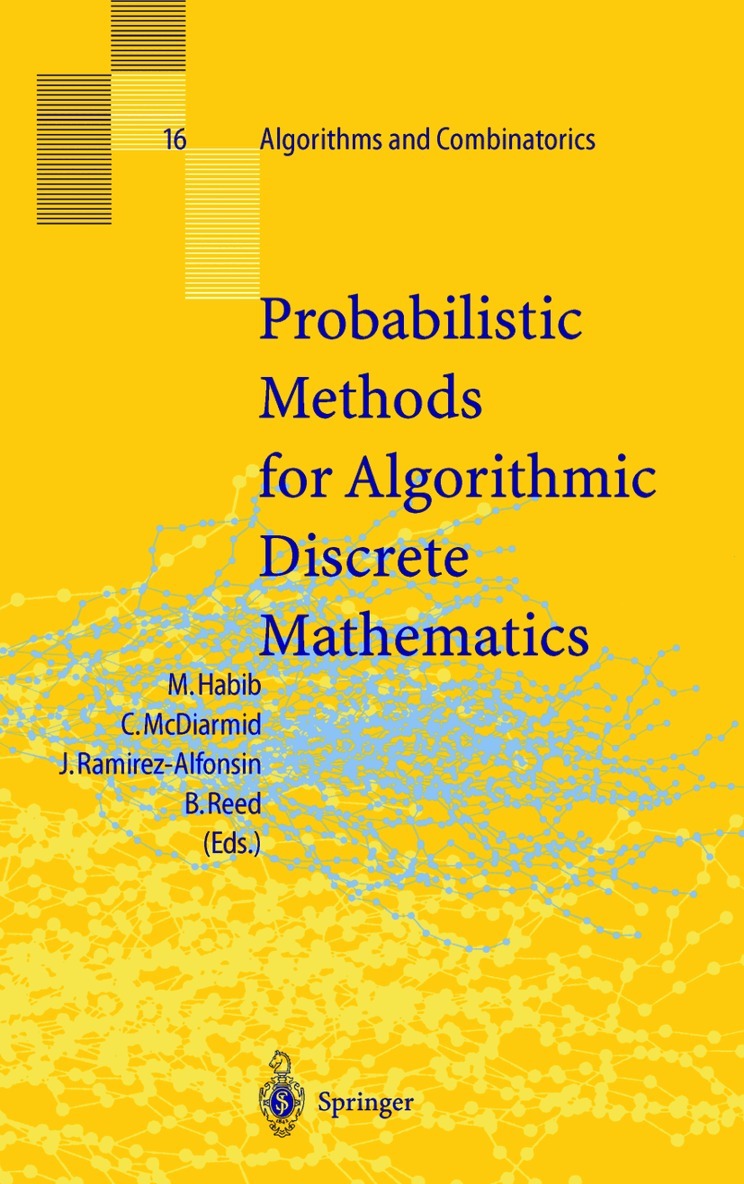
Leave nothing to chance. This cliche embodies the common belief that ran domness has no place in carefully planned methodologies, every step should be spelled out, each i dotted and each t crossed. In discrete mathematics at least, nothing could be further from the truth. Introducing random choices into algorithms can improve their performance. The application of proba bilistic tools has led to the resolution of combinatorial problems which had resisted attack for decades. The chapters in this volume explore and celebrate this fact. Our intention was to bring together, for the first time, accessible discus sions of the disparate ways in which probabilistic ideas are enriching discrete mathematics. These discussions are aimed at mathematicians with a good combinatorial background but require only a passing acquaintance with the basic definitions in probability (e.g. expected value, conditional probability). A reader who already has a firm grasp on the area will be interested in the original research, novel syntheses, and discussions of ongoing developments scattered throughout the book. Some of the most convincing demonstrations of the power of these tech niques are randomized algorithms for estimating quantities which are hard to compute exactly. One example is the randomized algorithm of Dyer, Frieze and Kannan for estimating the volume of a polyhedron. To illustrate these techniques, we consider a simple related problem. Suppose S is some region of the unit square defined by a system of polynomial inequalities: Pi (x. y) ~ o.
E-bok
PDF, Engelska, 20131 891 kr
Läs direkt efter köp
Over the past decade, many major advances have been made in the field of graph colouring via the probabilistic method. This monograph provides an accessible and unified treatment of these results, using tools such as the Lovasz Local Lemma and Talagrand''s concentration inequality.The topics covered include: Kahn''s proofs that the Goldberg-Seymour and List Colouring Conjectures hold asymptotically; a proof that for some absolute constant C, every graph of maximum degree Delta has a Delta+C total colouring; Johansson''s proof that a triangle free graph has a O(Delta over log Delta) colouring; algorithmic variants of the Local Lemma which permit the efficient construction of many optimal and near-optimal colourings.This begins with a gentle introduction to the probabilistic method and will be useful to researchers and graduate students in graph theory, discrete mathematics, theoretical computer science and probability.
Del 16 - Algorithms and Combinatorics
Probabilistic Methods for Algorithmic Discrete Mathematics
Häftad, Engelska, 2010
1 084 kr
Skickas inom 10-15 vardagar
Leave nothing to chance. This cliche embodies the common belief that ran domness has no place in carefully planned methodologies, every step should be spelled out, each i dotted and each t crossed. In discrete mathematics at least, nothing could be further from the truth. Introducing random choices into algorithms can improve their performance. The application of proba bilistic tools has led to the resolution of combinatorial problems which had resisted attack for decades. The chapters in this volume explore and celebrate this fact. Our intention was to bring together, for the first time, accessible discus sions of the disparate ways in which probabilistic ideas are enriching discrete mathematics. These discussions are aimed at mathematicians with a good combinatorial background but require only a passing acquaintance with the basic definitions in probability (e.g. expected value, conditional probability). A reader who already has a firm grasp on the area will be interested in the original research, novel syntheses, and discussions of ongoing developments scattered throughout the book. Some of the most convincing demonstrations of the power of these tech niques are randomized algorithms for estimating quantities which are hard to compute exactly. One example is the randomized algorithm of Dyer, Frieze and Kannan for estimating the volume of a polyhedron. To illustrate these techniques, we consider a simple related problem. Suppose S is some region of the unit square defined by a system of polynomial inequalities: Pi (x. y) ~ o.
E-bok
PDF, Engelska, 20131 416 kr
Läs direkt efter köp
Leave nothing to chance. This cliche embodies the common belief that ran domness has no place in carefully planned methodologies, every step should be spelled out, each i dotted and each t crossed. In discrete mathematics at least, nothing could be further from the truth. Introducing random choices into algorithms can improve their performance. The application of proba bilistic tools has led to the resolution of combinatorial problems which had resisted attack for decades. The chapters in this volume explore and celebrate this fact. Our intention was to bring together, for the first time, accessible discus sions of the disparate ways in which probabilistic ideas are enriching discrete mathematics. These discussions are aimed at mathematicians with a good combinatorial background but require only a passing acquaintance with the basic definitions in probability (e.g. expected value, conditional probability). A reader who already has a firm grasp on the area will be interested in the original research, novel syntheses, and discussions of ongoing developments scattered throughout the book. Some of the most convincing demonstrations of the power of these tech niques are randomized algorithms for estimating quantities which are hard to compute exactly. One example is the randomized algorithm of Dyer, Frieze and Kannan for estimating the volume of a polyhedron. To illustrate these techniques, we consider a simple related problem. Suppose S is some region of the unit square defined by a system of polynomial inequalities: Pi (x. y) ~ o.