Colin McDiarmid – författare
Visar alla böcker från författaren Colin McDiarmid. Handla med fri frakt och snabb leverans.
8 produkter
8 produkter
Del 34 - Oxford Lecture Series in Mathematics and Its Applications
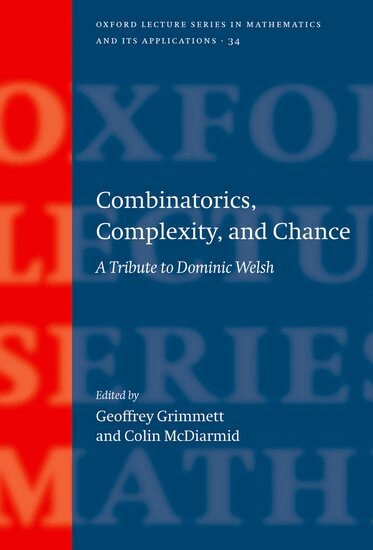
Combinatorics, Complexity, and Chance
A Tribute to Dominic Welsh
Inbunden, Engelska, 2007
1 973 kr
Skickas inom 5-8 vardagar
Professor Dominic Welsh has made significant contributions to the fields of combinatorics and discrete probability, including matroids, complexity, and percolation, and has taught, influenced and inspired generations of students and researchers in mathematics. This volume summarises and reviews the consistent themes from his work through a series of articles written by renowned experts. These articles contain original research work, set in a broader context by the inclusion of review material. As a reference text in its own right, this book will be valuable to academic researchers, research students, and others seeking an introduction to the relevant contemporary aspects of these fields.
Del 84 - London Mathematical Society Student Texts
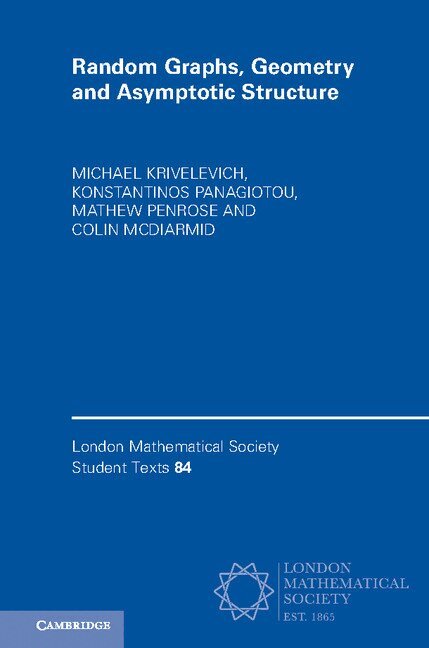
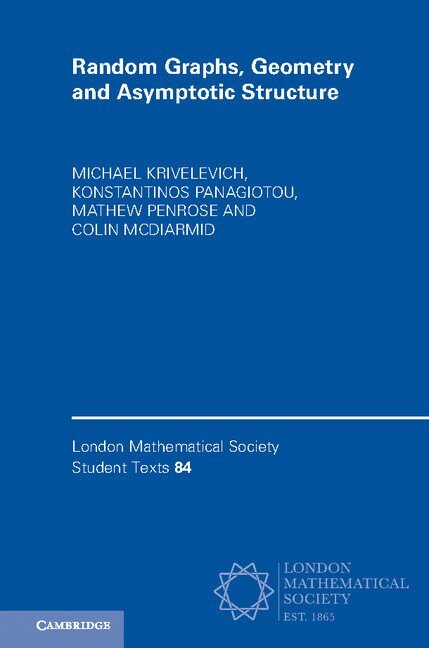
Random Graphs, Geometry and Asymptotic Structure
Inbunden, Engelska, 2016
935 kr
Skickas inom 7-10 vardagar
The theory of random graphs is a vital part of the education of any researcher entering the fascinating world of combinatorics. However, due to their diverse nature, the geometric and structural aspects of the theory often remain an obscure part of the formative study of young combinatorialists and probabilists. Moreover, the theory itself, even in its most basic forms, is often considered too advanced to be part of undergraduate curricula, and those who are interested usually learn it mostly through self-study, covering a lot of its fundamentals but little of the more recent developments. This book provides a self-contained and concise introduction to recent developments and techniques for classical problems in the theory of random graphs. Moreover, it covers geometric and topological aspects of the theory and introduces the reader to the diversity and depth of the methods that have been devised in this context.
E-bok
Engelska, 2016633 kr
Läs direkt efter köp
The theory of random graphs is a vital part of the education of any researcher entering the fascinating world of combinatorics. However, due to their diverse nature, the geometric and structural aspects of the theory often remain an obscure part of the formative study of young combinatorialists and probabilists. Moreover, the theory itself, even in its most basic forms, is often considered too advanced to be part of undergraduate curricula, and those who are interested usually learn it mostly through self-study, covering a lot of its fundamentals but little of the more recent developments. This book provides a self-contained and concise introduction to recent developments and techniques for classical problems in the theory of random graphs. Moreover, it covers geometric and topological aspects of the theory and introduces the reader to the diversity and depth of the methods that have been devised in this context.
E-bok
PDF, Engelska, 2016633 kr
Läs direkt efter köp
The theory of random graphs is a vital part of the education of any researcher entering the fascinating world of combinatorics. However, due to their diverse nature, the geometric and structural aspects of the theory often remain an obscure part of the formative study of young combinatorialists and probabilists. Moreover, the theory itself, even in its most basic forms, is often considered too advanced to be part of undergraduate curricula, and those who are interested usually learn it mostly through self-study, covering a lot of its fundamentals but little of the more recent developments. This book provides a self-contained and concise introduction to recent developments and techniques for classical problems in the theory of random graphs. Moreover, it covers geometric and topological aspects of the theory and introduces the reader to the diversity and depth of the methods that have been devised in this context.
Del 16 - Algorithms and Combinatorics
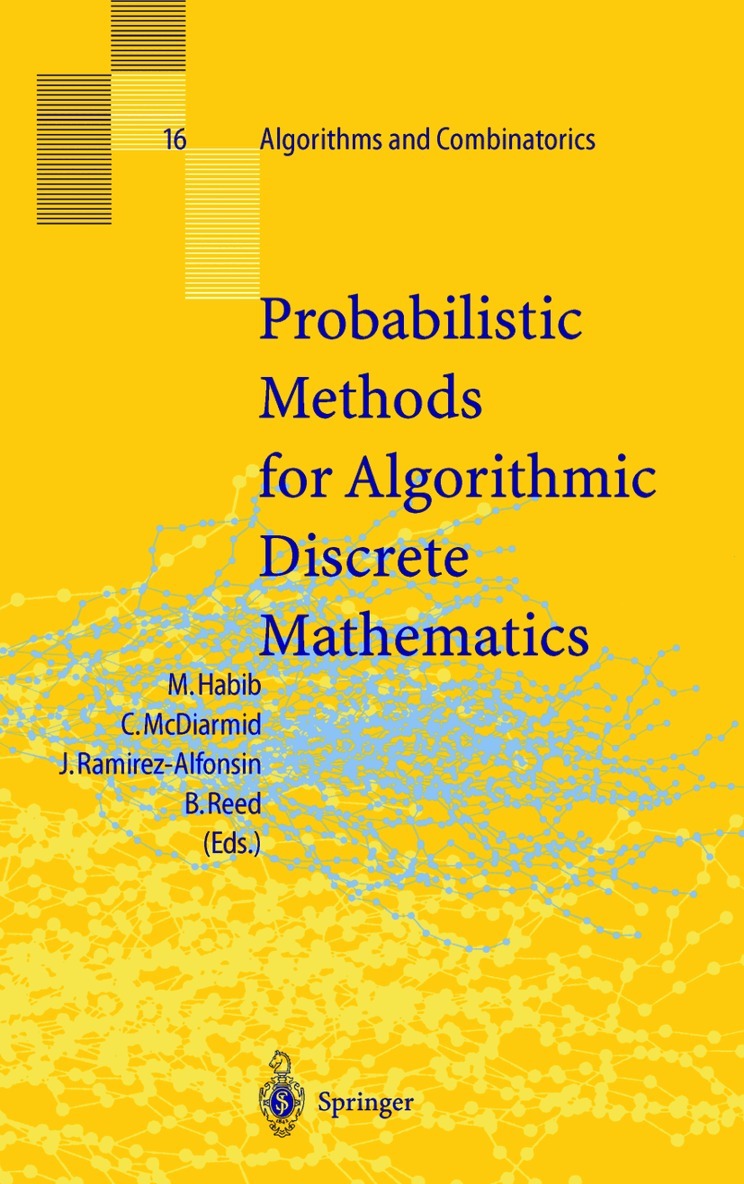
Probabilistic Methods for Algorithmic Discrete Mathematics
Inbunden, Engelska, 1998
1 084 kr
Skickas inom 10-15 vardagar
Leave nothing to chance. This cliche embodies the common belief that ran domness has no place in carefully planned methodologies, every step should be spelled out, each i dotted and each t crossed. In discrete mathematics at least, nothing could be further from the truth. Introducing random choices into algorithms can improve their performance. The application of proba bilistic tools has led to the resolution of combinatorial problems which had resisted attack for decades. The chapters in this volume explore and celebrate this fact. Our intention was to bring together, for the first time, accessible discus sions of the disparate ways in which probabilistic ideas are enriching discrete mathematics. These discussions are aimed at mathematicians with a good combinatorial background but require only a passing acquaintance with the basic definitions in probability (e.g. expected value, conditional probability). A reader who already has a firm grasp on the area will be interested in the original research, novel syntheses, and discussions of ongoing developments scattered throughout the book. Some of the most convincing demonstrations of the power of these tech niques are randomized algorithms for estimating quantities which are hard to compute exactly. One example is the randomized algorithm of Dyer, Frieze and Kannan for estimating the volume of a polyhedron. To illustrate these techniques, we consider a simple related problem. Suppose S is some region of the unit square defined by a system of polynomial inequalities: Pi (x. y) ~ o.
Del 16 - Algorithms and Combinatorics
Probabilistic Methods for Algorithmic Discrete Mathematics
Häftad, Engelska, 2010
1 084 kr
Skickas inom 10-15 vardagar
Leave nothing to chance. This cliche embodies the common belief that ran domness has no place in carefully planned methodologies, every step should be spelled out, each i dotted and each t crossed. In discrete mathematics at least, nothing could be further from the truth. Introducing random choices into algorithms can improve their performance. The application of proba bilistic tools has led to the resolution of combinatorial problems which had resisted attack for decades. The chapters in this volume explore and celebrate this fact. Our intention was to bring together, for the first time, accessible discus sions of the disparate ways in which probabilistic ideas are enriching discrete mathematics. These discussions are aimed at mathematicians with a good combinatorial background but require only a passing acquaintance with the basic definitions in probability (e.g. expected value, conditional probability). A reader who already has a firm grasp on the area will be interested in the original research, novel syntheses, and discussions of ongoing developments scattered throughout the book. Some of the most convincing demonstrations of the power of these tech niques are randomized algorithms for estimating quantities which are hard to compute exactly. One example is the randomized algorithm of Dyer, Frieze and Kannan for estimating the volume of a polyhedron. To illustrate these techniques, we consider a simple related problem. Suppose S is some region of the unit square defined by a system of polynomial inequalities: Pi (x. y) ~ o.
E-bok
PDF, Engelska, 20131 416 kr
Läs direkt efter köp
Leave nothing to chance. This cliche embodies the common belief that ran domness has no place in carefully planned methodologies, every step should be spelled out, each i dotted and each t crossed. In discrete mathematics at least, nothing could be further from the truth. Introducing random choices into algorithms can improve their performance. The application of proba bilistic tools has led to the resolution of combinatorial problems which had resisted attack for decades. The chapters in this volume explore and celebrate this fact. Our intention was to bring together, for the first time, accessible discus sions of the disparate ways in which probabilistic ideas are enriching discrete mathematics. These discussions are aimed at mathematicians with a good combinatorial background but require only a passing acquaintance with the basic definitions in probability (e.g. expected value, conditional probability). A reader who already has a firm grasp on the area will be interested in the original research, novel syntheses, and discussions of ongoing developments scattered throughout the book. Some of the most convincing demonstrations of the power of these tech niques are randomized algorithms for estimating quantities which are hard to compute exactly. One example is the randomized algorithm of Dyer, Frieze and Kannan for estimating the volume of a polyhedron. To illustrate these techniques, we consider a simple related problem. Suppose S is some region of the unit square defined by a system of polynomial inequalities: Pi (x. y) ~ o.
Del 84 - London Mathematical Society Student Texts
Random Graphs, Geometry and Asymptotic Structure
Häftad, Engelska, 2016
521 kr
Tillfälligt slut
The theory of random graphs is a vital part of the education of any researcher entering the fascinating world of combinatorics. However, due to their diverse nature, the geometric and structural aspects of the theory often remain an obscure part of the formative study of young combinatorialists and probabilists. Moreover, the theory itself, even in its most basic forms, is often considered too advanced to be part of undergraduate curricula, and those who are interested usually learn it mostly through self-study, covering a lot of its fundamentals but little of the more recent developments. This book provides a self-contained and concise introduction to recent developments and techniques for classical problems in the theory of random graphs. Moreover, it covers geometric and topological aspects of the theory and introduces the reader to the diversity and depth of the methods that have been devised in this context.