Michel Habib – författare
Visar alla böcker från författaren Michel Habib. Handla med fri frakt och snabb leverans.
9 produkter
9 produkter
Häftad, Engelska, 2003
1 116 kr
Skickas inom 10-15 vardagar
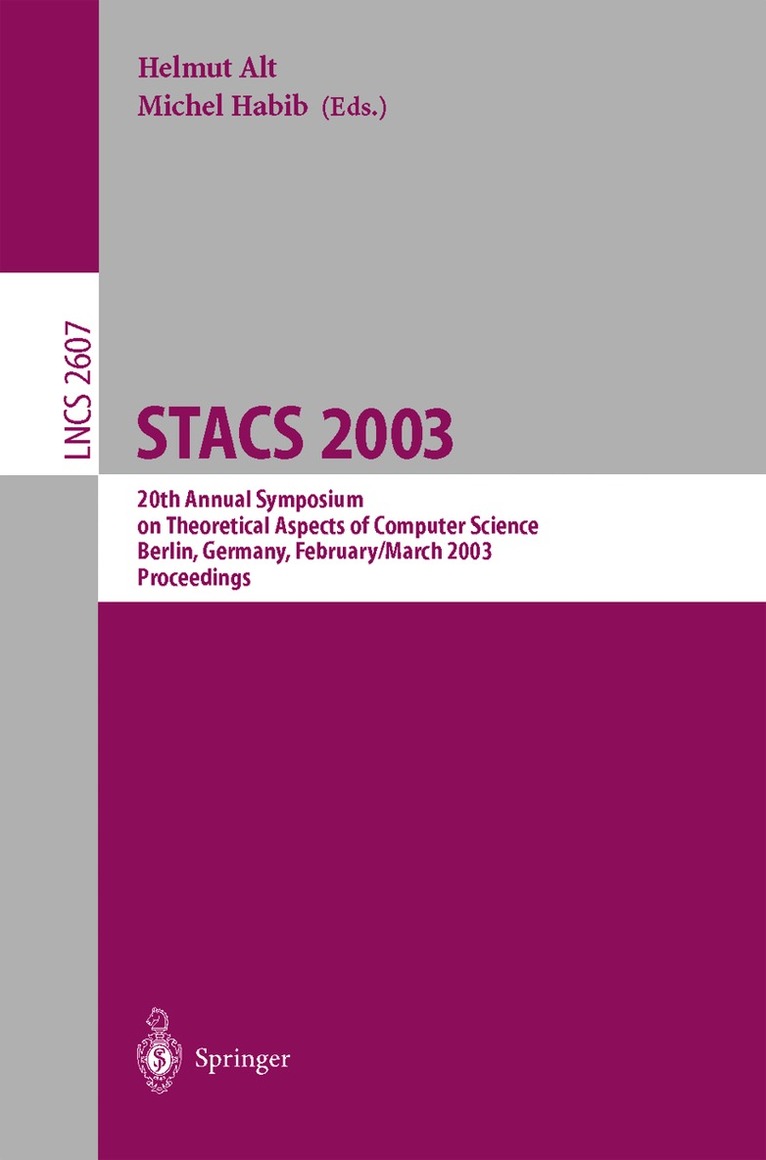
The Symposium on Theoretical Aspects of Computer Science (STACS) is - ternately held in France and Germany. The latest conference, February 27 to March 1, 2003 at the Institute of Computer Science, Freie Universit. at Berlin is the twentieth in this series. The previous meetings took place in Paris (1984), Saarbruc .. ken (1985), Orsay (1986), Passau (1987), Bordeaux (1988), Paderborn (1989), Rouen (1990), Hamburg (1991), Cachan (1992), Wurzburg .. (1993), Caen (1994), Munc .. hen (1995), Grenoble (1996), Lub .. eck (1997), Paris (1998), Trier (1999), Lille (2000), Dresden (2001), and Antibes/Juan-les-Pins (2002). Unlike some other important theory conferences STACS covers the whole range of theoretical computer science including algorithms and data structures, automata and formal languages, complexity theory, semantics, logic in computer science, and current challenges like biological computing, quantum computing, and mobile and net computing. The interest in STACS has been increasing continuously during recent years and has turned it into one of the most signi?cant conferences in theoretical computer science.The STACS 2003 call for papers led to a record number of 253 submissions from all over the world.
Häftad, Engelska, 2004
1 116 kr
Skickas inom 10-15 vardagar
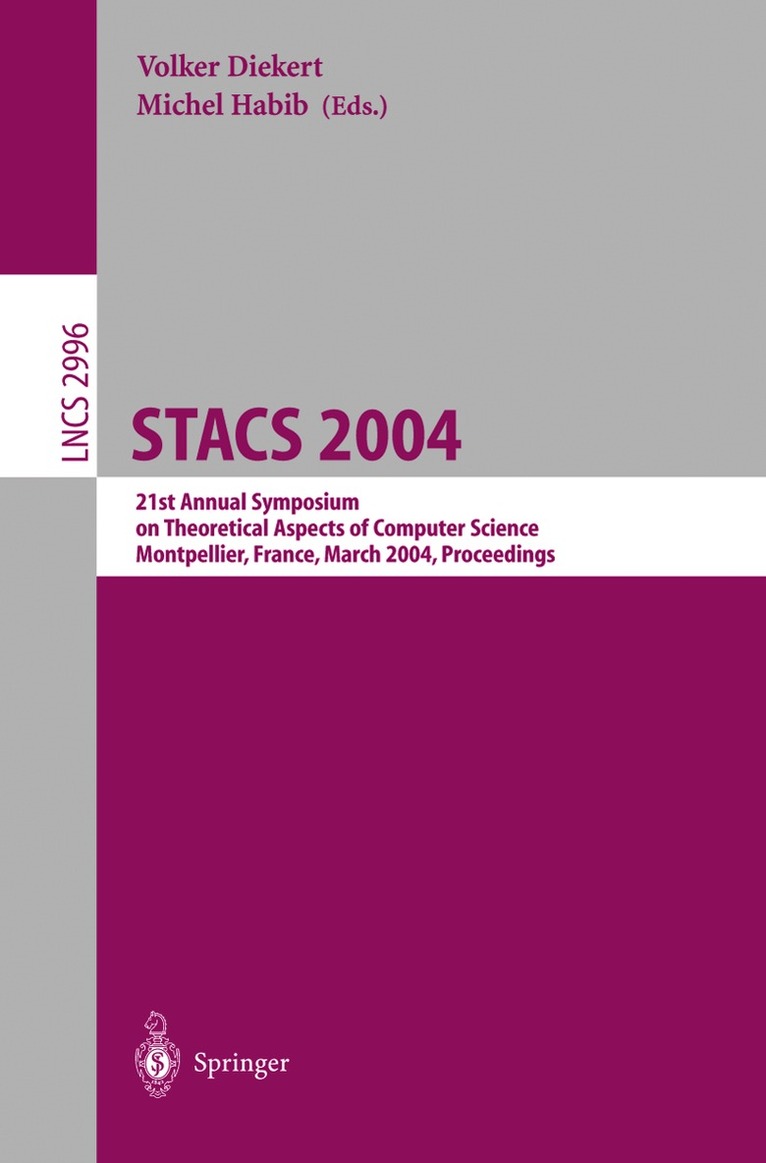
The Symposium on Theoretical Aspects of Computer Science (STACS) is alt- nately held in France and in Germany. The conference of March 25-27, 2004 at the Corum, Montpellier was the twenty-?rst in this series. Previous meetings took place in Paris (1984), Saarbruc .. ken (1985), Orsay (1986), Passau (1987), Bordeaux (1988), Paderborn (1989), Rouen (1990), Hamburg (1991), Cachan (1992),Wurzburg .. (1993),Caen(1994),Munc .. hen(1995),Grenoble(1996),Lub .. eck (1997), Paris (1998), Trier (1999), Lille (2000), Dresden (2001), Antibes (2002), and Berlin (2003). The symposium looks back at a remarkable tradition of over 20 years. The interest in STACS has been increasing continuously during recent years and has turned it into one of the most signi?cant conferences in theoretical computer science. The STACS 2004 call for papers led to more than 200 submissions from all over the world. Thereviewingprocesswasextremelyhard:morethan800reviewsweredone. We would like to thank the program committee and all external referees for the valuable work they put into the reviewing process of this conference. We had a two-day meeting for the program committee in Montpellier during November 21-22, 2003.Just 54 papers (i.e., 27% of the submissions) could be accepted, as we wanted to keep the conference in its standard format with only two parallel sessions. This strict selection guaranteed the very high scienti?c quality of the conference.
E-bok
PDF, Engelska, 20041 408 kr
Läs direkt efter köp
E-bok
PDF, Engelska, 20031 416 kr
Läs direkt efter köp
Del 16 - Algorithms and Combinatorics
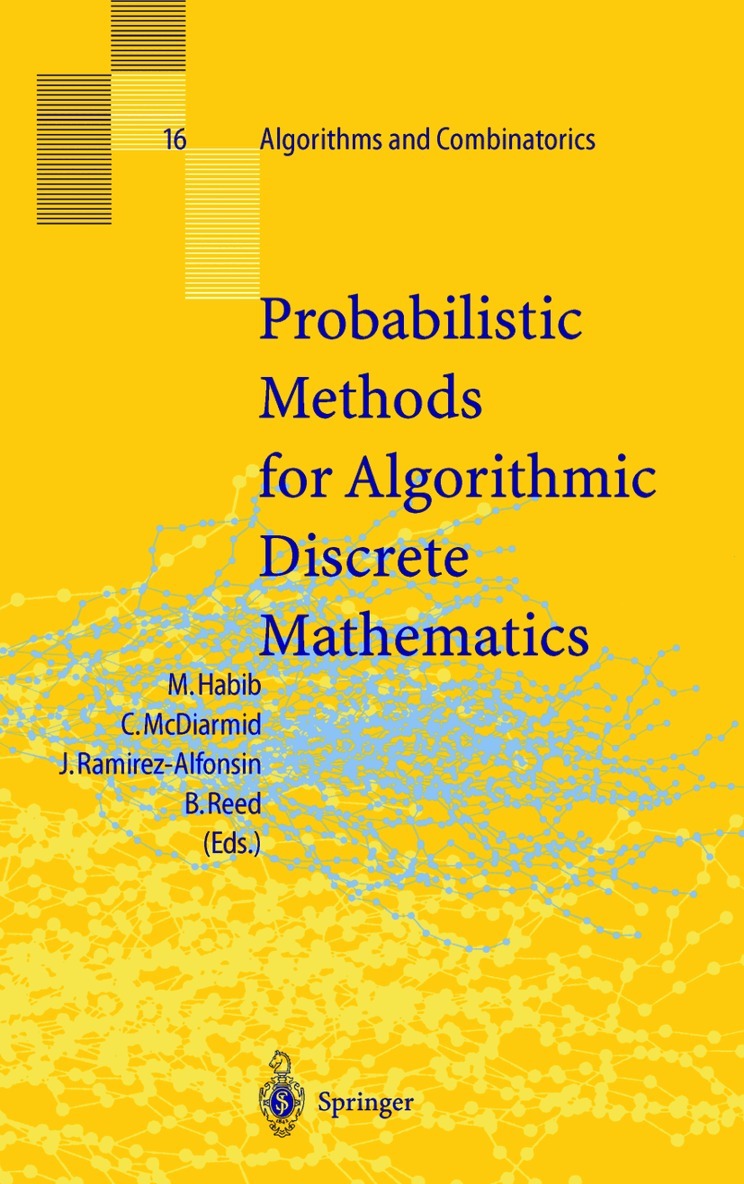
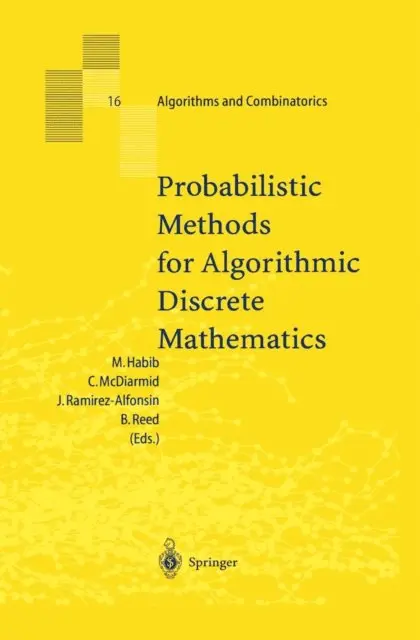
Probabilistic Methods for Algorithmic Discrete Mathematics
Inbunden, Engelska, 1998
1 084 kr
Skickas inom 10-15 vardagar
Leave nothing to chance. This cliche embodies the common belief that ran domness has no place in carefully planned methodologies, every step should be spelled out, each i dotted and each t crossed. In discrete mathematics at least, nothing could be further from the truth. Introducing random choices into algorithms can improve their performance. The application of proba bilistic tools has led to the resolution of combinatorial problems which had resisted attack for decades. The chapters in this volume explore and celebrate this fact. Our intention was to bring together, for the first time, accessible discus sions of the disparate ways in which probabilistic ideas are enriching discrete mathematics. These discussions are aimed at mathematicians with a good combinatorial background but require only a passing acquaintance with the basic definitions in probability (e.g. expected value, conditional probability). A reader who already has a firm grasp on the area will be interested in the original research, novel syntheses, and discussions of ongoing developments scattered throughout the book. Some of the most convincing demonstrations of the power of these tech niques are randomized algorithms for estimating quantities which are hard to compute exactly. One example is the randomized algorithm of Dyer, Frieze and Kannan for estimating the volume of a polyhedron. To illustrate these techniques, we consider a simple related problem. Suppose S is some region of the unit square defined by a system of polynomial inequalities: Pi (x. y) ~ o.
Del 16 - Algorithms and Combinatorics
Probabilistic Methods for Algorithmic Discrete Mathematics
Häftad, Engelska, 2010
1 084 kr
Skickas inom 10-15 vardagar
Leave nothing to chance. This cliche embodies the common belief that ran domness has no place in carefully planned methodologies, every step should be spelled out, each i dotted and each t crossed. In discrete mathematics at least, nothing could be further from the truth. Introducing random choices into algorithms can improve their performance. The application of proba bilistic tools has led to the resolution of combinatorial problems which had resisted attack for decades. The chapters in this volume explore and celebrate this fact. Our intention was to bring together, for the first time, accessible discus sions of the disparate ways in which probabilistic ideas are enriching discrete mathematics. These discussions are aimed at mathematicians with a good combinatorial background but require only a passing acquaintance with the basic definitions in probability (e.g. expected value, conditional probability). A reader who already has a firm grasp on the area will be interested in the original research, novel syntheses, and discussions of ongoing developments scattered throughout the book. Some of the most convincing demonstrations of the power of these tech niques are randomized algorithms for estimating quantities which are hard to compute exactly. One example is the randomized algorithm of Dyer, Frieze and Kannan for estimating the volume of a polyhedron. To illustrate these techniques, we consider a simple related problem. Suppose S is some region of the unit square defined by a system of polynomial inequalities: Pi (x. y) ~ o.
Häftad, Engelska, 2010
546 kr
Skickas inom 10-15 vardagar
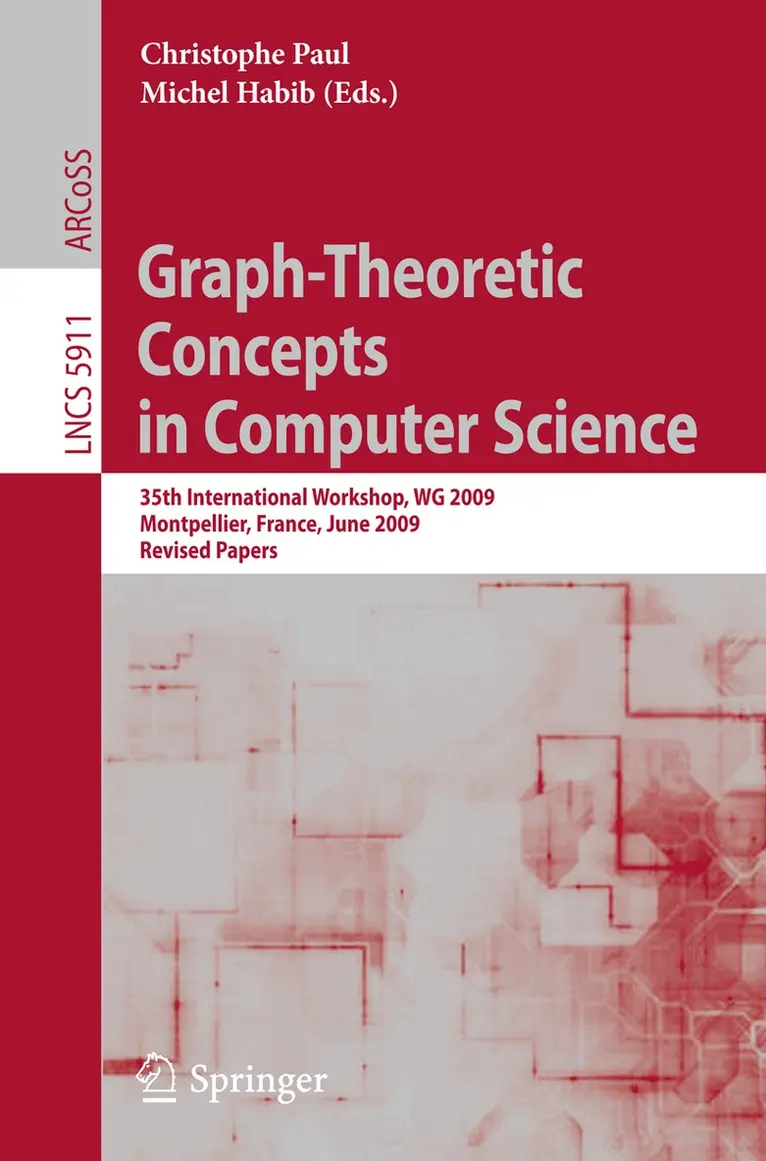
The 35th International Workshop on Graph-Theoretic Concepts in Computer Science (WG 2009) took place at Montpellier (France), June 24–26 2009. About 80 computer scientists from all over the world (Australia, Belgium, Canada, China, Czech Republic, France, Germany, Greece, Israel, Japan, Korea, The Netherlands, Norway, Spain, UK, USA) attended the conference. Since1975,ithastakenplace20timesinGermany,fourtimesinTheNeth- lands, twice in Austria, as well as once in Italy, Slovakia, Switzerland, the Czech Republic, France, Norway, and the UK. The conference aims at uniting theory and practice by demonstrating how graph-theoretic concepts can be applied to various areas in computer science, or by extracting new problems from appli- tions. The goal is to present recent research results and to identify and explore directions of future research. The conference is well-balanced with respect to established researchers and young scientists. There were 69 submissions. Each submission was reviewed by at least three, and on average four, Program Committee members. The Committee decided to accept 28 papers. Due to the competition and the limited schedule, some good papers could not be accepted. Theprogramalsoincludedexcellentinvitedtalks:onegivenbyDanielKràlon “AlgorithmsforClassesofGraphswithBoundedExpansion,” the otherbyDavid Eppsteinon“Graph-TheoreticSolutionstoComputationalGeometryProblems.” The proceedings contains two survey papers on these topics.
E-bok
PDF, Engelska, 2009712 kr
Läs direkt efter köp
The 35th International Workshop on Graph-Theoretic Concepts in Computer Science (WG 2009) took place at Montpellier (France), June 24–26 2009. About 80 computer scientists from all over the world (Australia, Belgium, Canada, China, Czech Republic, France, Germany, Greece, Israel, Japan, Korea, The Netherlands, Norway, Spain, UK, USA) attended the conference. Since1975,ithastakenplace20timesinGermany,fourtimesinTheNeth- lands, twice in Austria, as well as once in Italy, Slovakia, Switzerland, the Czech Republic, France, Norway, and the UK. The conference aims at uniting theory and practice by demonstrating how graph-theoretic concepts can be applied to various areas in computer science, or by extracting new problems from appli- tions. The goal is to present recent research results and to identify and explore directions of future research. The conference is well-balanced with respect to established researchers and young scientists. There were 69 submissions. Each submission was reviewed by at least three, and on average four, Program Committee members. The Committee decided to accept 28 papers. Due to the competition and the limited schedule, some good papers could not be accepted. Theprogramalsoincludedexcellentinvitedtalks:onegivenbyDanielKràlon “AlgorithmsforClassesofGraphswithBoundedExpansion,” the otherbyDavid Eppsteinon“Graph-TheoreticSolutionstoComputationalGeometryProblems.” The proceedings contains two survey papers on these topics.
E-bok
PDF, Engelska, 20131 416 kr
Läs direkt efter köp
Leave nothing to chance. This cliche embodies the common belief that ran domness has no place in carefully planned methodologies, every step should be spelled out, each i dotted and each t crossed. In discrete mathematics at least, nothing could be further from the truth. Introducing random choices into algorithms can improve their performance. The application of proba bilistic tools has led to the resolution of combinatorial problems which had resisted attack for decades. The chapters in this volume explore and celebrate this fact. Our intention was to bring together, for the first time, accessible discus sions of the disparate ways in which probabilistic ideas are enriching discrete mathematics. These discussions are aimed at mathematicians with a good combinatorial background but require only a passing acquaintance with the basic definitions in probability (e.g. expected value, conditional probability). A reader who already has a firm grasp on the area will be interested in the original research, novel syntheses, and discussions of ongoing developments scattered throughout the book. Some of the most convincing demonstrations of the power of these tech niques are randomized algorithms for estimating quantities which are hard to compute exactly. One example is the randomized algorithm of Dyer, Frieze and Kannan for estimating the volume of a polyhedron. To illustrate these techniques, we consider a simple related problem. Suppose S is some region of the unit square defined by a system of polynomial inequalities: Pi (x. y) ~ o.