Bruce Stephenson - Böcker
Visar alla böcker från författaren Bruce Stephenson. Handla med fri frakt och snabb leverans.
5 produkter
5 produkter
Del 13 - Studies in the History of Mathematics and Physical Sciences
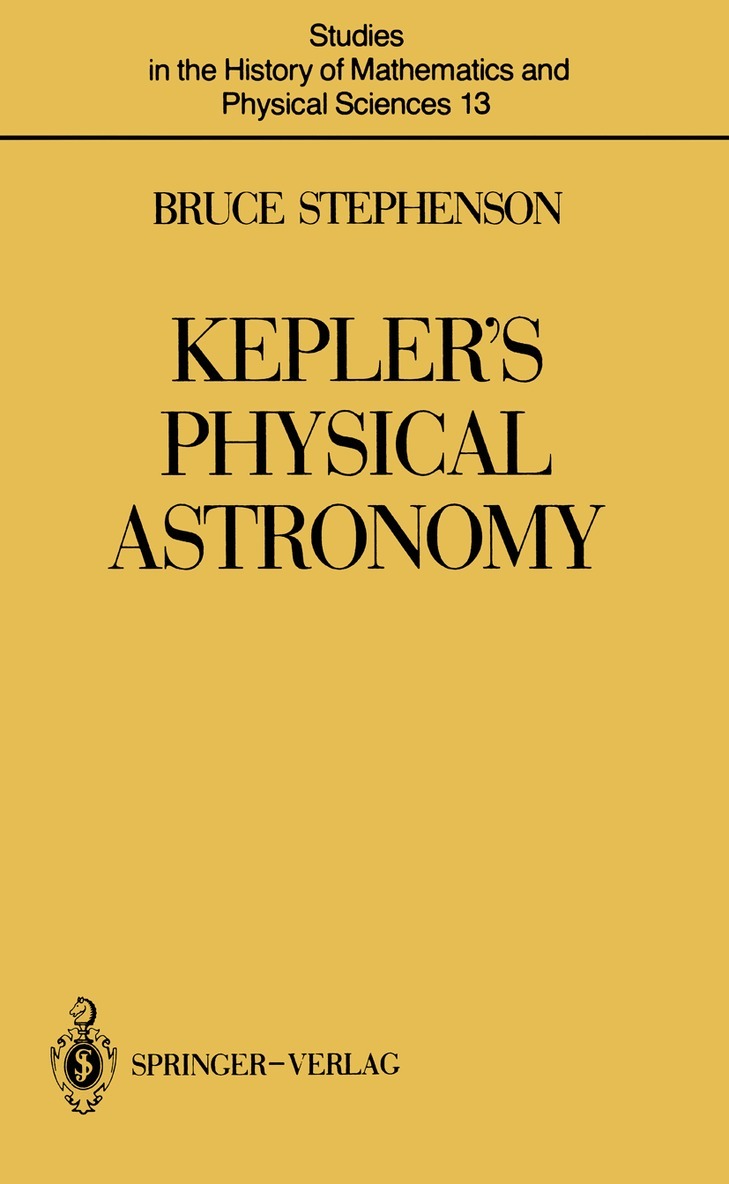
Kepler’s Physical Astronomy
Inbunden, Engelska, 1987
1 061 kr
Skickas inom 10-15 vardagar
Kepler's Physical Astronomy is an account of Kepler's reformulation of astronomy as a physical science, and of his successful use of (incorrect) physics as a guide in his astronomical discoveries. It presents the only reliable account of the internal logic of Kepler's so-called first and second laws, showing how and to what extent Kepler thought he had derived them from his physical principles. It explains for the first time Kepler's attempt to use an obscure discovery of Tycho Brahe to unify and confirm all of his own physical theories. It also describes the intricate (and neglected) theory which Kepler developed to account for the additional anomalies needed for the theory of the moon.

1 025 kr
Skickas inom 3-6 vardagar
From Hipparchus and Ptolemy in the ancient world, through Copernicus and Brahe in the sixteenth century, astronomers had used geometrical models to give a kinematic account of the movements of the sun, moon, and planets. Johannes Kepler revolutionized this most ancient of sciences by being the first to understand astronomy as a part of physics. By closely and clearly analyzing the texts of Kepler's great astronomical works, in particular the Astronomia nova of 1609, Bruce Stephenson demonstrates the importance of Kepler's physical principles--principles now known to be "incorrect"--in the creation of his first two laws of planetary motion.
502 kr
Skickas inom 7-10 vardagar
Valued today for its development of the third law of planetary motion, Harmonice mundi (1619) was intended by Kepler to expand on ancient efforts to discern a Creator's plan for the planetary system--an arrangement thought to be based on harmonic relationships. Challenging critics who characterize Kepler's theories of harmonic astronomy as "mystical," Bruce Stephenson offers the first thorough technical analysis of the music the astronomer thought the heavens made, and the logic that led him to find musical patterns in his data. In so doing, Stephenson illuminates crucial aspects of Kepler's intellectual development, particularly his ways of classifying and drawing inferences. Beginning with a survey of similar theories associating music with the cyclic motions of planets, from Plato to Boethius, the author highlights Ptolemy's Harmonics, a source of inspiration for Kepler's later work. Turning to Kepler himself, Stephenson gives an account of his polyhedral theory, which explains the number and sizes of the planetary orbits in terms of the five regular poly-hedral.He then examines in detail an early theory that relates the planets' vel-ocities to a musical chord, and analyzes Kepler's unpublished commentary on Ptolemy's Harmonics. Devoting most of his attention to Book Five of Harmonice mundi, in which Kepler elaborated on the musical structure of the planetary system, Stephenson lays important groundwork for any further evaluation of Kepler's scientific thought. Originally published in 1994. The Princeton Legacy Library uses the latest print-on-demand technology to again make available previously out-of-print books from the distinguished backlist of Princeton University Press. These editions preserve the original texts of these important books while presenting them in durable paperback and hardcover editions. The goal of the Princeton Legacy Library is to vastly increase access to the rich scholarly heritage found in the thousands of books published by Princeton University Press since its founding in 1905.
2 414 kr
Skickas inom 3-6 vardagar
Valued today for its development of the third law of planetary motion, Harmonice mundi (1619) was intended by Kepler to expand on ancient efforts to discern a Creator's plan for the planetary system--an arrangement thought to be based on harmonic relationships. Challenging critics who characterize Kepler's theories of harmonic astronomy as "mystical," Bruce Stephenson offers the first thorough technical analysis of the music the astronomer thought the heavens made, and the logic that led him to find musical patterns in his data. In so doing, Stephenson illuminates crucial aspects of Kepler's intellectual development, particularly his ways of classifying and drawing inferences. Beginning with a survey of similar theories associating music with the cyclic motions of planets, from Plato to Boethius, the author highlights Ptolemy's Harmonics, a source of inspiration for Kepler's later work. Turning to Kepler himself, Stephenson gives an account of his polyhedral theory, which explains the number and sizes of the planetary orbits in terms of the five regular poly-hedral.He then examines in detail an early theory that relates the planets' vel-ocities to a musical chord, and analyzes Kepler's unpublished commentary on Ptolemy's Harmonics. Devoting most of his attention to Book Five of Harmonice mundi, in which Kepler elaborated on the musical structure of the planetary system, Stephenson lays important groundwork for any further evaluation of Kepler's scientific thought. Originally published in 1994. The Princeton Legacy Library uses the latest print-on-demand technology to again make available previously out-of-print books from the distinguished backlist of Princeton University Press. These editions preserve the original texts of these important books while presenting them in durable paperback and hardcover editions. The goal of the Princeton Legacy Library is to vastly increase access to the rich scholarly heritage found in the thousands of books published by Princeton University Press since its founding in 1905.
Del 13 - Studies in the History of Mathematics and Physical Sciences
Kepler’s Physical Astronomy
Häftad, Engelska, 2012
1 166 kr
Skickas inom 10-15 vardagar
Kepler's Physical Astronomy is an account of Kepler's reformulation of astronomy as a physical science, and of his successful use of (incorrect) physics as a guide in his astronomical discoveries. It presents the only reliable account of the internal logic of Kepler's so-called first and second laws, showing how and to what extent Kepler thought he had derived them from his physical principles. It explains for the first time Kepler's attempt to use an obscure discovery of Tycho Brahe to unify and confirm all of his own physical theories. It also describes the intricate (and neglected) theory which Kepler developed to account for the additional anomalies needed for the theory of the moon.