
C. Beyer – författare
Visar alla böcker från författaren . Handla med fri frakt och snabb leverans.
9 produkter
9 produkter
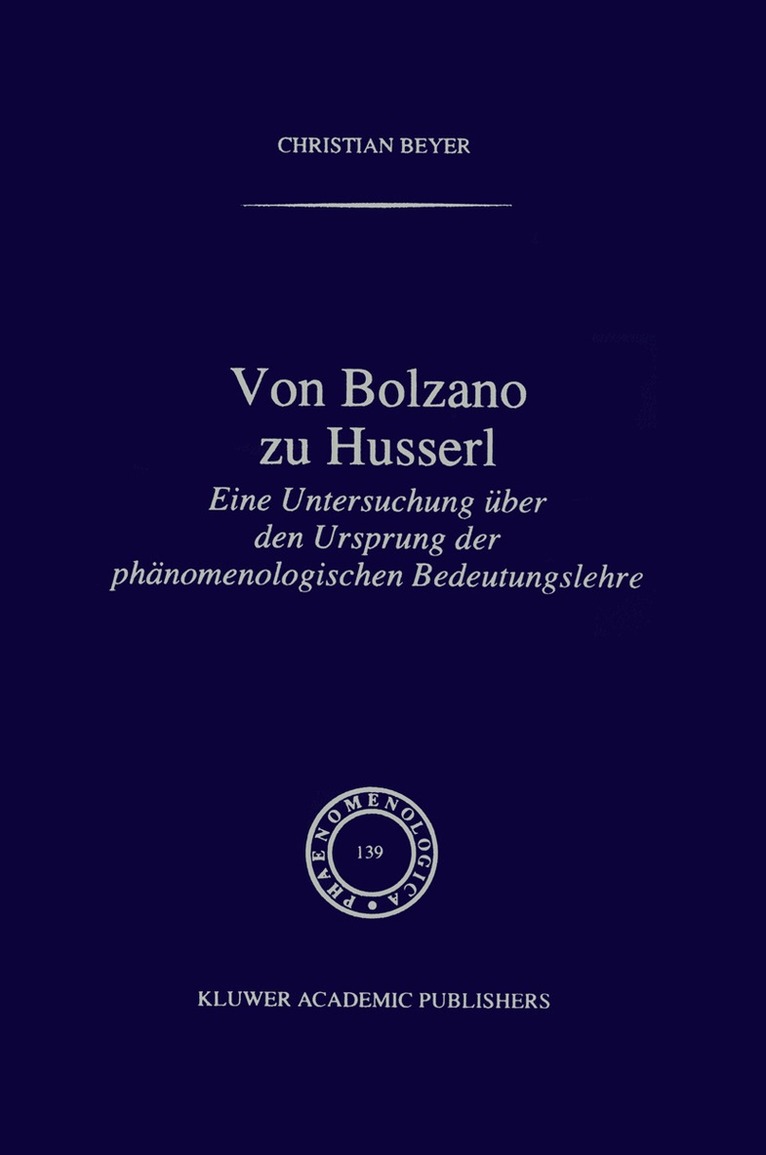
Del 139 - Phaenomenologica
Von Bolzano zu Husserl
Eine Untersuchung über den Ursprung der phänomenologischen Bedeutungslehre
Inbunden, Tyska, 1996
1 715 kr
Skickas inom 10-15 vardagar
This text contains a detailed study of the historical and systematical origin of Edmund Husserl's views on meaning as manifested in his influential work, "Logical Investigations" (1900-01) and "Ideas" (1913), relating them both to Bernard Bolzano's theory of the relationship between logical experiences and their objective contents (from his 1837 "Theory of Science") and to Hermann Lotze's theory of ideas (from his 1874 "Logic"). The author clarifies the basic concepts of Husserl's theory of meaning and shows that it is Platonic (rather than Aristotelian) in spirit. Furthermore, he defends an "identificationalistic" interpretation of Husserl's central notion of "noematic X" and outlines a Husserlian contribution to the "externalism/internalism" debate in recent analytic philosophy. The book is aimed at philosophers of language, mind and logic with either a phenomenological or an analytic background, Husserl scholars, and historians of 19th- and 20th-century philosophy.

Inbunden, Tyska, 1887
2 424 kr
Skickas inom 5-8 vardagar

Inbunden, Tyska, 1887
1 574 kr
Skickas inom 5-8 vardagar

Inbunden, Tyska, 1884
1 831 kr
Skickas inom 5-8 vardagar

Inbunden, Tyska, 1887
1 831 kr
Skickas inom 5-8 vardagar

Inbunden, Tyska, 1887
3 195 kr
Skickas inom 5-8 vardagar
E-bok
PDF, Tyska, 20131 381 kr
Läs direkt efter köp
Del 139 - Phaenomenologica
Von Bolzano zu Husserl
Eine Untersuchung über den Ursprung der phänomenologischen Bedeutungslehre
Häftad, Tyska, 2011
1 413 kr
Skickas inom 10-15 vardagar
This book contains a detailed study of the historical and systematical origin of Edmund Husserl's views on meaning as manifested in his most influential Logical Investigations (1900-01) and Ideas (1913), relating them both to Bernard Bolzano's theory of the relationship between logical experiences and their objective contents (from his 1837 Theory of Science) and to Hermann Lotze's theory of ideas (from his 1874 Logic). The author clarifies the basic concepts of Husserl's theory of meaning and shows that it is Platonic (rather than Aristotelian) in spirit. Furthermore, he defends an 'identificationalistic' interpretation of Husserl's central notion of 'noematic X' and outlines a Husserlian contribution to the 'externalism/internalism' debate in recent analytic philosophy. Primary audience: Philosophers of language, mind and logic with either a phenomenological or an analytic background, Husserl scholars, historians of nineteenth and twentieth century philosophy.
Häftad, Tyska, 2012
328 kr
Tillfälligt slut