Calvin Bedient - Böcker
Visar alla böcker från författaren Calvin Bedient. Handla med fri frakt och snabb leverans.
6 produkter
6 produkter
611 kr
Skickas inom 10-15 vardagar
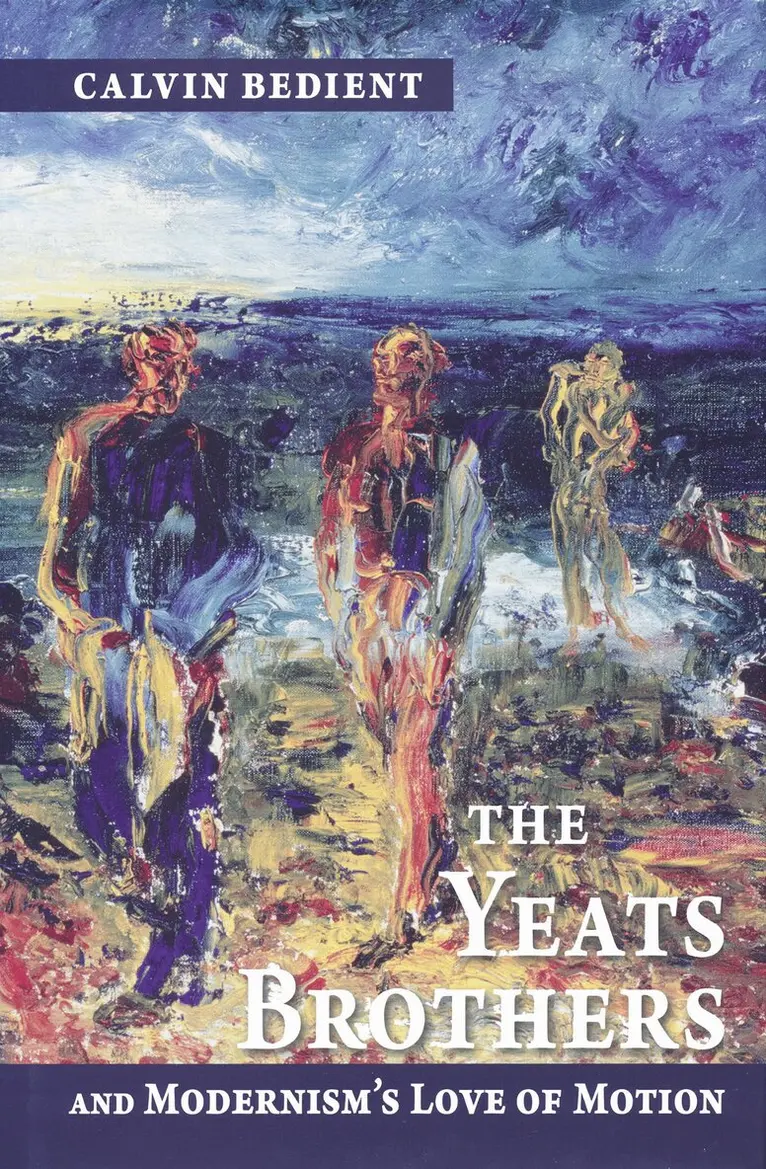
In The Yeats Brothers, Calvin Bedient delivers a brilliant exploration of modernism through the mutual illumination provided by Ireland's greatest poet and greatest painter. By examining the poems of the one and the paintings of the other, he recovers an often overlooked quality both artists embraced in their work—that core feature of modernism, a thoroughgoing preoccupation with motion and fluidity, that terrifying encounter with the universe conceptualized as force.Bedient's is the first book to treat W. B. Yeats and Jack Yeats as twin geniuses in the detection and representation of chaos. William Butler Yeats's love and fear of motion pervade every aspect of his poetry, helping to determine his themes, riddle his images, and shape the cadences of his verse. Jack Yeats's focus on change and motion caused him to engage with the cross-currents of his time, not—as sometimes thought—to remain locked in the past.Through daring and nuanced readings of the poems and analyses of the paintings, Bedient reveals the two artists to have been complicit with modernism—against homogeneity, alert to divisions, polyphony, and restlessness in things and in ourselves. Adept in close discussion of poetic and painterly style, and magisterial in his grasp of theorists, Bedient provides us with genuinely new interpretations of the Yeats brothers' work, and with a more sophisticated understanding of modernism.
512 kr
Skickas inom 3-6 vardagar
The Totality for Kids is the second collection of poems by Joshua Clover, whose debut, Madonna anno domini, won the Walt Whitman award from the Academy of American Poets. This volume takes as its subject the troubled sleep of late modernity, from the grandeur and failure of megacities to the retreats and displacements of the suburbs. The power of crowds and architecture commingles with the alienation and idleness of the observer, caught between "the brutal red dream/Of the collective" and "the parade/Of the ideal citizen." The book's action takes place in these gaps, "dead spaces beside the endlessly grieving stream." The frozen tableau of the spectacle meets its double in the sense that something is always about to happen. Political furies and erotic imaginings coalesce and escape within a welter of unmoored allusions, encounters, citations, and histories, the dreams possible within the modern's excess of signification--as if to return revolutionary possibility to the regime of information by singing it its own song.
764 kr
Skickas inom 3-6 vardagar
In the post-Jane Austen era, George Eliot, D.H. Lawrence, and E.M. Forster uniquely probe the evolving nature of selfhood, each contributing to a broader dialogue on what it means to be fully human. Eliot embodies the Victorian commitment to duty and moral conscience, where restraint and selflessness form the highest ideals. In stark contrast, Lawrence celebrates instinctual vitality, emphasizing the authenticity found in embracing bodily desires as a form of spiritual truth. Forster, positioned between these two extremes, advocates a balanced integration of mind and flesh, famously urging that we "only connect." Together, these writers represent key perspectives in a shifting era where traditional Christian values gave way to modern self-assertion, reflecting a spectrum of approaches to identity amid the disintegration of Victorian norms.These authors capture the post-Christian struggle to redefine human ideals, resonating with Nietzsche's individualism and pushing back against Victorian rigidity. Eliot, Lawrence, and Forster each envision a path toward wholeness that reflects the era’s rethinking of moral and social values. Eliot’s structured conscience, Lawrence’s fervent embrace of natural vitality, and Forster’s pursuit of harmonious connection reveal the tensions of the human experience—between duty and desire, spiritual and physical, selflessness and fulfillment. In their distinct yet complementary ways, they mark a cultural and literary transition, showing the self as a complex site of conflict and potential, redefining what it means to live fully and meaningfully in a rapidly changing world.This title is part of UC Press's Voices Revived program, which commemorates University of California Press’s mission to seek out and cultivate the brightest minds and give them voice, reach, and impact. Drawing on a backlist dating to 1893, Voices Revived makes high-quality, peer-reviewed scholarship accessible once again using print-on-demand technology. This title was originally published in 1972.
1 690 kr
Skickas inom 3-6 vardagar
In the post-Jane Austen era, George Eliot, D.H. Lawrence, and E.M. Forster uniquely probe the evolving nature of selfhood, each contributing to a broader dialogue on what it means to be fully human. Eliot embodies the Victorian commitment to duty and moral conscience, where restraint and selflessness form the highest ideals. In stark contrast, Lawrence celebrates instinctual vitality, emphasizing the authenticity found in embracing bodily desires as a form of spiritual truth. Forster, positioned between these two extremes, advocates a balanced integration of mind and flesh, famously urging that we "only connect." Together, these writers represent key perspectives in a shifting era where traditional Christian values gave way to modern self-assertion, reflecting a spectrum of approaches to identity amid the disintegration of Victorian norms.These authors capture the post-Christian struggle to redefine human ideals, resonating with Nietzsche's individualism and pushing back against Victorian rigidity. Eliot, Lawrence, and Forster each envision a path toward wholeness that reflects the era’s rethinking of moral and social values. Eliot’s structured conscience, Lawrence’s fervent embrace of natural vitality, and Forster’s pursuit of harmonious connection reveal the tensions of the human experience—between duty and desire, spiritual and physical, selflessness and fulfillment. In their distinct yet complementary ways, they mark a cultural and literary transition, showing the self as a complex site of conflict and potential, redefining what it means to live fully and meaningfully in a rapidly changing world.This title is part of UC Press's Voices Revived program, which commemorates University of California Press’s mission to seek out and cultivate the brightest minds and give them voice, reach, and impact. Drawing on a backlist dating to 1893, Voices Revived makes high-quality, peer-reviewed scholarship accessible once again using print-on-demand technology. This title was originally published in 1972.
195 kr
Skickas inom 5-8 vardagar
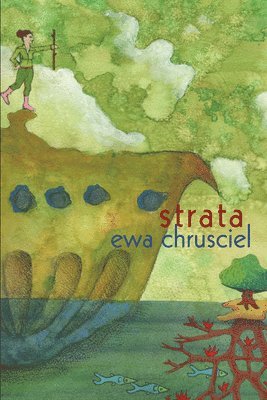
In Ewa Chrusciel’s first book in English, Strata, an exile’s memories are . . . at once a rapture of possession (of being possessed) and defeatingly untotalizable. Strata is . . . a tumultuous revelation of how much of the past there still is, right here in the near flight of letters, and of the burn of being in time at all, the difficulty of catching up with oneself in a universe that is never one, but always scattered. Strata is a book of concuspiscences, of combings for pleasures, yes, but even more for the Sacred Book it wants to be. In its every line, it shows that the rhapsodic is the right approach to the truth about the world. - from the foreword by Calvin Bedient Praise for Ewa Chrusciel’s poetry “With a wonderful insistence, each phrase in Ewa Chrusciel’s prose poetry can be experienced as a moment of transition, of what Emerson would have called a darting aim. “Whenever we visited, my grandfather would put his chair on the road and wait,” Chrusciel writes. “Kraina na Bosaka. We were the apparition of deer. Pray, why chase each stalk of wounded light?”’ - Tony Brinkley, Boston Review
156 kr
Skickas inom 7-10 vardagar
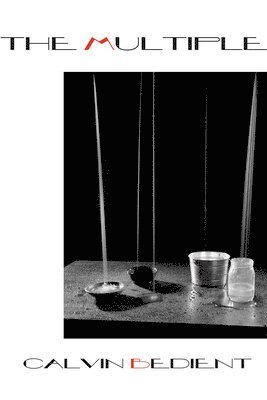
Calvin Bedient's fourth collection, The Multiple, meets an unspeakably excessive reality with an unremitting intensity of its own. The "multiple" in question is the imbroglio of entwinements and failed copulas within us and all around us, the reality underlying and giving the lie to our stereotypes. Dazzlingly resourceful-witty, multi-tonal, musical, propositional, painterly-the poems thump the increasingly empty box of cultural goods, an inheritance that isn't really ours. We are left with a naked need for creativity in a cosmos whose gift of time is a gift of chaos. If in a universe that is "not-one . . . the rhapsodic is the avenue to the truth," as Alain Badiou says, the quality of the rhapsodic in The Multiple is as cacophonous and unforgiving as it is lyrical and hooked. The truth is extreme, this aggressively uncensored book says, as it battles to give equal power to a savage voice and a soaring voice. Strong in their invisible architecture, these are poems of wild openness and sheer aliveness.