Carlo Testa - Böcker
Visar alla böcker från författaren Carlo Testa. Handla med fri frakt och snabb leverans.
4 produkter
4 produkter
518 kr
Skickas inom 10-15 vardagar
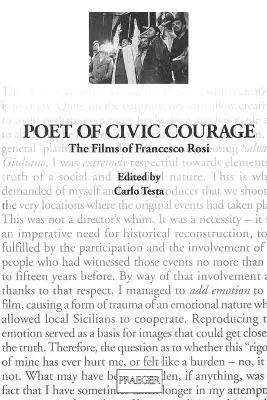
Rosi's films consistently and directly address the themes of political and institutional corruption and the complex relationship between the individual, the mafia, and the state. Whether evoking the multiple facets of Sicilian banditry in Salvatore Giuliano (1962), exposing right-wing killing squads in Cadaveri eccellenti (Illustrious Corpses) (1976), or courageously debating the roots of Italian terrorism in ^ITre fratelli (Three Brothers)^R (1981), his gripping political-documentary works have managed to combine factual and intellectual rigor with box office success and wide critical acclaim. This book offers a series of essays by leading Italian academics, each exploring a key Rosi film, together with an interview and comprehensive bibliographic and filmographic material. A notable feature is an article by the director himself, in which he reflects on the development and future of Italian political cinema.This book offers a series of essays by leading Italian academics, each exploring a key Rosi film, together with an interview and comprehensive bibliographic and filmographic material. A notable feature is an article by the director himself, in which he reflects on the development and future of Italian political cinema.
1 160 kr
Skickas inom 10-15 vardagar
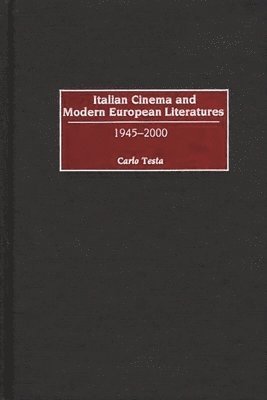
The history of cinema, and notably that of post-war Italian cinema, can only be understood adequately in the context of other contiguous cultural disciplines. World literature, including that of France, Germany, and Russia, played a key role in the development of post-war Italian film and the cinematic technique it has come to embody. Moving away from the usual modes of defining this period—a trajectory that begins with neorealism and ends with Bertolucci—author Carlo Testa offers proof that coming to terms with literary texts is an essential step toward understanding the motion pictures they influenced.The means of recreating literature for the screen has changed drastically over the last half-century, as has the impact of different national traditions on Italian cinema. Testa's work is the first to explicitly and deliberately link postwar Italian cinema to general intellectual concerns such as the relationship between literary authors and cinematic auteurs. Moreover, his analysis of the impact of French, German, and Russian cultures on Italy brings forth a new reading of Italian cinema, a new paradigm for exploring complex issues of authorship, culture, and art.
1 052 kr
Skickas inom 11-20 vardagar
The movie screen has been the forum for many star pairings: Bogart and Bacall, Tracy and Hepburn, and Fellini and Kafka. While this latter combination might seem slightly unexpected or improbable at first sight, Carlo Testa's Masters of Two Arts demonstrates that pairings of famed directors and writers are commonplace in modern Italian cinema. Surprisingly, the study of the interrelation between Italian cinema and European literature has been almost completely neglected in film scholarship. Testa addresses and attempts to correct this oversight with nine in-depth analyses of the one-on-one rapport between an Italian filmmaker and a "classic" name in modern European literature. Looking at combinations such as Pasolini and Sade, Rossellini and Stendhal, and Visconti and Mann amongst others, Testa uses theoretical as well as historical methods, showing how the respective text undergoes not 'adaptation' but full 're-creation' (as defined by Èizenshtein) in a different art form and, even more importantly, in a new cultural context.
522 kr
Skickas inom 7-10 vardagar
The movie screen has been the forum for many star pairings: Bogart and Bacall, Tracy and Hepburn, and Fellini and Kafka. While this latter combination might seem slightly unexpected or improbable at first sight, Carlo Testa's Masters of Two Arts demonstrates that pairings of famed directors and writers are commonplace in modern Italian cinema. Surprisingly, the study of the interrelation between Italian cinema and European literature has been almost completely neglected in film scholarship. Testa addresses and attempts to correct this oversight with nine in-depth analyses of the one-on-one rapport between an Italian filmmaker and a "classic" name in modern European literature. Looking at combinations such as Pasolini and Sade, Rossellini and Stendhal, and Visconti and Mann amongst others, Testa uses theoretical as well as historical methods, showing how the respective text undergoes not 'adaptation' but full 're-creation' (as defined by Èizenshtein) in a different art form and, even more importantly, in a new cultural context.