Carolyn Yerkes – författare
Visar alla böcker från författaren Carolyn Yerkes. Handla med fri frakt och snabb leverans.
2 produkter
2 produkter
666 kr
Skickas inom 5-8 vardagar
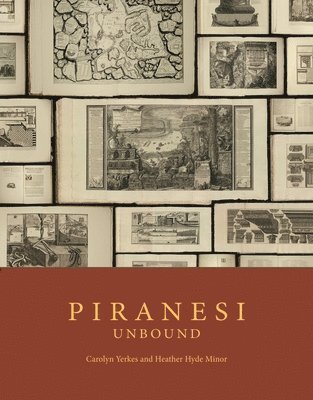
Why Piranesi’s greatest works weren’t his famous prints but rather the books for which he made themA draftsman, printmaker, architect, and archaeologist, Giovanni Battista Piranesi (1720–78) is best known today as the virtuoso etcher of the immersive and captivating Views of Rome and the darkly inventive Imaginary Prisons. Yet Carolyn Yerkes and Heather Hyde Minor argue that his single greatest art form—one that combined his obsessions most powerfully and that he pursued throughout his career—was the book. Piranesi Unbound provides a fundamental reinterpretation of Piranesi by recognizing him, first and foremost, as a writer, illustrator, printer, and publisher of books.Featuring nearly two hundred of Piranesi’s engravings and drawings, including some that have never been published before, this visually stunning book returns Piranesi’s artworks to the context for which he originally produced them: a dozen volumes that combine text and image, archaeology and imagination, erudition and humor. Drawing on new research, Piranesi Unbound uncovers the social networks in which Piranesi published, including the readers who bought, read, and debated his books. It reveals his habit of raiding the wastepaper pile for cast-off sheets upon which to draw and fuse printed images and texts. It shows how, even after his books were bound, they were subject to change by Piranesi and others as pages were torn out and added.The first major exploration of the lives of Piranesi’s books, Piranesi Unbound reimagines the full range of the artist’s creativity by showing how it is inextricably bound to his career as a maker of books.
1 081 kr
Kommande
The first in-depth study of siege prints, a monumental form of art depicting the vast scale of early modern warfareIn the first half of the sixteenth century, the technologies of artillery warfare and large-format printmaking converged to give rise to a new type of art. Siegelands examines an extraordinary series of enormous woodcuts created in the Holy Roman Empire at a time when political turmoil and religious strife tore apart northern Europe.As the distance between enemies became the defining condition of war, artists confronted the challenge of representing a slow form of violence that was singularly unheroic. Sieges were vast gatherings of people, mobile camps on the scale of temporary cities that aimed to conquer an enemy through attrition rather than through combat. The makers of monumental siege prints confronted these realities by pushing the limits of their medium.With superb illustrations, many published here for the first time, Siegelands recovers a neglected genre of art that arose at a pivotal moment in European history. Carolyn Yerkes describes the complicated narratives of strategy, attack, settlement, and stalemate embedded in the context of landscape and urban architecture. These works on paper—designed to rival the period’s grandest achievements in tapestry, fresco painting, and relief sculpture—were created from multiple sheets to form expansive wall-sized compositions, many of which survive only in single impressions. With the ambition of history painting, the prints brought sophisticated political arguments about the stakes of war to the society that war created.