Catharine Edwards - Böcker
Visar alla böcker från författaren Catharine Edwards. Handla med fri frakt och snabb leverans.
11 produkter
11 produkter
518 kr
Skickas inom 5-8 vardagar
For the Romans, the manner of a person’s death was the most telling indication of their true character. Death revealed the true patriot, the genuine philosopher, even, perhaps, the great artist—and certainly the faithful Christian. Catharine Edwards draws on the many and richly varied accounts of death in the writings of Roman historians, poets, and philosophers, including Cicero, Lucretius, Virgil, Seneca, Petronius, Tacitus, Tertullian, and Augustine, to investigate the complex significance of dying in the Roman world.Death in the Roman world was largely understood and often literally viewed as a spectacle. Those deaths that figured in recorded history were almost invariably violent—murders, executions, suicides—and yet the most admired figures met their ends with exemplary calm, their last words set down for posterity. From noble deaths in civil war, mortal combat between gladiators, political execution and suicide, to the deathly dinner of Domitian, the harrowing deaths of women such as the mythical Lucretia and Nero’s mother Agrippina, as well as instances of Christian martyrdom, Edwards engagingly explores the culture of death in Roman literature and history.
577 kr
Skickas inom 7-10 vardagar
Rome stands today for an empire and for a city. The essays gathered in this volume explore some of the many ways in which the two were interwoven. Rome was fed, beautified and enriched by empire just as it was swollen, polluted, infected and occupied by it. Empire was paraded in the streets of Rome, and exhibited in the city's buildings. Empire also made the city ineradicably foreign, polyglot, an alien capital, and a focus for un-Roman activities. The city was where the Roman cosmos was most concentrated, and so was most contested. Deploying a range of methodologies on materials ranging from Egyptian obelisks to human skeletal remains, via Christian art and Latin poetry, the contributors to this volume weave a series of pathways through the world-city, exploring the different kinds of centrality Rome had in the empire. The result is a startlingly original picture of both empire and city.
577 kr
Skickas inom 7-10 vardagar
This collection of essays explores aspects of the reception of ancient Rome in a number of European countries from the late eighteenth century to the end of the Second World War. Rome has been made to stand for literary authority, republican heroism, imperial power and decline, the Catholic Church, the pleasure of ruins. The studies offered here examine some of the sometimes strange and unexpected places where Roman presences have manifested themselves during this period. Scholars from several disciplines, including English literature and history of art, as well as classics, bring to bear a variety of approaches on a wide range of images and texts, from statues of Napoleon to Freud's analysis of dreams. Rome's seemingly boundless capacity for multiple, indeed conflicting, signification has made it an extraordinarily fertile paradigm for making sense of - and also for destabilizing - history, politics, identity, memory and desire.
1 172 kr
Skickas inom 7-10 vardagar
The letters of Seneca are uniquely engaging among the works that have survived from antiquity. They offer an urgent guide to Stoic self-improvement but also cast light on Roman attitudes towards slavery, gladiatorial combat and suicide. This selection of letters conveys their range and variety, with a particular focus on letters from the earlier part of the collection. As well as a general introduction, it features a brief introductory essay on each letter, which draws out its themes and sets it in context. The commentary explains the more challenging aspects of Seneca's Latin. It also casts light on his engagement with Stoic (and Epicurean) ideas, on the historical context within which the letters were written and on their literary sophistication. This edition will be invaluable for undergraduate and graduate students and scholars of Seneca's moral and intellectual development.
441 kr
Skickas inom 7-10 vardagar
The letters of Seneca are uniquely engaging among the works that have survived from antiquity. They offer an urgent guide to Stoic self-improvement but also cast light on Roman attitudes towards slavery, gladiatorial combat and suicide. This selection of letters conveys their range and variety, with a particular focus on letters from the earlier part of the collection. As well as a general introduction, it features a brief introductory essay on each letter, which draws out its themes and sets it in context. The commentary explains the more challenging aspects of Seneca's Latin. It also casts light on his engagement with Stoic (and Epicurean) ideas, on the historical context within which the letters were written and on their literary sophistication. This edition will be invaluable for undergraduate and graduate students and scholars of Seneca's moral and intellectual development.
500 kr
Skickas inom 7-10 vardagar
The city of Rome is built not only of bricks and marble but also of the words of its writers. For the ancient inhabitant or visitor, the buildings of Rome, the public spaces of the city, were crowded with meanings and associations. These meanings were generated partly through activities associated with particular places, but Rome also took on meanings from literature written about the city: stories of its foundation, praise of its splendid buildings, laments composed by those obliged to leave it. Ancient writers made use of the city to explore the complexities of Roman history, power and identity. This book aims to chart selected aspects of Rome's resonance in literature and the literary resonance of Rome. A wide range of texts are explored, from later periods as well as from antiquity, since, as the author hopes to show, Gibbon, Goethe and others can be revealing guides to the literary topography of ancient Rome.
1 282 kr
Skickas inom 7-10 vardagar
This collection of essays explores aspects of the reception of ancient Rome in a number of European countries from the late eighteenth century to the end of the Second World War. Rome has been made to stand for literary authority, republican heroism, imperial power and decline, the Catholic Church, the pleasure of ruins. The studies offered here examine some of the sometimes strange and unexpected places where Roman presences have manifested themselves during this period. Scholars from several disciplines, including English literature and history of art, as well as classics, bring to bear a variety of approaches on a wide range of images and texts, from statues of Napoleon to Freud's analysis of dreams. Rome's seemingly boundless capacity for multiple, indeed conflicting, signification has made it an extraordinarily fertile paradigm for making sense of - and also for destabilizing - history, politics, identity, memory and desire.
1 295 kr
Skickas inom 7-10 vardagar
The question this book addresses is not how immoral the ancient Romans were, but why the literature they produced is so preoccupied with immorality. The modern image of immoral Rome derives from ancient accounts which are largely critical rather than celebratory. Far from being empty commonplaces, these accusations constituted a powerful discourse through which Romans negotiated conflicts and tensions in their social and political order. This study proceeds by a detailed examination of a wide range of translated ancient texts, exploring the dynamics of their rhetoric, as well as the ends to which they were deployed. Roman moralising discourse, Edwards suggests, may be seen as especially concerned with the articulation of anxieties about gender, social status and political power. This revised edition contains a substantial new Introduction which engages with critical and scholarly developments in the study of Roman culture since the original publication.
341 kr
Skickas inom 7-10 vardagar
The question this book addresses is not how immoral the ancient Romans were, but why the literature they produced is so preoccupied with immorality. The modern image of immoral Rome derives from ancient accounts which are largely critical rather than celebratory. Far from being empty commonplaces, these accusations constituted a powerful discourse through which Romans negotiated conflicts and tensions in their social and political order. This study proceeds by a detailed examination of a wide range of translated ancient texts, exploring the dynamics of their rhetoric, as well as the ends to which they were deployed. Roman moralising discourse, Edwards suggests, may be seen as especially concerned with the articulation of anxieties about gender, social status and political power. This revised edition contains a substantial new Introduction which engages with critical and scholarly developments in the study of Roman culture since the original publication.
Cicero's Tongue: The Life of Rome's Greatest Orator and the End of the Republic
Inbunden, Engelska, 2026
345 kr
Kommande
328 kr
Kommande
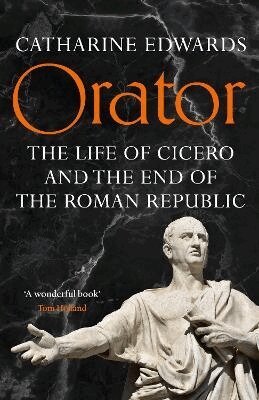
'A wonderful book'Tom Holland'Edwards has done a marvellous job of showing us Cicero the man, the scholar and the politician in highly entertaining style'Emma Southon'Orator gives us a Cicero for our times... Compelling and beautifully written'Eve MacDonald, author of CarthageA gripping new biography of one of the most influential and fascinating figures in classical history: CiceroWhen the Roman statesman Cicero was murdered in 43 BCE, his head was cut off and his tongue pierced with pins – a final, brutal act of revenge against a man whose words had shaped a generation and made him many enemies. Rising from provincial obscurity to the highest elected office in Rome, Cicero became the greatest orator of his age, a figure who believed that speech itself could defend a republic.Yet Cicero was far more than a master of rhetoric. His long and turbulent life unfolded alongside the collapse of the Roman Republic, and often at its very centre. He moved among Julius Caesar and Pompey the Great, crushed a conspiracy that threatened the foundations of Rome and cast himself as the republic’s last hope. His writings on politics, philosophy and society would prove enormously influential, while his uneasy response to the rise of autocratic power continues to provoke admiration and debate.In this gripping new biography, the distinguished classicist Catharine Edwards brings Cicero vividly to life, revealing both the brilliance and the contradictions of a man caught between principle and ambition. At a moment when democratic institutions feel fragile, and the power of persuasion is once again under scrutiny, Cicero’s life speaks to us with renewed urgency.