Charles Bambach - Böcker
Visar alla böcker från författaren Charles Bambach. Handla med fri frakt och snabb leverans.
8 produkter
8 produkter
234 kr
Skickas inom 7-10 vardagar
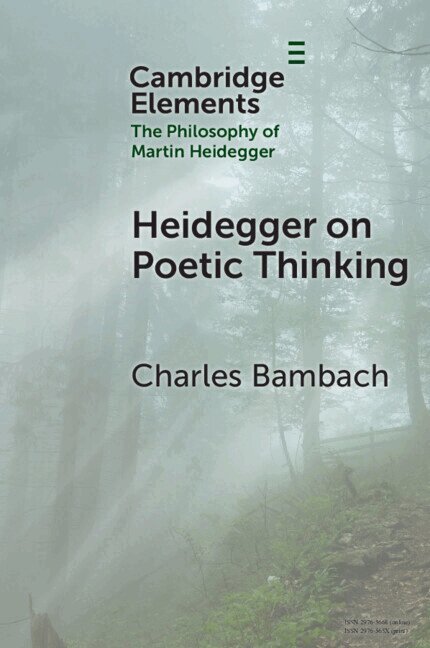
One of the striking features of Heidegger's philosophical engagement concerns his privileging of poetry and poetic thinking. In this understanding of language as fundamentally poetic, Heidegger puts forward a different way to do philosophy. In this Element, the author places Heidegger's poetic thinking in conversation with Sophocles and Hölderlin as a way to situate his critique of global technology and instrumental thinking in the postwar years. This Element also offers a critique of Heidegger's efforts to arrogate poetic thinking to his own aim of a destinal form of German national self-assertion through poetry. Overall, the aim here is to show how crucial poetic thinking is to the way Heidegger understands philosophy as a radical engagement with language.
753 kr
Skickas inom 7-10 vardagar
One of the striking features of Heidegger's philosophical engagement concerns his privileging of poetry and poetic thinking. In this understanding of language as fundamentally poetic, Heidegger puts forward a different way to do philosophy. In this Element, the author places Heidegger's poetic thinking in conversation with Sophocles and Hölderlin as a way to situate his critique of global technology and instrumental thinking in the postwar years. This Element also offers a critique of Heidegger's efforts to arrogate poetic thinking to his own aim of a destinal form of German national self-assertion through poetry. Overall, the aim here is to show how crucial poetic thinking is to the way Heidegger understands philosophy as a radical engagement with language.
463 kr
Tillfälligt slut
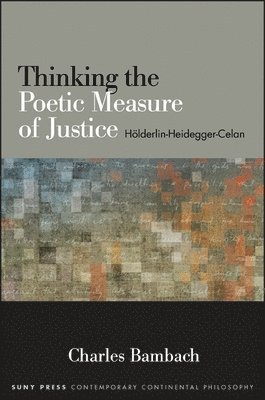
A new reading of justice engaging the work of two philosophical poets who stand in conversation with the work of Martin Heidegger.What is the measure of ethics? What is the measure of justice? And how do we come to measure the immeasurability of these questions? Thinking the Poetic Measure of Justice situates the problem of justice in the interdisciplinary space between philosophy and poetry in an effort to explore the sources of ethical life in a new way. Charles Bambach engages the works of two philosophical poets who stand as the bookends of modernity-Friedrich Hölderlin (1770–1843) and Paul Celan (1920–1970)-offering close textual readings of poems from each that define and express some of the crucial problems of German philosophical thought in the twentieth century: tensions between the native and the foreign, the proper and the strange, the self and the other. At the center of this philosophical conversation between Hölderlin and Celan, Bambach places the work of Martin Heidegger to rethink the question of justice in a nonlegal, nonmoral register by understanding it in terms of poetic measure. Focusing on Hölderlin's and Heidegger's readings of pre-Socratic philosophy and Greek tragedy, as well as on Celan's reading of Kabbalah, he frames the problem of poetic justice against the trauma of German destruction in the twentieth century.
1 215 kr
Tillfälligt slut
A new reading of justice engaging the work of two philosophical poets who stand in conversation with the work of Martin Heidegger.What is the measure of ethics? What is the measure of justice? And how do we come to measure the immeasurability of these questions? Thinking the Poetic Measure of Justice situates the problem of justice in the interdisciplinary space between philosophy and poetry in an effort to explore the sources of ethical life in a new way. Charles Bambach engages the works of two philosophical poets who stand as the bookends of modernity-Friedrich Hölderlin (1770–1843) and Paul Celan (1920–1970)-offering close textual readings of poems from each that define and express some of the crucial problems of German philosophical thought in the twentieth century: tensions between the native and the foreign, the proper and the strange, the self and the other. At the center of this philosophical conversation between Hölderlin and Celan, Bambach places the work of Martin Heidegger to rethink the question of justice in a nonlegal, nonmoral register by understanding it in terms of poetic measure. Focusing on Hölderlin's and Heidegger's readings of pre-Socratic philosophy and Greek tragedy, as well as on Celan's reading of Kabbalah, he frames the problem of poetic justice against the trauma of German destruction in the twentieth century.
Philosophers and Their Poets
Reflections on the Poetic Turn in Philosophy since Kant
Häftad, Engelska, 2020
566 kr
Skickas inom 3-6 vardagar
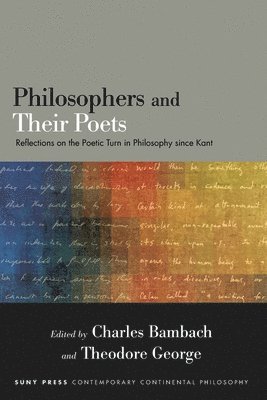
Examines the role that poets and the poetic word play in the formation of philosophical thinking in the modern German tradition.Several of the most celebrated philosophers in the German tradition since Kant afford to poetry an all-but-unprecedented status in Western thought. Fichte, Hegel, Nietzsche, Heidegger, and Gadamer argue that the scope, limits, and possibilities of philosophy are intimately intertwined with those of poetry. For them, poetic thinking itself is understood as intrinsic to the kind of thinking that defines philosophical inquiry and the philosophical life, and they developed their views through extensive and sustained considerations of specific poets, as well as specific poetic figures and images. This book offers essays by leading scholars that address each of the major figures of this tradition and the respective poets they engage, including Schiller, Archilochus, Pindar, Hölderlin, Eliot, and Celan, while also discussing the poets' contemporary relevance to philosophy in the continental tradition.Above all, the book explores an approach to language that rethinks its role as a mere tool for communication or for the dissemination of knowledge. Here language will be understood as an essential event that opens up the world in a primordial sense whereby poetry comes to have a deeply ethical significance for human beings. In this way, the volume positions ethics at the center of continental discourse, even as it engages philosophy itself as a discourse about language attuned to the rigor of what poetry ultimately expresses.
Philosophers and Their Poets
Reflections on the Poetic Turn in Philosophy since Kant
Inbunden, Engelska, 2019
1 057 kr
Tillfälligt slut
Examines the role that poets and the poetic word play in the formation of philosophical thinking in the modern German tradition.Several of the most celebrated philosophers in the German tradition since Kant afford to poetry an all-but-unprecedented status in Western thought. Fichte, Hegel, Nietzsche, Heidegger, and Gadamer argue that the scope, limits, and possibilities of philosophy are intimately intertwined with those of poetry. For them, poetic thinking itself is understood as intrinsic to the kind of thinking that defines philosophical inquiry and the philosophical life, and they developed their views through extensive and sustained considerations of specific poets, as well as specific poetic figures and images. This book offers essays by leading scholars that address each of the major figures of this tradition and the respective poets they engage, including Schiller, Archilochus, Pindar, Hölderlin, Eliot, and Celan, while also discussing the poets' contemporary relevance to philosophy in the continental tradition.Above all, the book explores an approach to language that rethinks its role as a mere tool for communication or for the dissemination of knowledge. Here language will be understood as an essential event that opens up the world in a primordial sense whereby poetry comes to have a deeply ethical significance for human beings. In this way, the volume positions ethics at the center of continental discourse, even as it engages philosophy itself as a discourse about language attuned to the rigor of what poetry ultimately expresses.
608 kr
Skickas inom 3-6 vardagar
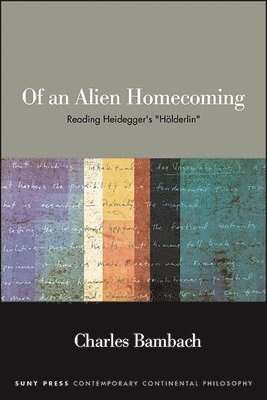
The first book-length study in English of the Heidegger-Hölderlin relation, addressing the tension between Heidegger's political commitments during National Socialism and Hölderlin's ideal of poetic dwelling.Few themes resonate as powerfully in Heidegger as those connected to homecoming, homeland, and Heimat. This emphasis plays out most powerfully in Heidegger's reading of Hölderlin and his turn towards language, art, and poetizing as a way of thinking through the poet's relevance in the epoch of homelessness and the abandonment of the gods. As the first book-length study in English of the Heidegger-Hölderlin relation, Of an Alien Homecoming addresses the tension within Heidegger's work between his disastrous political commitments during the era of National Socialism and his attempts to open a path to a German future nurtured on Hölderlin's ideal of poetic dwelling. Charles Bambach reads this work on Hölderlin from 1934–1948 in conversation with the Black Notebooks and Heidegger's metapolitics, even as he uncovers an ethical dimension within Heidegger that pervades his reading of poetry. Throughout all of these various stages on Heidegger's thought path, Hölderlin remains the poet who poetizes the possibility of finding our lost home amidst the homelessness brought about in the epoch of technological thinking.
1 456 kr
Skickas inom 3-6 vardagar
The first book-length study in English of the Heidegger-Hölderlin relation, addressing the tension between Heidegger's political commitments during National Socialism and Hölderlin's ideal of poetic dwelling.Few themes resonate as powerfully in Heidegger as those connected to homecoming, homeland, and Heimat. This emphasis plays out most powerfully in Heidegger's reading of Hölderlin and his turn towards language, art, and poetizing as a way of thinking through the poet's relevance in the epoch of homelessness and the abandonment of the gods. As the first book-length study in English of the Heidegger-Hölderlin relation, Of an Alien Homecoming addresses the tension within Heidegger's work between his disastrous political commitments during the era of National Socialism and his attempts to open a path to a German future nurtured on Hölderlin's ideal of poetic dwelling. Charles Bambach reads this work on Hölderlin from 1934–1948 in conversation with the Black Notebooks and Heidegger's metapolitics, even as he uncovers an ethical dimension within Heidegger that pervades his reading of poetry. Throughout all of these various stages on Heidegger's thought path, Hölderlin remains the poet who poetizes the possibility of finding our lost home amidst the homelessness brought about in the epoch of technological thinking.