Charles E. Carraher - Böcker
Visar alla böcker från författaren Charles E. Carraher. Handla med fri frakt och snabb leverans.
5 produkter
5 produkter
1 073 kr
Skickas inom 10-15 vardagar
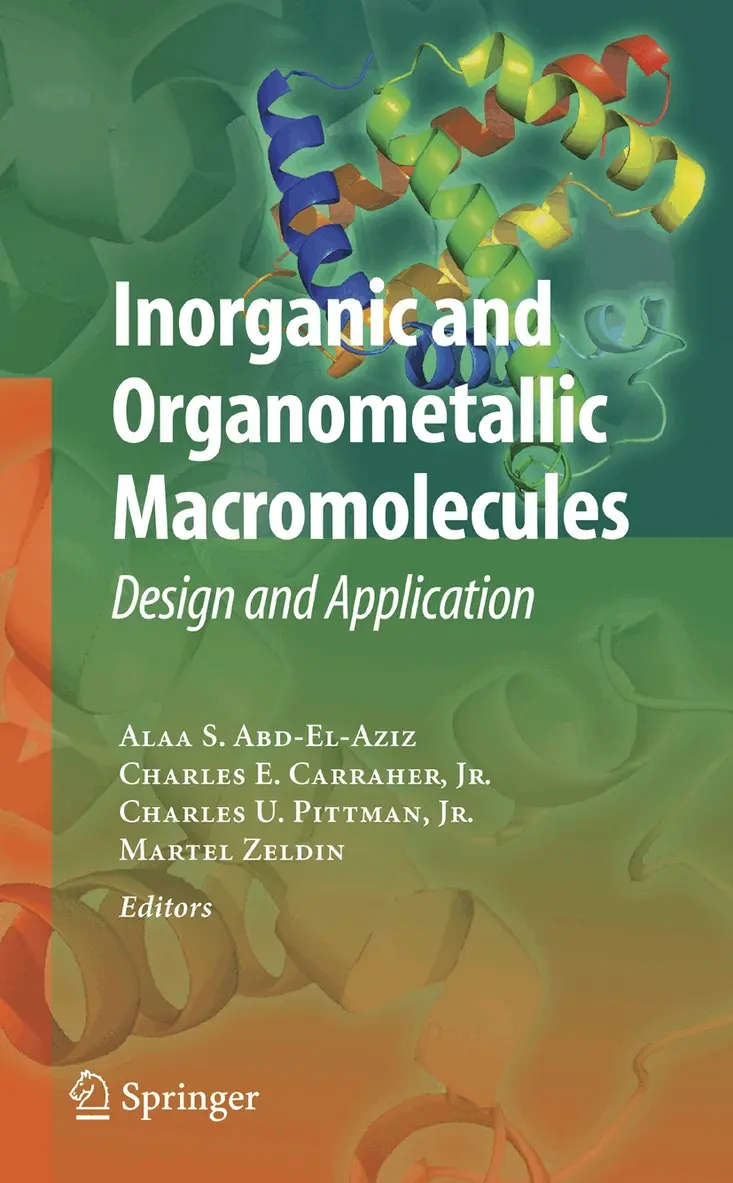
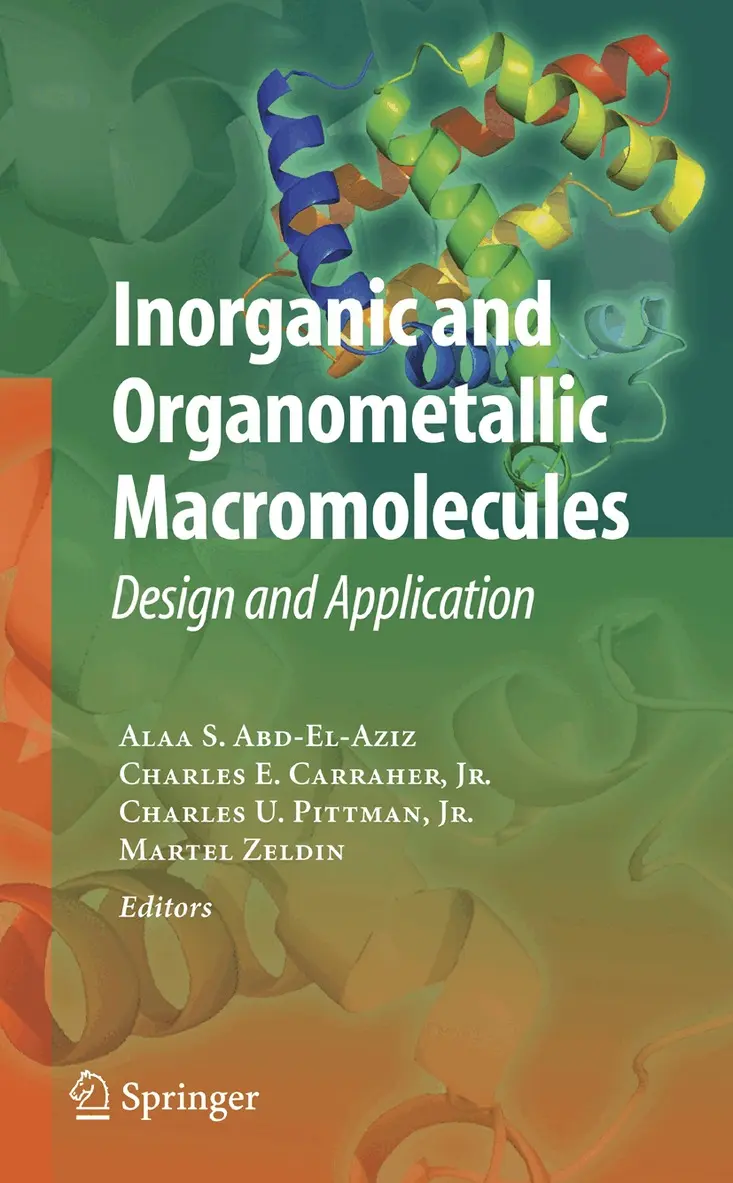
Polymeric materials of the 21st century often contain atoms that are not present in traditional polymers. Polymers containing nontraditional atoms are now of interest because of their unique properties. This book demonstrates the breadth of these properties and some of the specialized analytical techniques that have been developed to characterize them. Chapters 1, 2, 3, 4 and 7 emphasize the emerging special properties of mate- als dealing with the transmission of light for the purpose of communication, as well as other efforts. Later chapters deal with the use of materials in treating a variety of disease-causing microbes—including viruses responsible for pandemic herpes and the common cold (Chapter 8), cancers (Chapter 11), and bacterial infections (Chapter 17). The interaction of these materials for future biological investigations is investigated in Chapters 5 and 6. Chapter 12 provides a comprehensive review of the application of Mössbauer spectroscopy to metal-containing polymers and Chapter 13 reviews the application of a new mass spectrometry technique. The use of metal-containing polymers as catalysts is described in Chapters 1, 9, and 10. Their use as precursors for advanced ceramics (Chapter 14), high temperature materials (Chapter 15), and flame reta- ants (Chapter 16) is also discussed. The unusual property of selected materials to spontaneously form fibers is described in Chapter 18.
1 073 kr
Skickas inom 10-15 vardagar
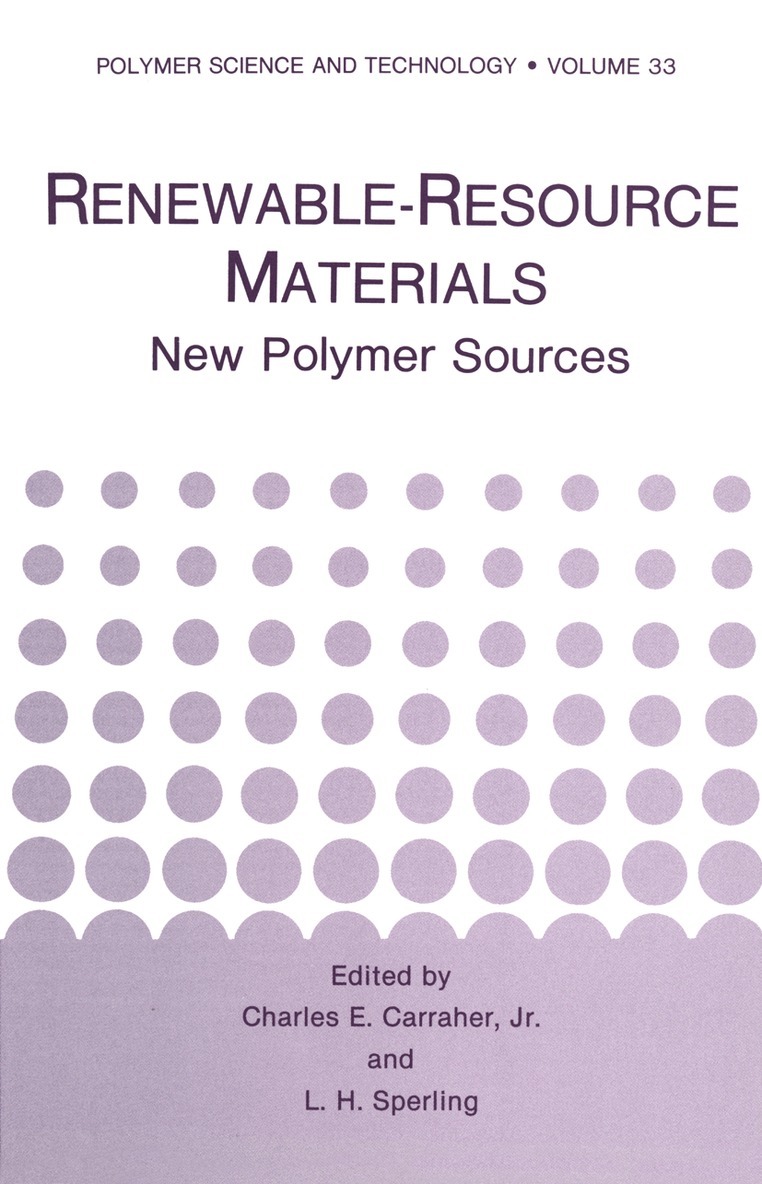
I will plant in the wilderness the cedar the acacia-tree and the myrtle and the oil-tree; I will set in the desert the cypress, the plane-tree and the larch together; That they may see, and know and consider and understand together, That the hand of the Lord hath done this, ••• Isaiah, 41:19 and 20 (first portion) The need to improve our utilization of the Earth's natural resources is everyone's business, from every country. This book presents papers from all parts of the world on the subject of making new or improved polymers from renewable resources, be they plastics, elastomers, fibers, coatings, or adhesives. In important ways, this book constitutes part II of an edited work published by Plenum Press in 1983, "Polymer Applications of Renewable-Resource Materials. " To that extent, about half of the authors are the same. However, their papers present an update of their research three years later. The other half of the authors are entirely new. Bo~h of these books grew out of symposia sponsored by the Polymeric Materials: Science and Engineering Division of the American Chemical Society. The papers for the present book are based loosely on a symposium held at the Miami Beach meeting in April, 1985. Unfortunately, interest in polymers from renewable resources fluctuates with the price and availability of petroleum oil. At the time of writing this preface, the price is low, and appears to be headed lower still.
540 kr
Skickas inom 10-15 vardagar
The sheer volume of topics which could have been included under our general title prompted us to make some rather arbitrary decisions about content. Modification by irradiation is not included because the activity in this area is being treated elsewhere. We have chosen to emphasize chemical routes to modification and have striven to pre- sent as balanced a representation of current activity as time and page count permit. Industrial applications, both real and potential, are included. Where appropriate, we have encouraged the contributors to include review material to help provide the reader with adequate context. The initial chapter is a review from a historical perspective of polymer modification and contains an extensive bibliography.The remainder of the book is divided into four general areas: Reactions and Preparation of Copolymers Reactions and Preparation of Block and Graft Copolymers Modification Through Condensation Reactions Applications The chemical modification of homopolymers such as polyvinylchlo- ride, polyethylene, poly(chloroalkylene sulfides), polysulfones, poly- chloromethylstyrene, polyisobutylene, polysodium acrylate, polyvinyl alcohol, polyvinyl chloroformate, sulfonated polystyrene; block and graft copolymers such as poly(styrene-block-ethylene-co-butylene- block-styrene), poly(I,4-polybutadiene-block ethylene oxide), star chlorine-telechelic polyisobutylene, poly(isobutylene-co-2,3-dimethyl- 1,3-butadiene), poly(styrene-co-N-butylmethacrylate); cellulose, dex- tran and inulin, is described.
540 kr
Skickas inom 10-15 vardagar
The vast array of libraries in the world bear mute witness to the truth of the 3000-year-old observation of King Solomon who stated " ... of making many books there is no end, and much study is a weariness of the flesh." Yet books are an essential written record of our lives and the progress of science and humanity. Here is another book to add to this huge collection, but, hopefully, not just another collection of pages, but rather a book with a specific purpose to aid in alleviating the "weariness of the flesh" that could arise from much studying of other journals and books in order to obtain the basic information contained herein. This book is about polymeric materials and biological activity, as the title notes. Polymeric materials, in the broad view taken here, would include not only synthetic polymers (e.g., polyethylene, polyvinyl chloride, polyesters, polyamides, etc.), but also the natural macromolecules (e.g., proteins, nucleic acids, polysaccharides) which compose natural tissues in humans, animals and plants. In the broad sense used here, biological activity is any type of such action whether it be in medication, pest control, plant-growth regu lation, and so on. In short, this book attempts to consider, briefly, the use of any type of polymeric material system with essentially any kind of biological activity.
1 073 kr
Skickas inom 10-15 vardagar
Polymeric materials of the 21st century often contain atoms that are not present in traditional polymers. Polymers containing nontraditional atoms are now of interest because of their unique properties. This book demonstrates the breadth of these properties and some of the specialized analytical techniques that have been developed to characterize them. Chapters 1, 2, 3, 4 and 7 emphasize the emerging special properties of mate- als dealing with the transmission of light for the purpose of communication, as well as other efforts. Later chapters deal with the use of materials in treating a variety of disease-causing microbes—including viruses responsible for pandemic herpes and the common cold (Chapter 8), cancers (Chapter 11), and bacterial infections (Chapter 17). The interaction of these materials for future biological investigations is investigated in Chapters 5 and 6. Chapter 12 provides a comprehensive review of the application of Mössbauer spectroscopy to metal-containing polymers and Chapter 13 reviews the application of a new mass spectrometry technique. The use of metal-containing polymers as catalysts is described in Chapters 1, 9, and 10. Their use as precursors for advanced ceramics (Chapter 14), high temperature materials (Chapter 15), and flame reta- ants (Chapter 16) is also discussed. The unusual property of selected materials to spontaneously form fibers is described in Chapter 18.