Charles U. Pittman - Böcker
Visar alla böcker från författaren Charles U. Pittman. Handla med fri frakt och snabb leverans.
5 produkter
5 produkter
1 064 kr
Skickas inom 10-15 vardagar
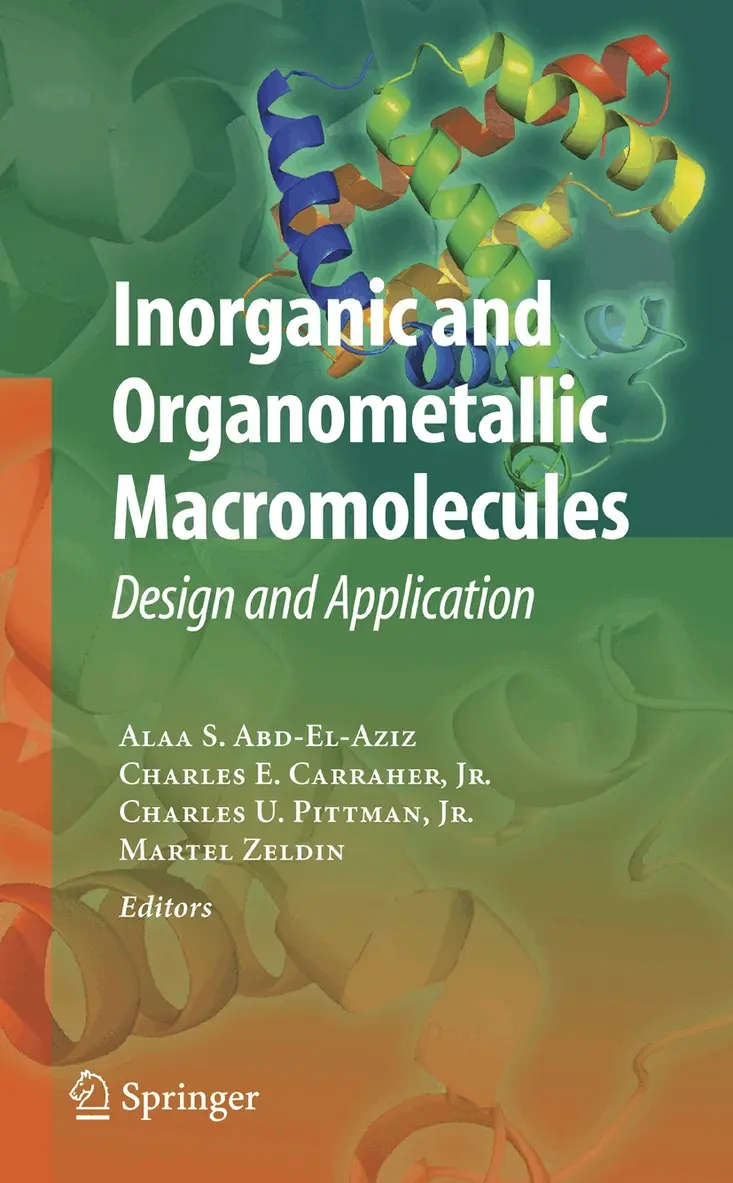
Polymeric materials of the 21st century often contain atoms that are not present in traditional polymers. Polymers containing nontraditional atoms are now of interest because of their unique properties. This book demonstrates the breadth of these properties and some of the specialized analytical techniques that have been developed to characterize them. Chapters 1, 2, 3, 4 and 7 emphasize the emerging special properties of mate- als dealing with the transmission of light for the purpose of communication, as well as other efforts. Later chapters deal with the use of materials in treating a variety of disease-causing microbes—including viruses responsible for pandemic herpes and the common cold (Chapter 8), cancers (Chapter 11), and bacterial infections (Chapter 17). The interaction of these materials for future biological investigations is investigated in Chapters 5 and 6. Chapter 12 provides a comprehensive review of the application of Mössbauer spectroscopy to metal-containing polymers and Chapter 13 reviews the application of a new mass spectrometry technique. The use of metal-containing polymers as catalysts is described in Chapters 1, 9, and 10. Their use as precursors for advanced ceramics (Chapter 14), high temperature materials (Chapter 15), and flame reta- ants (Chapter 16) is also discussed. The unusual property of selected materials to spontaneously form fibers is described in Chapter 18.
536 kr
Skickas inom 10-15 vardagar
Research on metal-containing polymers began in the early 1960's when several workers found that vinyl ferrocene and other vinylic transition metal u -com plexes would undergo polymerization under the same conditions as conventional organic monomers to form high polymers which incorporated a potentially reactive metal as an integral part of the polymer structures. Some of these materials could act as semi-conducters and pos sessed one or two dimensional conductivity. Thus appli cations in electronics could be visualized immediately. Other workers found that reactions used to make simple metal chelates could be used to prepare polymers if the ligands were designed properly. As interest in homo geneous catalysts developed in the late 60's and early 70's, several investigators began binding homogeneous catalysts onto polymers, where the advantage of homo geneous catalysis - known reaction mechanisms and the advantage of heterogeneous catalysis - simplicity and ease of recovery of catalysts could both be obtained. Indeed the polymer matrix itself often enhanced the selectivity of the catalyst.
634 kr
Skickas inom 5-8 vardagar
536 kr
Skickas inom 10-15 vardagar
Interest in preparing new polymers peaked about 1966. Since that time, industrial and government support for the synthesis and study of new polymers has steadily declined. Gone are the good days when government funds supported a great push to attain ulti mate thermal stability for organic polymeric materials. Gone are the good days when many chemical companies, encouraged by the obvious potential for rewards, had great interest and provided support for preparing new polymers. We now often hear managers say "we have enough polymers" or "all we need to do is find additional and better ways to use existing polymers. " The latter often in cludes the statement, "we can get the new materials that are wanted from polymer alloys or blends. " Interest in preparing new monomers has also waned, even though it is well recognized that monomers with special functionality are greatly needed to fine-tune existing polymers for specific tasks. Shrinkage of interest in new monomer and polymer research has not come about solely as a result of the obvious maturity of the polymers industry. Since uses for polymers continue to grow and there is still room for good concepts to study, lack of market growth and fields of study have probably not significantly contribu ted to that shrinkage.
1 064 kr
Skickas inom 10-15 vardagar
Polymeric materials of the 21st century often contain atoms that are not present in traditional polymers. Polymers containing nontraditional atoms are now of interest because of their unique properties. This book demonstrates the breadth of these properties and some of the specialized analytical techniques that have been developed to characterize them. Chapters 1, 2, 3, 4 and 7 emphasize the emerging special properties of mate- als dealing with the transmission of light for the purpose of communication, as well as other efforts. Later chapters deal with the use of materials in treating a variety of disease-causing microbes—including viruses responsible for pandemic herpes and the common cold (Chapter 8), cancers (Chapter 11), and bacterial infections (Chapter 17). The interaction of these materials for future biological investigations is investigated in Chapters 5 and 6. Chapter 12 provides a comprehensive review of the application of Mössbauer spectroscopy to metal-containing polymers and Chapter 13 reviews the application of a new mass spectrometry technique. The use of metal-containing polymers as catalysts is described in Chapters 1, 9, and 10. Their use as precursors for advanced ceramics (Chapter 14), high temperature materials (Chapter 15), and flame reta- ants (Chapter 16) is also discussed. The unusual property of selected materials to spontaneously form fibers is described in Chapter 18.