Charles Hucker - Böcker
Visar alla böcker från författaren Charles Hucker. Handla med fri frakt och snabb leverans.
3 produkter
3 produkter
138 kr
Skickas inom 7-10 vardagar
In the first study of Two Studies on Ming History, Charles O. Hucker presents an account of a military campaign that provides insight into the nature of civil officials’ authority, decision-making, and relationship with the Ming court. In the spring and summer of 1556, a Chinese renegade named Hsü Hai led an invading group of Japanese and Chinese soldiers on a plundering foray through the northeastern sector of Chekiang province. Opposing them was a military establishment that for years past had been battered by coastal raiders, now under the control of an ambitious and clever official named Hu Tsung-hsien. The campaign was not one of the most consequential in China’s military history, even during the Ming dynasty (1368–1644). But it was famous and well reported in its time, and it illustrates some of the unusual ways in which the Chinese of the imperial age coped with the often unusual military problems they faced. In the second part of Two Studies, Hucker presents a translation of K’ai-tu ch’uan-hsin, a popular narrative of a spontaneous demonstration in which literati and commoners alike rose up to defend an austere and incorruptible adherent to Confucian morality who had been doomed to die because of his defiance of the ruthless and heterodox clique that had usurped imperial power. In 1626, Chinese political morality was at one of its lowest ebbs. On the throne at Peking was an incompetent twenty-one-year-old emperor who was much too occupied with puttering at carpentry to pay attention to the government. Into the vacuum stepped Wei Chung-hsien, the favorite of the emperor’s governess. Wei used brutal terror to make himself undisputed master of the vast bureaucratic mechanism that administered China. One of Wei’s many victims was Chou Shun-ch’ang, a member of the official class who was said to have hated evil as a personal enemy. Chou became critical of Wei, an order was put out for Chou’s arrest, and a popular uprising occurred in protest.
138 kr
Skickas inom 7-10 vardagar
In the latter half of the fourteenth century, at one end of the Eurasian continent, the stage was not yet set for the emergence of modern nation-states. At the other end, the Chinese drove out their Mongol overlords, inaugurated a new native dynasty called Ming (1368–1644), and reasserted the mastery of their national destiny. It was a dramatic era of change, the full significance of which can only be perceived retrospectively. With the establishment of the Ming dynasty, a major historical tension rose into prominence between more absolutist and less absolutist modes of rulership. This produced a distinctive style of rule that modern students have come to call Ming despotism. It proved a capriciously absolutist pattern for Chinese government into our own time. [1, 2 ,3]
401 kr
Skickas inom 7-10 vardagar
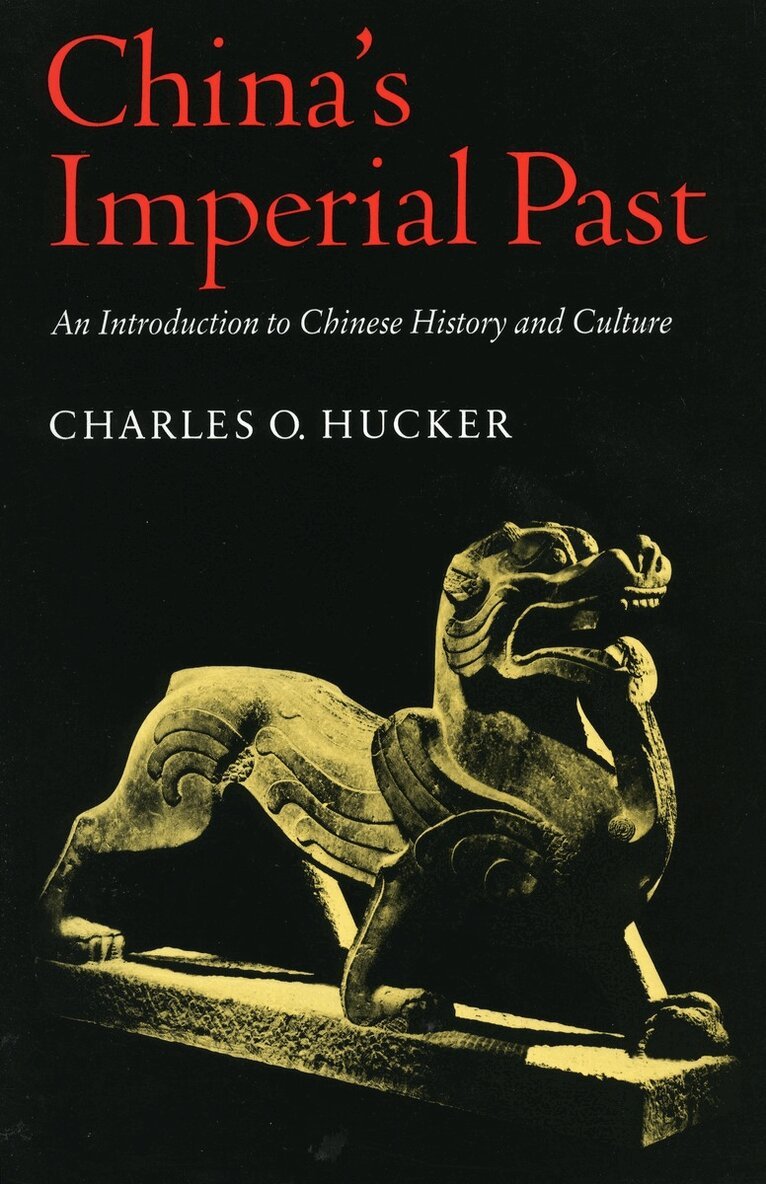
A work unique in the sweep of its design and scope, intended expressly for the general reader interested in human history and culture, this is a vivid panoramic survey of the vast course of Chinese civilization from prehistory to 1850, when the old China began the agonizing transition to the new. Historical surveys of China tend to be dynasty-by-dynasty chronicles with a profusion of names and dates and occaisional cultural tidbits, or to concentrate on the period from earliest times to the Han dynasty (or the T'ang), giving only scant coverage to the last thousand years. China's Imperial Past is different. Not only does it treat the three major periods of Chinese history at roughly equal length, weaving all their complexity into a balanced, integrated whole, but it gives ample space to China's magnificent literary and artistic achievements.The author's approach is primarily interpretive, emphasizing patterns of change and development rather than factual details, but he never loses sight of the particularities that made traditional Chinese civilization one of the richest in human history. Especially notable are the many translations of Chinese poetry, among them more than twenty exquisite poems from the great poets of the T'ang.The author divides Chinese history into three major epochs: a formative age, from high antiquity to the unification of China under the Ch'in in the third century B.C.; an early imperial age, from the Han dynasty (202 B.C.-A.D. 220) through the T'ang (618-907) and its breakdown; and a later imperial age, from the Sung dynasty (960-1279) to the mid-nineteenth century. Each major epoch is considered in topical chapters—on general history, political institutions, socioeconomic organization, religion and thought, and literature and the arts. A brief Epilogue comments on aspects of Chinese history since 1850.The book includes 47 plates, eight maps, and various charts, and as appendixes and unusually detailed chronological table, notes on the Chines language, and suggestions for supplementary reading.