Charles Neimeyer – författare
Visar alla böcker från författaren Charles Neimeyer. Handla med fri frakt och snabb leverans.
3 produkter
3 produkter
Inbunden, Engelska, 1996
1 365 kr
Skickas inom 10-15 vardagar
An exploration of the motivations, characteristics, and psychology of suicideWhy do people take their own lives? How can clinicians best plan and carry out intelligent treatment of desperate patients who are giving up on themselves?Suicide, its motivations, characteristics, and psychology are explicated in these papers by the most experienced and renowned experts on the subject. A definitive volume, Essential Papers on Suicide features the work of Ernest Jones; Kate Friedlander; George Murphy, R. H. Wilkinson, S. Gassner, and J. Kayes; Joseph C. Sabbath; Robert E. Litman; Milton Rosenbaum; Charles Swearingen; Avery D. Weisman; Mervin Glasser, Egl Laufer, Moses Laufer and Myer Wohl; Donald A. Schwartz, Don E. Flinn and Paul F. Slawson; Aaron T. Beck, Maria Kovacs and Arlene Weissman; Marie sberg, Lil Traskman and Peter Thoren; Stuart Asch; John T. Maltsberger; Alex D. Pokorny; Erna Furman; Cynthia R. Pfeffer, Robert Plutchik, Mark S. Mizruchi and Robert Lipkins; Myrna M. Weissman, Gerald L. Klerman, Jeffrey S. Markowitz and R. Oullette; Jan Fawcett, William A. Scheftner, Louis Fogg, David C. Clark, Michael A. Young, Don Hedeker, and Robert Gibbons, among others.
Häftad, Engelska, 2023
338 kr
Kommande
Understanding the Course of the War for American independence through Geographical RegionsIdentifying discrete geographical areas in order to better understand a conflict that moves across hundreds of thousands of square miles of land and water, such as the American Civil War and World War II, has been a valuable historical method. During this time of greater study of the war that made America, the authors of Theaters of the American Revolution take this approach for the first time. The result is a stimulating volume that will allow readers to see how the war flowed from region to region from 1775 to 1781, beginning in the Northern colonies and Canada, through the dark months in the Middle colonies, to a shift to the South and culmination at Yorktown. Simultaneously, the war raged up and down the western frontier, with the Patriots working to keep the British and their Indian allies from disrupting the main battle armies to the east. Equally important was the war at sea, where American privateers and a fledgling navy attempted to harass the British; but with the entrance of France to the conflict, the control of the sea took a much more balanced—and important— aspect. With specially commissioned maps and colorful descriptions of eighteenth century American terrain, settlements, and cities, as well as key battles, Theaters of the American Revolution provides an ideal introduction to understanding one of the most important wars in world history in its totality.ContentsIntroduction • James Kirby Martin and David L. PrestonThe Northern Theater • James Kirby MartinThe Middle Theater • Edward G. Lengel and Mark Edward LenderThe Southern Theater • Jim PiecuchThe Western Theater • Mark Edward LenderThe Naval Theater • Charles Neimeyer
E-bok
Engelska, 2015600 kr
Läs direkt efter köp
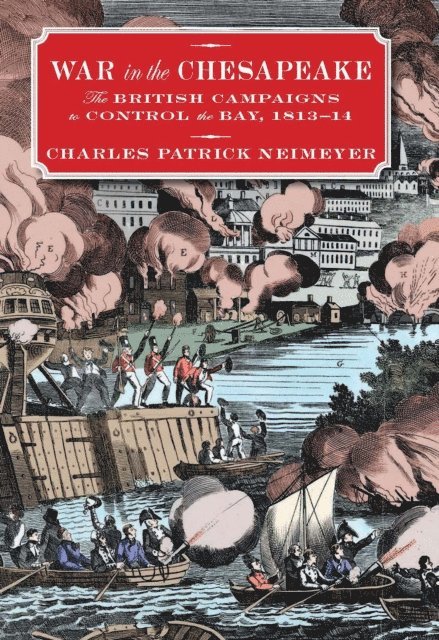
In the early nineteenth century, the United States of America was far from united. The United States faced internal strife over the extent of governance and the rights of individual states. The United States’ relationship with their former colonial power was also uncertain. Britain impressed American sailors and supported Native Americans’ actions in the northwest and on the Canadian border. In the summer of 1812, President James Madison chose to go to war against Britain. War in the Chesapeake illustrates the causes for the War of 1812, the political impacts of the war on America, and the war effort in the Chesapeake Bay. The book examines the early war efforts, when both countries focused efforts on Canada and the Northwest front. Some historians claim Madison chose to go to war in an attempt to annex the neighboring British territories. The book goes on to discuss the war in the Chesapeake Bay. The British began their Chesapeake campaign in an effort to relieve pressure on their defenses in Canada. Rear Admiral George Cockburn led the resulting efforts, and began to terrorize the towns of the Chesapeake. From Norfolk to Annapolis, the British forces raided coastal towns, plundering villages for supplies and encouraging slaves to join the British forces. The British also actively campaigned against the large American frigates—seeing them as the only threat to their own naval superiority. War in the Chesapeake traces these British efforts on land and sea. It also traces the Americans’ attempts to arm and protect the region while the majority of the American regular forces fought on the Northwest front. In the summer campaign of 1814, the British trounced the Americans at Bladensburg, and burned Washington, D.C. Afterwards, the Baltimoreans shocked the British with a stalwart defense at Fort McHenry. The British leaders, Vice Admiral Sir Alexander Cochrane and Major General Robert Ross, did not expect strong resistance after their quick victories at Bladensburg. War in the Chesapeake tells the story of some of the earliest national heroes, including the defenders of Baltimore and naval leaders like John Rodgers and Stephen Decatur. The following December 1814, the United States and Britain signed the Treaty of Ghent, ending hostilities and returning North America to a peaceful status quo. The United States and neighboring Canada would not go to war on opposing sides again. The United States left the war slightly more unified and independent of the British.