Chaya T. Halberstam – författare
Visar alla böcker från författaren Chaya T. Halberstam. Handla med fri frakt och snabb leverans.
4 produkter
Trial Stories in Jewish Antiquity
Counternarratives of Justice
E-bok, 2024
1155 kr
Lägg i varukorg
What can early Jewish courtroom narratives tell us about the capacity and limits of human justice? By exploring how judges and the act of judging are depicted in these narratives, Trial Stories in Jewish Antiquity: Counternarratives of Justice challenges the prevailing notion, both then and now, of …
Trial Stories in Jewish Antiquity
Counternarratives of Justice
E-bok, 2025
1155 kr
Lägg i varukorg
What can early Jewish courtroom narratives tell us about the capacity and limits of human justice? By exploring how judges and the act of judging are depicted in these narratives, Trial Stories in Jewish Antiquity: Counternarratives of Justice challenges the prevailing notion, both then and now, of …
Trial Stories in Jewish Antiquity
Counternarratives of Justice
Inbunden, 2024
1148 kr
Lägg i varukorg
What can early Jewish courtroom narratives tell us about the capacity and limits of human justice? By exploring how judges and the act of judging are depicted in these narratives, Trial Stories in Jewish Antiquity: Counternarratives of Justice challenges the prevailing notion, both then and now, of …
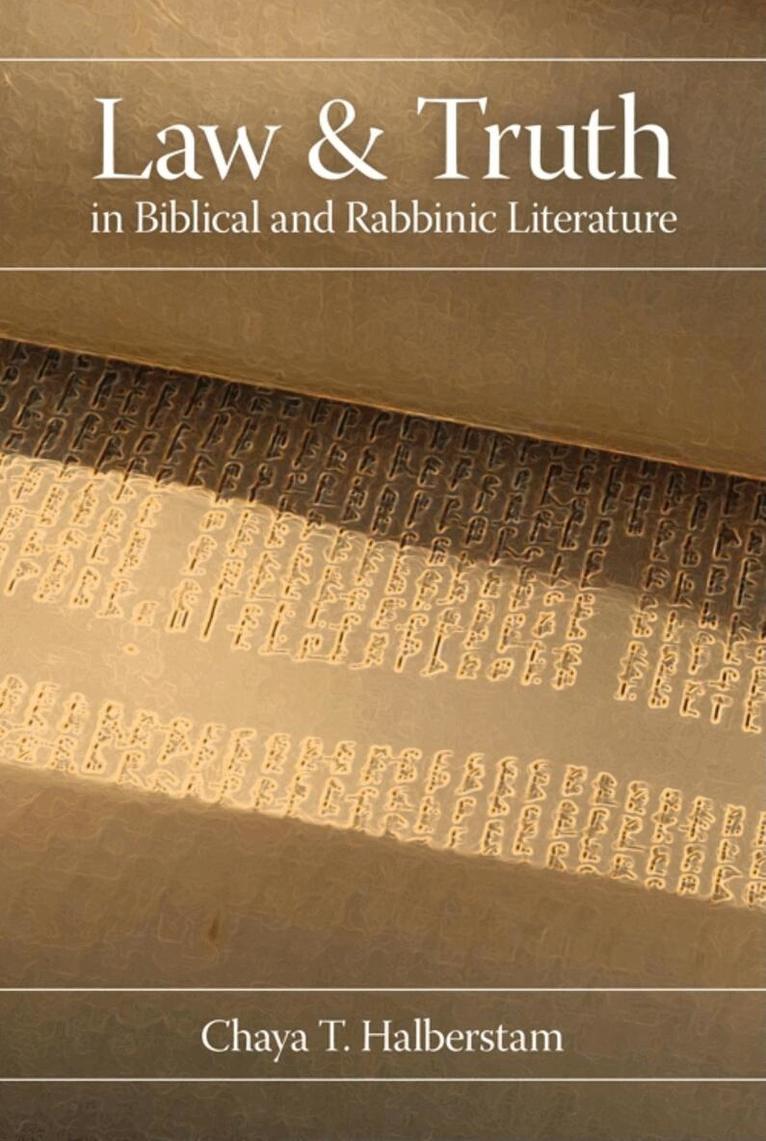
Law and Truth in Biblical and Rabbinic Literature
Inbunden, 2010
415 kr
Lägg i varukorg
How can humans ever attain the knowledge required to administer and implement divine law and render perfect justice in this world? Contrary to the belief that religious law is infallible, Chaya T. Halberstam shows that early rabbinic jurisprudence is characterized by fundamental uncertainty. She …