Chris C. Demchak - Böcker
Visar alla böcker från författaren Chris C. Demchak. Handla med fri frakt och snabb leverans.
4 produkter
4 produkter
Military Organizations, Complex Machines
Modernization in the U.S. Armed Services
Inbunden, Engelska, 1991
1 160 kr
Skickas inom 10-15 vardagar
Chris Demchak explores the reasons why military machines surprise their users and how they can change both the complexity and effectiveness of tactical organizations. She uses the Army's experiences with its M1 Abrams tank, as well as other examples, to explain the interaction of complex technology and militaries that seek to control uncertainty. Under some conditions, Demchak demonstrates, complexity in critical machines induces increased complexity in the organizations that use them, and can produce an army different from the one that was intended. Drawing on organization theory and her data, she argues that understanding this interaction will heavily influence whether armed forces reductions, savings, and modernization produce rapid, successful military organizations or lethally unpredictable ones.
Wars of Disruption and Resilience
Cybered Conflict, Power, and National Security
Inbunden, Engelska, 2011
1 236 kr
Skickas inom 5-8 vardagar
Increasingly, the power of a large, complex, wired nation like the United States rests on its ability to disrupt would-be cyber attacks and to be resilient against a successful attack or recurring campaign. Addressing the concerns of both theorists and those on the national security front lines, Chris C. Demchak presents a unified strategy for survival in an interconnected, ever-messier, more surprising cybered world and examines the institutional adaptations required of our defense, intelligence, energy, and other critical sectors for national security.Demchak introduces a strategy of “security resilience” against surprise attacks for a cybered world that is divided between modern, digitally vulnerable city-states and more dysfunctional global regions. Its key concepts build on theories of international relations, complexity in social-technical systems, and organizational-institutional adaptation. Demchak tests the strategy for reasonableness in history’s few examples of states disrupting rather than conquering and being resilient to attacks, including ancient Athens and Sparta, several British colonial wars, and two American limited wars. She applies the strategy to modern political, social, and technical challenges and presents three kinds of institutional adaptation that predicate the success of the security resilience strategy in response. Finally, Demchak discusses implications for the future including new forms of cyber aggression like the Stuxnet worm, the rise of the cyber-command concept, and the competition between the U.S. and China as global cyber leaders.Wars of Disruption and Resilience offers a blueprint for a national cyber-power strategy that is long in time horizon, flexible in target and scale, and practical enough to maintain the security of a digitized nation facing violent cybered conflict.
Wars of Disruption and Resilience
Cybered Conflict, Power, and National Security
Häftad, Engelska, 2011
502 kr
Skickas inom 5-8 vardagar
Increasingly, the power of a large, complex, wired nation like the United States rests on its ability to disrupt would-be cyber attacks and to be resilient against a successful attack or recurring campaign. Addressing the concerns of both theorists and those on the national security front lines, Chris C. Demchak presents a unified strategy for survival in an interconnected, ever-messier, more surprising cybered world and examines the institutional adaptations required of our defense, intelligence, energy, and other critical sectors for national security.Demchak introduces a strategy of “security resilience” against surprise attacks for a cybered world that is divided between modern, digitally vulnerable city-states and more dysfunctional global regions. Its key concepts build on theories of international relations, complexity in social-technical systems, and organizational-institutional adaptation. Demchak tests the strategy for reasonableness in history’s few examples of states disrupting rather than conquering and being resilient to attacks, including ancient Athens and Sparta, several British colonial wars, and two American limited wars. She applies the strategy to modern political, social, and technical challenges and presents three kinds of institutional adaptation that predicate the success of the security resilience strategy in response. Finally, Demchak discusses implications for the future including new forms of cyber aggression like the Stuxnet worm, the rise of the cyber-command concept, and the competition between the U.S. and China as global cyber leaders.Wars of Disruption and Resilience offers a blueprint for a national cyber-power strategy that is long in time horizon, flexible in target and scale, and practical enough to maintain the security of a digitized nation facing violent cybered conflict.
379 kr
Skickas inom 5-8 vardagar
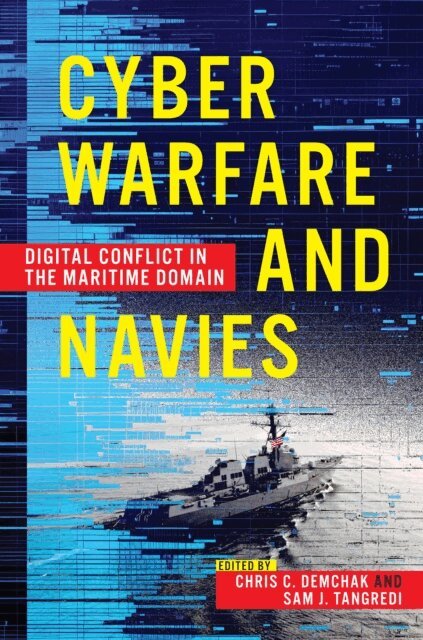
Cyber Warfare and Navies, an edited collection, takes a penetrating look into the threats that cyber warfare poses to operations in the maritime environment and the means of defending against cyberattack.As with all elements of the digital age, navies and commercial maritime operations around the world have become increasingly vulnerable to cyber conflict. Navies are obvious targets of hostile national and nonstate cyber actions. Almost every aspect of commercial maritime activities has become digitized and interconnected and thus vulnerable to cyber intrusions, sabotage, viruses, and destruction. In an era when 85 percent of global trade and 70 percent of all liquid fuels travel by sea, cyber effects on ships, port-handling equipment, shipping companies, maritime suppliers, and other maritime industries can cripple manufacturing industries and retail businesses on a global basis. Neither navies nor commercial shipping can “sail away” from cyber threats. Initially, naval leaders had difficulty accepting and preparing for cyber warfare, which is largely viewed as a problem on land and from which ships were perceived as disconnected. As a consequence, effectively integrating cyber operations into its naval warfighting planning has proven challenging not only for the U.S. Navy, but for allied and adversary navies as well. The U.S. Navy created Fleet Cyber Command (FCC), with the U.S. Navy’s Tenth Fleet as its cyber operational arm and the Navy’s component contributing to U.S. Cyber Command (USCYBERCOM). However, thus far those efforts appear not to have served the Navy or USCYBERCOM as well as anticipated. Cyber Warfare and Navies outlines the various threats that cyber warfare poses to naval and commercial maritime operations as well as the abilities of modern navies to defend against those threats. It explains how navies are organized and equipped for cyber operations and the concepts and doctrine adopted by those navies—and provides recommendations on how to improve maritime cyber operations. The book covers not just the U.S. Navy, U.S. Marine Corps, and U.S Coast Guard, but also the navies of allies, opponents (China, Russia), and others. The book also explores the relationship between the U.S. Navy, Marine Corps, Coast Guard, and USCYBERCOM.