Chris Fitter - Böcker
Visar alla böcker från författaren Chris Fitter. Handla med fri frakt och snabb leverans.
7 produkter
7 produkter
1 680 kr
Skickas inom 5-8 vardagar
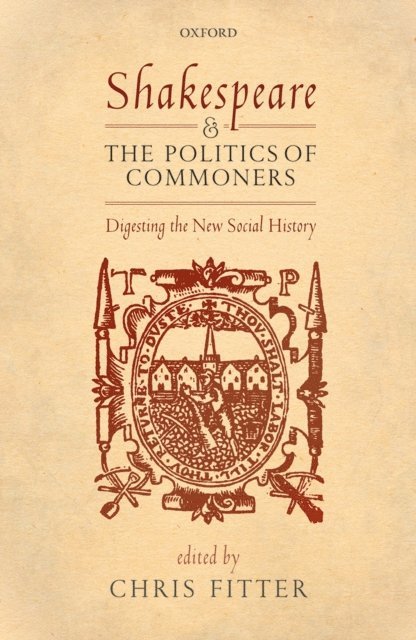
Shakespeare and the Politics of Commoners is a highly original contribution to our understanding of Shakespeare's plays. It breaks important new ground in introducing readers, lay and scholarly alike, to the existence and character of the political culture of the mass of ordinary commoners in Shakespeare's England, as revealed by the recent findings of 'the new social history'. The volume thereby helps to challenge the traditional myths of a non-political commons and a culture of obedience. It also brings together leading Shakespeareans, who digest recent social history, with eminent early modern social historians, who turn their focus on Shakespeare. This genuinely cross-disciplinary approach generates fresh readings of over ten of Shakespeare's plays and locates the impress on Shakespearean drama of popular political thought and pressure in this period of perceived crisis. The volume is unique in engaging and digesting the dramatic importance of the discoveries of the new social history, thereby resituating and revaluing Shakespeare within the social depth of politics.
Majesty and the Masses in Shakespeare and Marlowe
Western Anti-Monarchism, The Earl of Essex Challenge, and Political Stagecraft
Inbunden, Engelska, 2020
2 419 kr
Skickas inom 10-15 vardagar
This book is a landmark study of Shakespeare’s politics as revealed in his later History Plays. It offers the first ever survey of anti-monarchism in Western literature, history and philosophy, tracked from Hesiod and Homer through to contemporaries of Shakespeare such as George Buchanan and the authors of the Mirror for Magistrates, thus demonstrating that anxiety over monarchic power, and contemptuous demolitions of kingship as a disastrously irrational institution, formed an important and irremovable body of reflection in prestigious Western writing. Overturning the widespread assumption that "Elizabethans believed in divine right monarchy", it exposits the anti-monarchic critique built into Shakespeare’s Histories and Marlowe’s Massacre at Paris, in five chapters of close literary critical readings, paying innovative attention to performance values.Part Two focuses Queen Elizabeth’s principal challenger for national rule: the Earl of Essex, England’s most popular man. It demonstrates from detailed readings that, far from being an admirer of the war-crazed, unstable, bi-polar Essex, as is regularly asserted, Shakespeare launched in Richard II and Henry IV a campaign to puncture the reputation of the great earl, exposing him as a Machiavel seeking Elizabeth’s throne. Shakespeare emerges as a humane and clear-sighted critic of the follies intrinsic to dynastic monarchy: yet hostile, likewise, to the rash militarist, Essex, who would fling England into permanent war against Spain. Founded on an unprecedented and wide-ranging study of anti-monarchist thought, this book presents a significant contribution to Shakespeare and Marlowe criticism, studies of Tudor England, and the history of ideas.
Majesty and the Masses in Shakespeare and Marlowe
Western Anti-Monarchism, The Earl of Essex Challenge, and Political Stagecraft
Häftad, Engelska, 2022
723 kr
Skickas inom 10-15 vardagar
This book is a landmark study of Shakespeare’s politics as revealed in his later History Plays. It offers the first ever survey of anti-monarchism in Western literature, history and philosophy, tracked from Hesiod and Homer through to contemporaries of Shakespeare such as George Buchanan and the authors of the Mirror for Magistrates, thus demonstrating that anxiety over monarchic power, and contemptuous demolitions of kingship as a disastrously irrational institution, formed an important and irremovable body of reflection in prestigious Western writing. Overturning the widespread assumption that "Elizabethans believed in divine right monarchy", it exposits the anti-monarchic critique built into Shakespeare’s Histories and Marlowe’s Massacre at Paris, in five chapters of close literary critical readings, paying innovative attention to performance values.Part Two focuses Queen Elizabeth’s principal challenger for national rule: the Earl of Essex, England’s most popular man. It demonstrates from detailed readings that, far from being an admirer of the war-crazed, unstable, bi-polar Essex, as is regularly asserted, Shakespeare launched in Richard II and Henry IV a campaign to puncture the reputation of the great earl, exposing him as a Machiavel seeking Elizabeth’s throne. Shakespeare emerges as a humane and clear-sighted critic of the follies intrinsic to dynastic monarchy: yet hostile, likewise, to the rash militarist, Essex, who would fling England into permanent war against Spain. Founded on an unprecedented and wide-ranging study of anti-monarchist thought, this book presents a significant contribution to Shakespeare and Marlowe criticism, studies of Tudor England, and the history of ideas.
832 kr
Skickas inom 10-15 vardagar
This book argues that Shakespeare was permanently preoccupied with the brutality, corruption, and ultimate groundlessness of the political order of his state, and that the impact of original Tudor censorship, supplemented by the relatively depoliticizing aesthetic traditions of later centuries, have together obscured the consistent subversiveness of his work. Traditionally, Shakespeare’s political attitudes have been construed either as primarily conservative, or as essays in richly imaginative ambiguation, irreducible to settled viewpoints. Fitter contends that government censorship forced superficial acquiescence upon Shakespeare in establishment ideologies — monarchic, aristocratic and patriarchal — that were enunciated through rhetorical set pieces, but that Shakespeare the dramatist learned from Shakespeare the actor a variety of creative methods for sabotaging those perspectives in performance in the public theatres. Using historical contextualizations and recuperation of original performance values, the book argues that Shakespeare emerged as a radical writer not in middle age with King Lear and Coriolanus — plays whose radicalism is becoming widely recognized — but from his outset, with Henry VI and Taming of the Shrew. Recognizing Shakespeare’s allusiveness to 1590s controversies and dissident thought, and recovering the subtextual politics of Shakespeare’s distinctive stagecraft reveals populist, at times even radical meaning and a substantially new, and astonishingly interventionist, Shakespeare.
2 496 kr
Skickas inom 10-15 vardagar
This book argues that Shakespeare was permanently preoccupied with the brutality, corruption, and ultimate groundlessness of the political order of his state, and that the impact of original Tudor censorship, supplemented by the relatively depoliticizing aesthetic traditions of later centuries, have together obscured the consistent subversiveness of his work. Traditionally, Shakespeare’s political attitudes have been construed either as primarily conservative, or as essays in richly imaginative ambiguation, irreducible to settled viewpoints. Fitter contends that government censorship forced superficial acquiescence upon Shakespeare in establishment ideologies — monarchic, aristocratic and patriarchal — that were enunciated through rhetorical set pieces, but that Shakespeare the dramatist learned from Shakespeare the actor a variety of creative methods for sabotaging those perspectives in performance in the public theatres. Using historical contextualizations and recuperation of original performance values, the book argues that Shakespeare emerged as a radical writer not in middle age with King Lear and Coriolanus — plays whose radicalism is becoming widely recognized — but from his outset, with Henry VI and Taming of the Shrew. Recognizing Shakespeare’s allusiveness to 1590s controversies and dissident thought, and recovering the subtextual politics of Shakespeare’s distinctive stagecraft reveals populist, at times even radical meaning and a substantially new, and astonishingly interventionist, Shakespeare.
690 kr
Skickas inom 7-10 vardagar
Why was the art of landscape painting invented in the fifth century BC, abandoned with the collapse of Rome, and revived again in the High Middle Ages? Did the Greeks, or the ancient Christians perceive the natural world differently from the way we do now? In Poetry, Space, Landscape, Chris Fitter traces the history of nature-sensibility from the ancient world to the English Renaissance, setting poems and paintings in the widely differing cultural contexts that created them. He suggests a new social and historical theory of the conceptualisation of space, explaining the rise and fall of the idea of 'landscape'. And he argues that enduring basic categories of perception create different readings of natural reality determined by our social and material relations with nature.
3 818 kr
Skickas inom 10-15 vardagar
The Routledge Companion to Shakespeare and Politics challenges and transforms our understanding of the politics of Shakespeare’s plays. Through up-to-date essays by historians, biographers, and Shakespeare critics, this Companion offers, first, a systematic examination of dominant institutions and emergent thought in Shakespeare’s society, then meditation on Shakespeare’s representation of these.Contributors consider the common law and the legally embattled royal prerogative, the functioning of the justice system, the impact of angry Tudor reformers, early capitalism, war, libels, rebellion, populism, religion, and cosmological ferment, as well as the class system, Machiavelli, Montaigne, and theatrical transgression. Opening chapters discuss the harsh politicisation of childhood Shakespeare, the subversive practices built into grammar school education, and the mythic retirement of Shakespeare to an idyllic Warwickshire. Combining social panorama with sharp critical readings, this synoptic approach allows identification of a political coherence to Shakespeare’s drama: identifying commonalities of vision, frequently critical and dissident, returning in different plays. The final section looks at Shakespeare’s reception within Marxism, feminism, racial theory, LGBTQ+ thought, and ecocriticism.The collection recovers a lost Shakespeare, of substantial political disaffection in very dark times, offering a challenging political redirection of Shakespeare studies, and perhaps a Shakespeare for our era. As an authoritative, state-of-the-art guide to this resonant topic, it will be of interest to anyone researching or studying Shakespeare.