Christina R. Foust - Böcker
Visar alla böcker från författaren Christina R. Foust. Handla med fri frakt och snabb leverans.
4 produkter
4 produkter
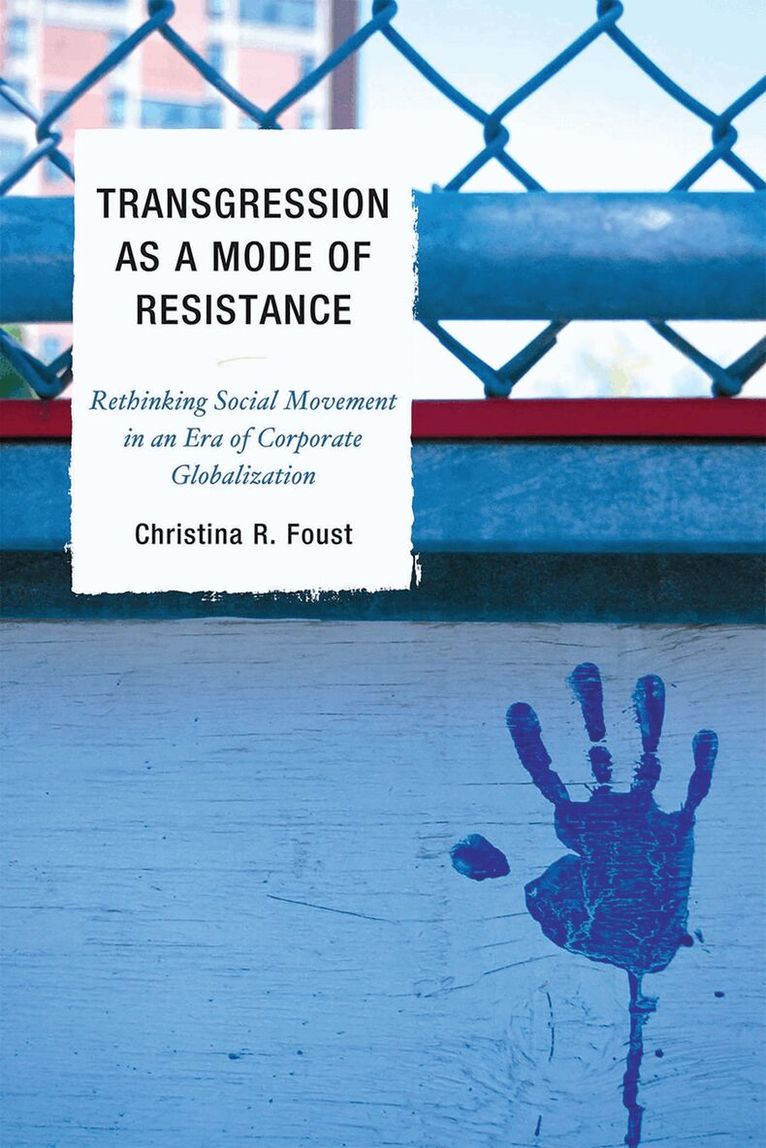
Transgression as a Mode of Resistance
Rethinking Social Movement in an Era of Corporate Globalization
Inbunden, Engelska, 2010
1 476 kr
Skickas inom 10-15 vardagar
Since industrialization, two major theoretical perspectives have accompanied the vibrant practice of social change. The first, hegemony, emerged as a less deterministic route to revolution from Marxist theory, and forms the common sense of social movement today. Within hegemonic resistance, rhetoric links issues, ideas, and identities to form a recognizable collective agent, whose aim is to transform the status quo into its vision of the world. The second major mode of resistance, transgression, grows from anarchist and autonomous resistance to capitalism. Transgression attempts to free individuals' uniqueness and creative power by deconstructing authority and explicating the body in resistance. Transgression as a Mode of Resistance: Rethinking Social Movement in an Era of Corporate Globalization provides the conceptual mapping for scholars, students, and practitioners to participate in the growing debate between these rich and powerful forces of social change. Through a broad perspective on philosophy and history, Christina R. Foust demonstrates that hegemony and transgression are sometimes conflicting, oftentimes inter-related practices. She responds to critics who believe that without a social change agent, resistance appears baseless and naïve; without a representational economy to cohere and express common interests, social movement is impossible. Through alternative social relationships and political performances, transgressive resistors may reinvent daily life.
363 kr
Skickas inom 7-10 vardagar
What Democracy Looks Like is a compelling and timely collection which combines two distinct but related theories in rhetoric and communication studies, while also exploring theories and ideas espoused by those in sociology, political science, and cultural studies.Recent protests around the world (such as the Arab Spring uprisings and Occupy Wall Street movements) have drawn renewed interest to the study of social change and, especially, to the manner in which words, images, events, and ideas associated with protestors can “move the social.” What Democracy Looks Like is an attempt to foster a more coherent understanding of social change among scholars of rhetoric and communication studies by juxtaposing the ideas of social movements and counterpublics—historically two key factors significant in the study of social change. Foust, Pason, and Zittlow Rogness’s volume compiles the voices of leading and new scholars who are contributing to the history, application, and new directions of these two concepts, all in conversation with a number of acts of resistance or social change.The theories of social movements and counterpublics are related, but distinct. Social movement theories tend to be concerned with enacting policy and legislative changes. Scholars flying this flag have concentrated on the organization and language (for example, rallies and speeches) that are meant to enact social change. Counterpublic theory, on the other hand, focuses less on policy changes and more on the unequal distribution of power and resources among different protest groups, which is sometimes synonymous with subordinated identity groups such as race, gender, sexuality, and class.Nonetheless, contributors argue that in recent years the distinctions between these two methods have become less evident. By putting the literatures of the two theories in conversation with one another, these scholars seek to promote and imagine social change outside the typical binaries.
539 kr
Skickas inom 10-15 vardagar
An accessible and engaging introduction to the critical study of popular culture, which provides students with the tools they need to make sense of the popular culture that inundates their everyday lives.This textbook centers on media ecology and equipment for living to introduce students to important theories and debates in the field. Each chapter engages an important facet of popular culture, ranging from the business of popular culture to communities, stories, and identities, to the simulation and sensation of pop culture. The text explains key terms and features contemporary case studies throughout, examining aspects such as memes and trends on social media, cancel culture, celebrities as influencers, gamification, "meta" pop culture, and personalized on-demand music. The book enables students to understand the complexity of power and influence, providing a better understanding of the ways pop culture is embedded in a wide range of everyday activities. Students are encouraged to reflect on how they consume and produce popular culture and understand how that shapes their sense of self and connections to others.Essential reading for undergraduate and postgraduate students of media studies, communication studies, cultural studies, popular culture, and other related subjects.
2 176 kr
Skickas inom 10-15 vardagar
An accessible and engaging introduction to the critical study of popular culture, which provides students with the tools they need to make sense of the popular culture that inundates their everyday lives.This textbook centers on media ecology and equipment for living to introduce students to important theories and debates in the field. Each chapter engages an important facet of popular culture, ranging from the business of popular culture to communities, stories, and identities, to the simulation and sensation of pop culture. The text explains key terms and features contemporary case studies throughout, examining aspects such as memes and trends on social media, cancel culture, celebrities as influencers, gamification, "meta" pop culture, and personalized on-demand music. The book enables students to understand the complexity of power and influence, providing a better understanding of the ways pop culture is embedded in a wide range of everyday activities. Students are encouraged to reflect on how they consume and produce popular culture and understand how that shapes their sense of self and connections to others.Essential reading for undergraduate and postgraduate students of media studies, communication studies, cultural studies, popular culture, and other related subjects.