Christoph Cox - Böcker
Visar alla böcker från författaren Christoph Cox. Handla med fri frakt och snabb leverans.
9 produkter
9 produkter
1 007 kr
Skickas inom 7-10 vardagar
From Edison’s invention of the phonograph through contemporary field recording and sound installation, artists have become attracted to those domains against which music has always defined itself: noise, silence, and environmental sound. Christoph Cox argues that these developments in the sonic arts are not only aesthetically but also philosophically significant, revealing sound to be a continuous material flow to which human expressions contribute but which precedes and exceeds those expressions. Cox shows how, over the course of the twentieth and twenty-first centuries, philosophers and sonic artists have explored this “sonic flux.”Through the philosophical analysis of works by John Cage, Maryanne Amacher, Max Neuhaus, Christian Marclay, and many others, Sonic Flux contributes to the development of a materialist metaphysics and poses a challenge to the prevailing positions in cultural theory, proposing a realist and materialist aesthetics able to account not only for sonic art but for artistic production in general.
263 kr
Skickas inom 7-10 vardagar
From Edison’s invention of the phonograph through contemporary field recording and sound installation, artists have become attracted to those domains against which music has always defined itself: noise, silence, and environmental sound. Christoph Cox argues that these developments in the sonic arts are not only aesthetically but also philosophically significant, revealing sound to be a continuous material flow to which human expressions contribute but which precedes and exceeds those expressions. Cox shows how, over the course of the twentieth and twenty-first centuries, philosophers and sonic artists have explored this “sonic flux.”Through the philosophical analysis of works by John Cage, Maryanne Amacher, Max Neuhaus, Christian Marclay, and many others, Sonic Flux contributes to the development of a materialist metaphysics and poses a challenge to the prevailing positions in cultural theory, proposing a realist and materialist aesthetics able to account not only for sonic art but for artistic production in general.
294 kr
Skickas inom 7-10 vardagar
In 1977, Max Neuhaus turned a triangle of pedestrian space between 45th and 46th Streets in Times Square into an island of harmonic sound. The rich textures of that sound continue today, emanating from beneath the sidewalk grating, to anonymously reach an individual’s ears as if one has stumbled upon a secret. Known as Times Square, the celebrated installation was restored in 2002 with support from Dia Art Foundation, which further commissioned a site-specific piece, Time Piece Beacon, from Neuhaus in 2006 for its museum in Beacon, New York. This stunning book—the only volume in print dedicated solely to the work of Neuhaus—takes these two projects as a point of departure from which to consider the singular impact this artist has had in establishing sound as a medium in contemporary art. An interview with Neuhaus is complemented with essays by multidisciplinary scholars who investigate and situate his work within a historical context. Distributed for Dia Art Foundation
470 kr
Skickas inom 7-10 vardagar
Nietzsche: Naturalism and Interpretation offers a resolution of one of the most vexing problems in Nietzsche scholarship. As perhaps the most significant predecessor of more recent attempts to formulate a postmetaphysical epistemology and ontology, Nietzsche is considered by many critics to share this problem with his successors: How can an antifoundationalist philosophy avoid vicious relativism and legitimate its claim to provide a platform for the critique of arguments, practices, and institutions? Christoph Cox argues that Nietzsche successfully navigates between relativism and dogmatism, accepting the naturalistic critique of metaphysics and theology provided by modern science, yet maintaining that a thoroughgoing naturalism must move beyond scientific reductionism. It must accept a central feature of aesthetic understanding: acknowledgment of the primacy and irreducibility of interpretation. This view of Nietzsche's doctrines of perspectivism, becoming, and will to power as products of an overall naturalism balanced by a reciprocal commitment to interpretationism will spur new discussions of epistemology and ontology in contemporary thought.
2 022 kr
Skickas inom 10-15 vardagar
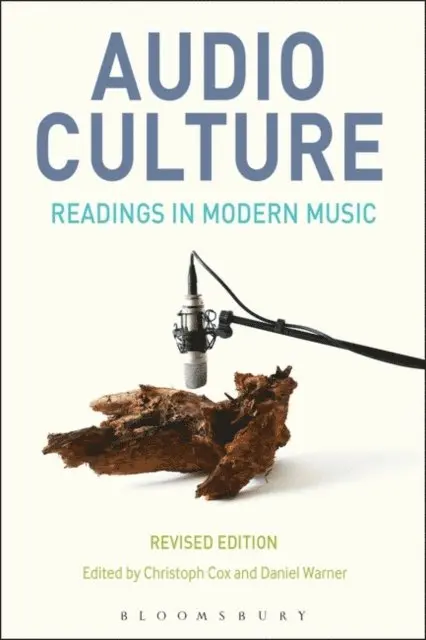
The groundbreaking Audio Culture: Readings in Modern Music (Continuum; September 2004; paperback original) maps the aural and discursive terrain of vanguard music today. Rather than offering a history of contemporary music, Audio Culture traces the genealogy of current musical practices and theoretical concerns, drawing lines of connection between recent musical production and earlier moments of sonic experimentation. It aims to foreground the various rewirings of musical composition and performance that have taken place in the past few decades and to provide a critical and theoretical language for this new audio culture.This new and expanded edition of the Audio Culture contains twenty-five additional essays, including four newly-commissioned pieces. Taken as a whole, the book explores the interconnections among such forms as minimalism, indeterminacy, musique concrète, free improvisation, experimental music, avant-rock, dub reggae, ambient music, hip hop, and techno via writings by philosophers, cultural theorists, and composers. Instead of focusing on some "crossover" between "high art" and "popular culture," Audio Culture takes all these musics as experimental practices on par with, and linked to, one another. While cultural studies has tended to look at music (primarily popular music) from a sociological perspective, the concern here is philosophical, musical, and historical.Audio Culture includes writing by some of the most important musical thinkers of the past half-century, among them John Cage, Brian Eno, Ornette Coleman, Pauline Oliveros, Maryanne Amacher, Glenn Gould, Umberto Eco, Jacques Attali, Simon Reynolds, Eliane Radigue, David Toop, John Zorn, Karlheinz Stockhausen, and many others. Each essay has its own short introduction, helping the reader to place the essay within musical, historical, and conceptual contexts, and the volume concludes with a glossary, a timeline, and an extensive discography.
668 kr
Skickas inom 10-15 vardagar
The groundbreaking Audio Culture: Readings in Modern Music (Continuum; September 2004; paperback original) maps the aural and discursive terrain of vanguard music today. Rather than offering a history of contemporary music, Audio Culture traces the genealogy of current musical practices and theoretical concerns, drawing lines of connection between recent musical production and earlier moments of sonic experimentation. It aims to foreground the various rewirings of musical composition and performance that have taken place in the past few decades and to provide a critical and theoretical language for this new audio culture.This new and expanded edition of the Audio Culture contains twenty-five additional essays, including four newly-commissioned pieces. Taken as a whole, the book explores the interconnections among such forms as minimalism, indeterminacy, musique concrète, free improvisation, experimental music, avant-rock, dub reggae, ambient music, hip hop, and techno via writings by philosophers, cultural theorists, and composers. Instead of focusing on some "crossover" between "high art" and "popular culture," Audio Culture takes all these musics as experimental practices on par with, and linked to, one another. While cultural studies has tended to look at music (primarily popular music) from a sociological perspective, the concern here is philosophical, musical, and historical.Audio Culture includes writing by some of the most important musical thinkers of the past half-century, among them John Cage, Brian Eno, Ornette Coleman, Pauline Oliveros, Maryanne Amacher, Glenn Gould, Umberto Eco, Jacques Attali, Simon Reynolds, Eliane Radigue, David Toop, John Zorn, Karlheinz Stockhausen, and many others. Each essay has its own short introduction, helping the reader to place the essay within musical, historical, and conceptual contexts, and the volume concludes with a glossary, a timeline, and an extensive discography.
717 kr
Skickas inom 10-15 vardagar
Ausgehend von der These, dass es sich bei der politischen Lyrik der Gegenwart vor allem um eine Lyrik des Politischen, eine lyrische Streitkultur handelt, wird in „Lyrische Agonistik. Das Politische in Gedichten der Gegenwart“ auf der Basis einer philosophischen ‚neue‘ Rhetorik und mit Rückbezug auf Ansätze der radikalen Demokratietheorie insbesondere von Chantal Mouffe und Ernesto Laclau eine neuartige rhetorische Methode zur Analyse des Politischen in der Lyrik der Gegenwart entwickelt. Grundlegend für diese Methode ist die von sophistischer Rhetoriktradition und radikaler Demokratietheorie geteilte Skepsis gegenüber allen epistemischen Letztbegründungsversuchen. Das Politische in der Lyrik der Gegenwart erweist sich im Kontext dieser beiden Bezugspunkte als die Zurückweisung fundamentaler Gründungversuche, die sich als diskursive Form der Verhandlung einer nur plausiblen, in ihrer Kontingenz stets angreifbaren Politik äußert. Ablesbar wird diese postfundamentalistische Wende in gegenwärtigen Gedichten anhand von rhetorischen Widersprüchen, die auf den unaufhebbaren konflikthaften Charakter des Politischen hindeuten, deren notwendige Gegenseite der ebenso rhetorisch ausgearbeitete Versuch ist, umstrittene Diskurse zugunsten einer nie letztbegründbaren Position zu hegemonisieren. Aufgezeigt wird das dem Politischen eigene Spiel aus Kontingenzerfahrung und Schließungsbemühungen anhand von drei disparaten Textbeispielen politischer Lyrik der letzten zehn Jahre: Tom Schulz’ „Die Maschinen sind volljährig“, Günter Grass’ „Was gesagt werden muss“ und Monika Rincks „was machen die frauen am sonntag?“.
Del 9 - Kriminalität in Literatur und Medien
Verbrechen (an) der Gesellschaft
Politik und Kriminalität in der Literatur
Häftad, Tyska, 2026
1 385 kr
Kommande
Der Vormarsch autokratischer Regime und die sich mit zunehmendem Nachdruck stellende Frage nach Verteilungsgerechtigkeit deuten auf eine Form von Kriminalität hin, die die Gesellschaft als Ganze anbelangt und damit eine politische Dimension offenbart. Nicht erst in der Gegenwart hat Literatur das politische Verbrechen zum Gegenstand erhoben und reflektiert. Die in diesem Band versammelten Beiträge stellen ganz unterschiedliche Versuche der Triangulation im Feld von Literatur, Verbrechen und Politik dar, die sich auch jenseits der Erforschung kriminalliterarischer Gattungskonventionen bewegen und vom Drama des Barock bis zum Comic reichen.
277 kr
Skickas inom 3-6 vardagar
Denna antologi – Ljudkonst – har som ambition att erbjuda en introduktion till och översikt över delar av ett landskap som utgörs av både konstnärliga soniska praktiker och teoretiska diskurser, vilka sammantagna formar ett fält som kommit att kallas ”ljudkonst”. De fjorton essäer av konstnärer och teoretiker som ingår i Ljudkonst (re)presenterar, skriver antologins redaktörer Åsa Stjerna och Andreas Engström, hur samtalet om ljudkonst har utvecklats och omvandlats i den teoretiska diskussionen under de senaste decennierna. De tecknar konturerna av en historia om begreppets konstruktion och dekonstruktion, och formar en interdisciplinär berättelse som inte desto mindre innebär inkluderanden och exkluderanden. Det är en komplex berättelse om ljudets materialitet, om ljudets ontologi, om dess frigörelse från en inommusikalisk tolkningssfär, om konstarternas diskursiva expansion och öppnande mot samtida konstnärliga och filosofiska strömningar. I Ljudkonst medverkar Helga de la Motte-Haber, David Toop, Douglas Kahn, Volker Straebel, Barbara Barthelmes, Golo Föllmer, Gernot Böhme, Frauke Behrendt, Gascia Ouzounian, Brandon LaBelle, Salomé Voegelin, Seth Kim-Cohen, Christoph Cox och Tara Rodgers. Ljudkonst utgör # 140 i Musikaliska Akademiens skriftserie.