Christoph Schnörr - Böcker
Visar alla böcker från författaren Christoph Schnörr. Handla med fri frakt och snabb leverans.
3 produkter
3 produkter
2 291 kr
Skickas inom 7-10 vardagar
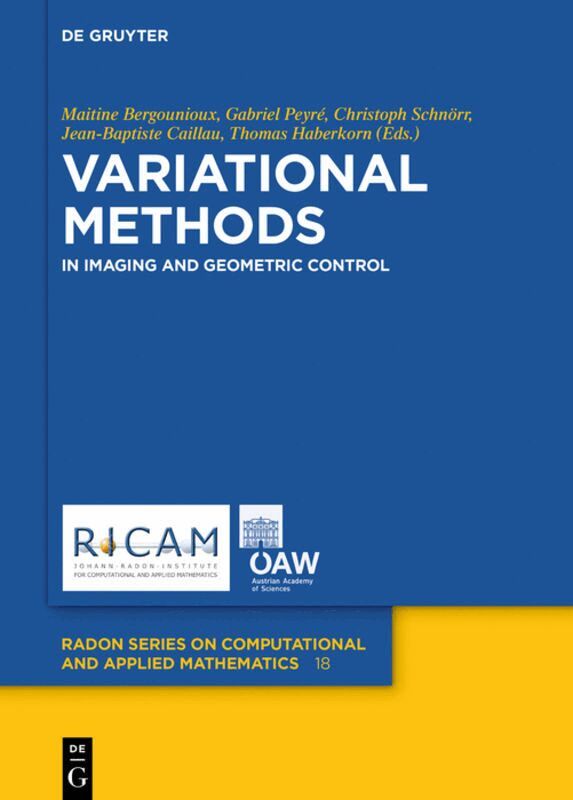
With a focus on the interplay between mathematics and applications of imaging, the first part covers topics from optimization, inverse problems and shape spaces to computer vision and computational anatomy. The second part is geared towards geometric control and related topics, including Riemannian geometry, celestial mechanics and quantum control. Contents:Part ISecond-order decomposition model for image processing: numerical experimentationOptimizing spatial and tonal data for PDE-based inpaintingImage registration using phase・amplitude separationRotation invariance in exemplar-based image inpaintingConvective regularization for optical flowA variational method for quantitative photoacoustic tomography with piecewise constant coefficientsOn optical flow models for variational motion estimationBilevel approaches for learning of variational imaging modelsPart IINon-degenerate forms of the generalized Euler・Lagrange condition for state-constrained optimal control problemsThe Purcell three-link swimmer: some geometric and numerical aspects related to periodic optimal controlsControllability of Keplerian motion with low-thrust control systemsHigher variational equation techniques for the integrability of homogeneous potentialsIntroduction to KAM theory with a view to celestial mechanicsInvariants of contact sub-pseudo-Riemannian structures and Einstein・Weyl geometryTime-optimal control for a perturbed Brockett integratorTwist maps and Arnold diffusion for diffeomorphismsA Hamiltonian approach to sufficiency in optimal control with minimal regularity conditions: Part IIndex
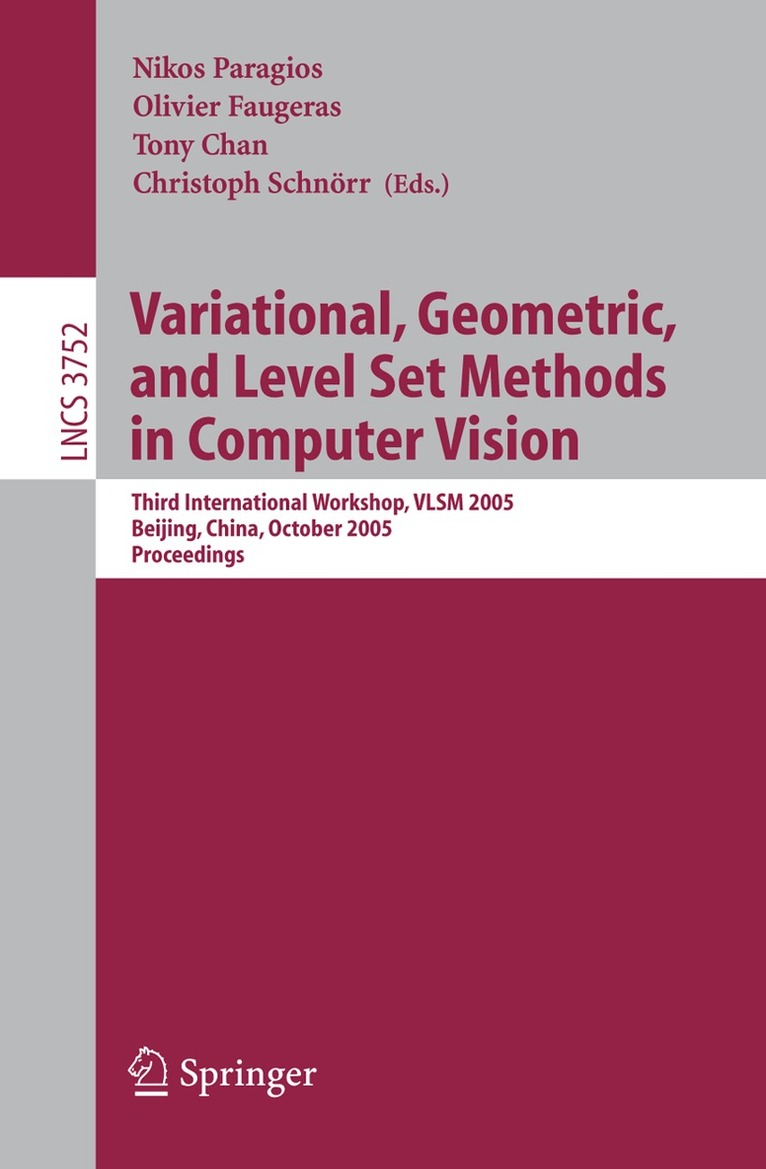
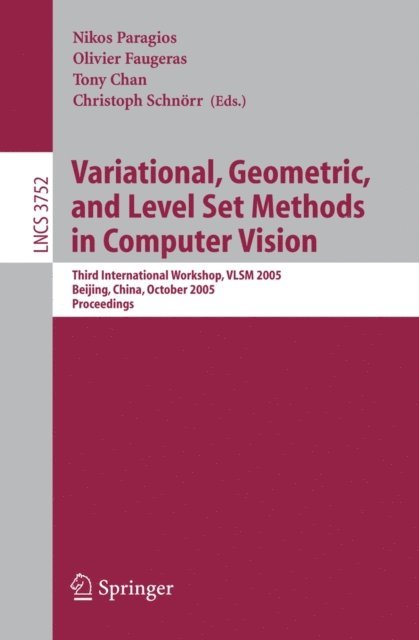
Variational, Geometric, and Level Set Methods in Computer Vision
Third International Workshop, VLSM 2005, Beijing, China, October 16, 2005, Proceedings
Häftad, Engelska, 2005
552 kr
Skickas inom 10-15 vardagar
Mathematical methods has been a dominant research path in computational vision leading to a number of areas like ?ltering, segmentation, motion analysis and stereo reconstruction. Within such a branch visual perception tasks can either be addressed through the introduction of application-driven geometric ?ows or through the minimization of problem-driven cost functions where their lowest potential corresponds to image understanding. The 3rd IEEE Workshop on Variational, Geometric and Level Set Methods focused on these novel mathematical techniques and their applications to c- puter vision problems. To this end, from a substantial number of submissions, 30 high-quality papers were selected after a fully blind review process covering a large spectrum of computer-aided visual understanding of the environment. The papers are organized into four thematic areas: (i) Image Filtering and Reconstruction, (ii) Segmentation and Grouping, (iii) Registration and Motion Analysis and (iiii) 3D and Reconstruction. In the ?rst area solutions to image enhancement, inpainting and compression are presented, while more advanced applications like model-free and model-based segmentation are presented in the segmentation area. Registration of curves and images as well as multi-frame segmentation and tracking are part of the motion understanding track, while - troducing computationalprocessesinmanifolds,shapefromshading,calibration and stereo reconstruction are part of the 3D track. We hope that the material presented in the proceedings exceeds your exp- tations and will in?uence your research directions in the future. We would like to acknowledge the support of the Imaging and Visualization Department of Siemens Corporate Research for sponsoring the Best Student Paper Award.
Pattern Recognition
29th DAGM Symposium, Heidelberg, Germany, September 12-14, 2007, Proceedings
Häftad, Engelska, 2007
552 kr
Skickas inom 10-15 vardagar
This book constitutes the refereed proceedings of the 29th Symposium of the German Association for Pattern Recognition, DAGM 2007. It covers image filtering, restoration and segmentation, shape analysis and representation, categorization and detection, computer vision and image retrieval, machine learning and statistical data analysis, biomedical data analysis, motion analysis and tracking, stereo and structure from motion, as well as 3D view registration and surface modeling.