Tony Chan – författare
Visar alla böcker från författaren Tony Chan. Handla med fri frakt och snabb leverans.
5 produkter
5 produkter
Häftad, Engelska, 2016
122 kr
Skickas inom 11-20 vardagar
Häftad, Engelska, 2005
561 kr
Skickas inom 10-15 vardagar
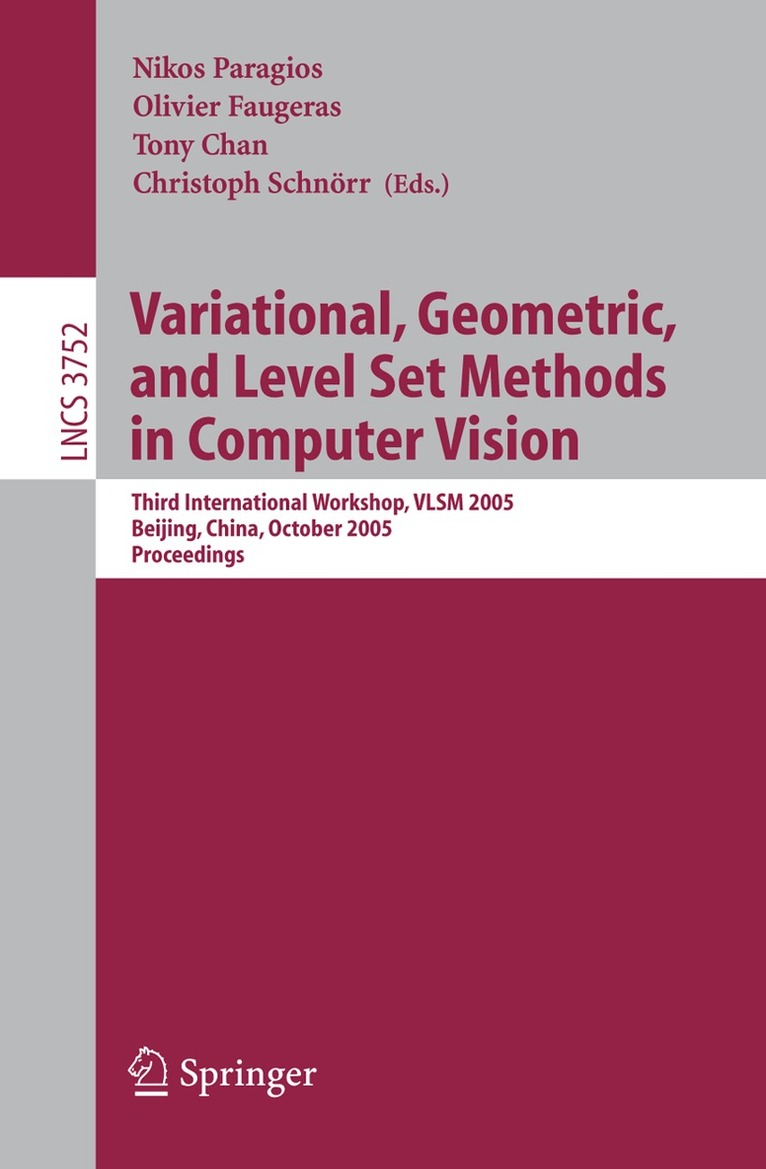
Mathematical methods has been a dominant research path in computational vision leading to a number of areas like ?ltering, segmentation, motion analysis and stereo reconstruction. Within such a branch visual perception tasks can either be addressed through the introduction of application-driven geometric ?ows or through the minimization of problem-driven cost functions where their lowest potential corresponds to image understanding. The 3rd IEEE Workshop on Variational, Geometric and Level Set Methods focused on these novel mathematical techniques and their applications to c- puter vision problems. To this end, from a substantial number of submissions, 30 high-quality papers were selected after a fully blind review process covering a large spectrum of computer-aided visual understanding of the environment. The papers are organized into four thematic areas: (i) Image Filtering and Reconstruction, (ii) Segmentation and Grouping, (iii) Registration and Motion Analysis and (iiii) 3D and Reconstruction. In the ?rst area solutions to image enhancement, inpainting and compression are presented, while more advanced applications like model-free and model-based segmentation are presented in the segmentation area. Registration of curves and images as well as multi-frame segmentation and tracking are part of the motion understanding track, while - troducing computationalprocessesinmanifolds,shapefromshading,calibration and stereo reconstruction are part of the 3D track. We hope that the material presented in the proceedings exceeds your exp- tations and will in?uence your research directions in the future. We would like to acknowledge the support of the Imaging and Visualization Department of Siemens Corporate Research for sponsoring the Best Student Paper Award.
E-bok
PDF, Engelska, 2005708 kr
Läs direkt efter köp
Mathematical methods has been a dominant research path in computational vision leading to a number of areas like ?ltering, segmentation, motion analysis and stereo reconstruction. Within such a branch visual perception tasks can either be addressed through the introduction of application-driven geometric ?ows or through the minimization of problem-driven cost functions where their lowest potential corresponds to image understanding. The 3rd IEEE Workshop on Variational, Geometric and Level Set Methods focused on these novel mathematical techniques and their applications to c- puter vision problems. To this end, from a substantial number of submissions, 30 high-quality papers were selected after a fully blind review process covering a large spectrum of computer-aided visual understanding of the environment. The papers are organized into four thematic areas: (i) Image Filtering and Reconstruction, (ii) Segmentation and Grouping, (iii) Registration and Motion Analysis and (iiii) 3D and Reconstruction. In the ?rst area solutions to image enhancement, inpainting and compression are presented, while more advanced applications like model-free and model-based segmentation are presented in the segmentation area. Registration of curves and images as well as multi-frame segmentation and tracking are part of the motion understanding track, while - troducing computationalprocessesinmanifolds,shapefromshading,calibration and stereo reconstruction are part of the 3D track. We hope that the material presented in the proceedings exceeds your exp- tations and will in?uence your research directions in the future. We would like to acknowledge the support of the Imaging and Visualization Department of Siemens Corporate Research for sponsoring the Best Student Paper Award.
Del 20 - Lecture Notes in Computational Science and Engineering
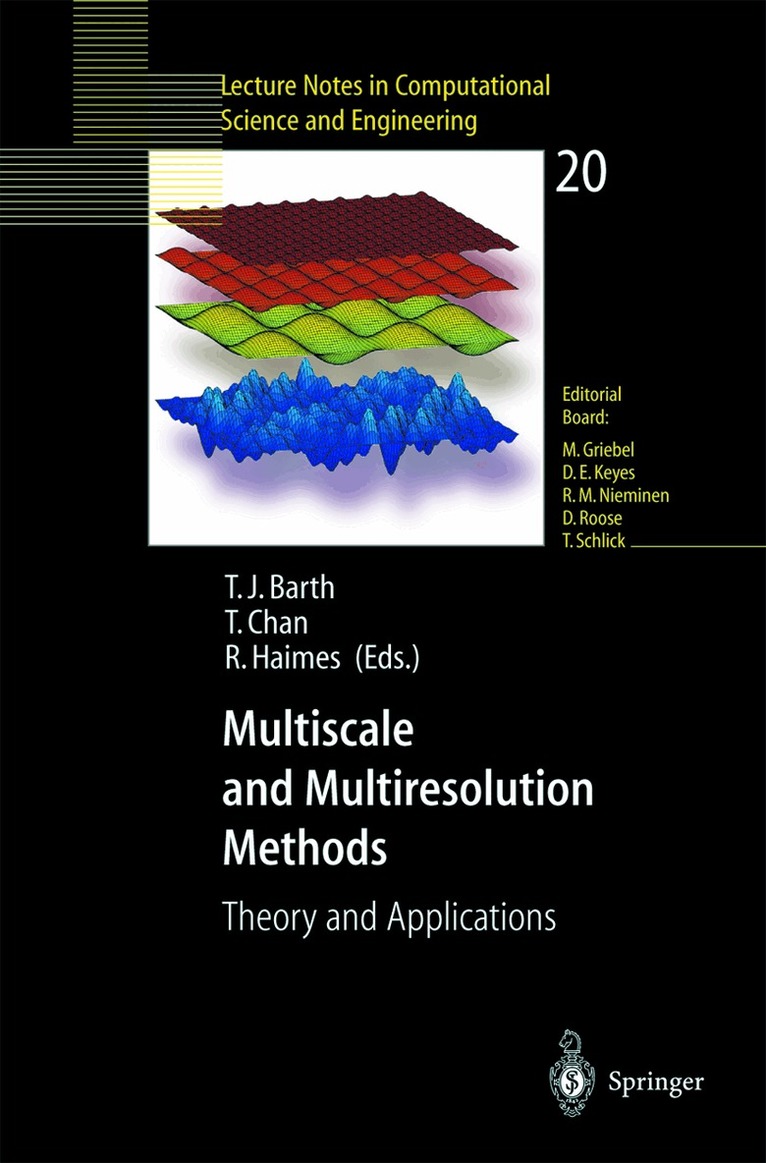
Multiscale and Multiresolution Methods
Theory and Applications
Häftad, Engelska, 2001
1 619 kr
Skickas inom 10-15 vardagar
Many computionally challenging problems omnipresent in science and engineering exhibit multiscale phenomena so that the task of computing or even representing all scales of action is computationally very expensive unless the multiscale nature of these problems is exploited in a fundamental way. Some diverse examples of practical interest include the computation of fluid turbulence, structural analysis of composite materials, terabyte data mining, image processing, and a multitude of others. This book consists of both invited and contributed articles which address many facets of efficient multiscale representation and scientific computation from varied viewpoints such as hierarchical data representations, multilevel algorithms, algebraic homogeni- zation, and others. This book should be of particular interest to readers interested in recent and emerging trends in multiscale and multiresolution computation with application to a wide range of practical problems.
E-bok
PDF, Engelska, 20121 977 kr
Läs direkt efter köp
Many computionally challenging problems omnipresent in science and engineering exhibit multiscale phenomena so that the task of computing or even representing all scales of action is computationally very expensive unless the multiscale nature of these problems is exploited in a fundamental way. Some diverse examples of practical interest include the computation of fluid turbulence, structural analysis of composite materials, terabyte data mining, image processing, and a multitude of others. This book consists of both invited and contributed articles which address many facets of efficient multiscale representation and scientific computation from varied viewpoints such as hierarchical data representations, multilevel algorithms, algebraic homogeni- zation, and others. This book should be of particular interest to readers interested in recent and emerging trends in multiscale and multiresolution computation with application to a wide range of practical problems.