Olivier Faugeras - Böcker
Visar alla böcker från författaren Olivier Faugeras. Handla med fri frakt och snabb leverans.
5 produkter
5 produkter
1 500 kr
Tillfälligt slut
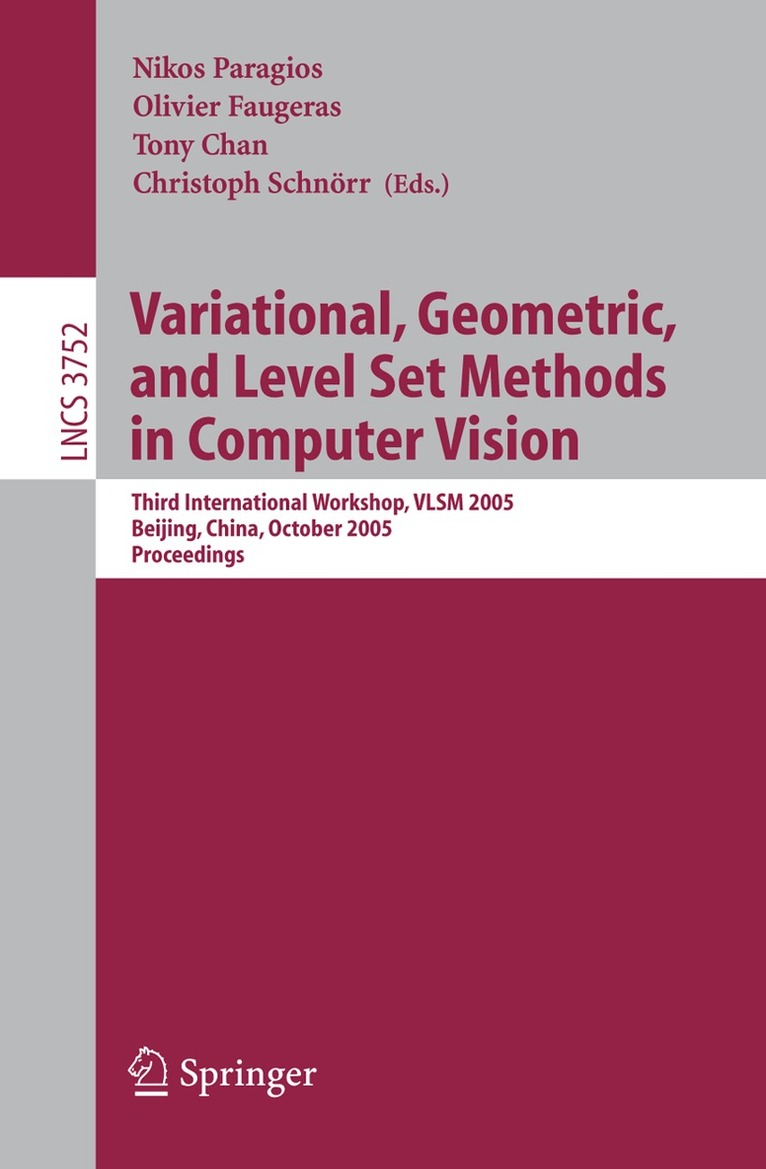
Variational, Geometric, and Level Set Methods in Computer Vision
Third International Workshop, VLSM 2005, Beijing, China, October 16, 2005, Proceedings
Häftad, Engelska, 2005
552 kr
Skickas inom 10-15 vardagar
Mathematical methods has been a dominant research path in computational vision leading to a number of areas like ?ltering, segmentation, motion analysis and stereo reconstruction. Within such a branch visual perception tasks can either be addressed through the introduction of application-driven geometric ?ows or through the minimization of problem-driven cost functions where their lowest potential corresponds to image understanding. The 3rd IEEE Workshop on Variational, Geometric and Level Set Methods focused on these novel mathematical techniques and their applications to c- puter vision problems. To this end, from a substantial number of submissions, 30 high-quality papers were selected after a fully blind review process covering a large spectrum of computer-aided visual understanding of the environment. The papers are organized into four thematic areas: (i) Image Filtering and Reconstruction, (ii) Segmentation and Grouping, (iii) Registration and Motion Analysis and (iiii) 3D and Reconstruction. In the ?rst area solutions to image enhancement, inpainting and compression are presented, while more advanced applications like model-free and model-based segmentation are presented in the segmentation area. Registration of curves and images as well as multi-frame segmentation and tracking are part of the motion understanding track, while - troducing computationalprocessesinmanifolds,shapefromshading,calibration and stereo reconstruction are part of the 3D track. We hope that the material presented in the proceedings exceeds your exp- tations and will in?uence your research directions in the future. We would like to acknowledge the support of the Imaging and Visualization Department of Siemens Corporate Research for sponsoring the Best Student Paper Award.
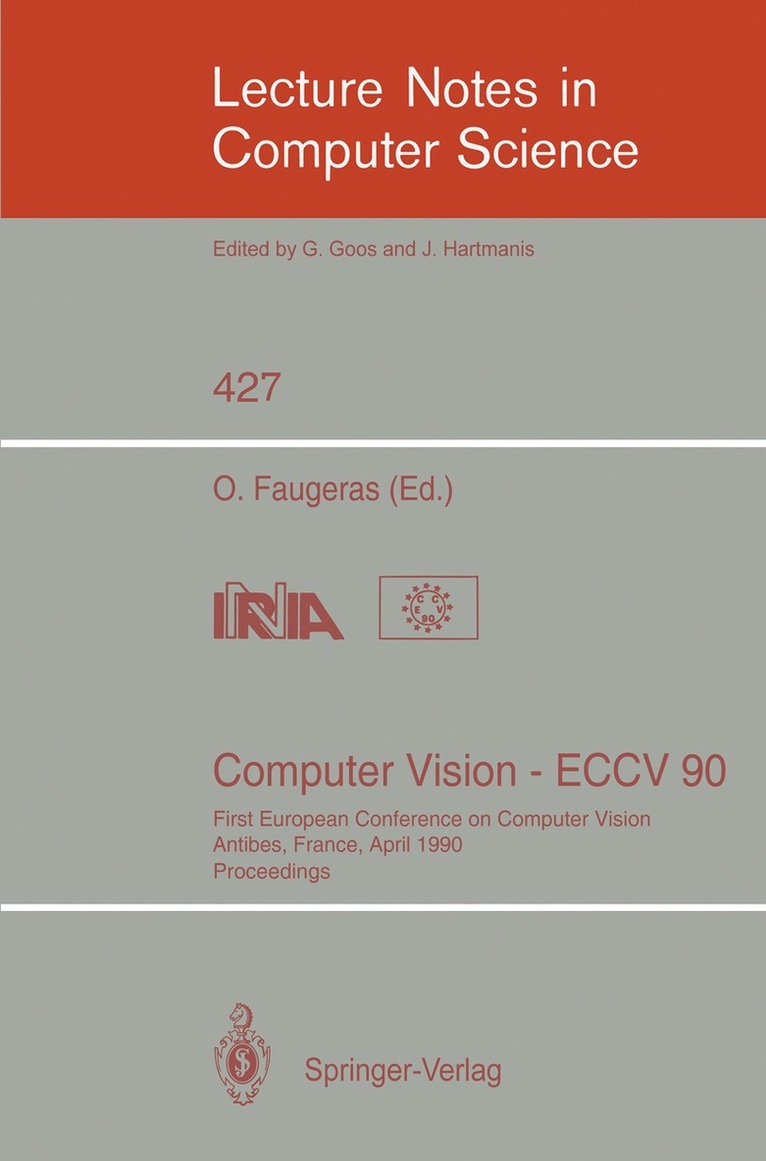
Computer Vision - ECCV 90
First European Conference on Computer Vision. Antibes, France, April 23-27, 1990. Proceedings
Häftad, Engelska, 1990
1 064 kr
Skickas inom 10-15 vardagar
A collection of papers on computer vision research in Euro-pe, with sections on image features, stereo and reconstruc-tion, optical flow, motion, structure from motion, tracking,stereo and motion, features and shape, shape description,and recognition and matching.
1 170 kr
Skickas inom 10-15 vardagar
This volume treats the analysis of 3D dynamic scenes using a stereovision system. Several approaches are described, for example two different methods of dealing with long and short sequences of images of an unknown environment, including an arbitrary number of rigid mobile objects. Results obtained from stereovision systems are found to be superior to those from monocular image systems, which are often very sensitive to noise and therefore of little use in practice. It is shown that motion estimation can be further improved by the explicit modelling of uncertainty in geometric objects. The techniques developed in this book have been successfully demonstrated with a large number of real images in the context of visual navigation of a mobile robot.
Del 27 - Springer Series in Information Sciences
3D Dynamic Scene Analysis
A Stereo Based Approach
Häftad, Engelska, 2012
536 kr
Skickas inom 10-15 vardagar
he problem of analyzing sequences of images to extract three-dimensional T motion and structure has been at the heart of the research in computer vi sion for many years. It is very important since its success or failure will determine whether or not vision can be used as a sensory process in reactive systems. The considerable research interest in this field has been motivated at least by the following two points: 1. The redundancy of information contained in time-varying images can over come several difficulties encountered in interpreting a single image. 2. There are a lot of important applications including automatic vehicle driv ing, traffic control, aerial surveillance, medical inspection and global model construction. However, there are many new problems which should be solved: how to effi ciently process the abundant information contained in time-varying images, how to model the change between images, how to model the uncertainty inherently associated with the imaging system and how to solve inverse problems which are generally ill-posed. There are of course many possibilities for attacking these problems and many more remain to be explored. We discuss a few of them in this book based on work carried out during the last five years in the Computer Vision and Robotics Group at INRIA (Institut National de Recherche en Informatique et en Automatique).