Christophe Wall-Romana - Böcker
Visar alla böcker från författaren Christophe Wall-Romana. Handla med fri frakt och snabb leverans.
5 produkter
5 produkter
743 kr
Skickas inom 10-15 vardagar
Cinepoetry analyzes how French poets have remapped poetry through the lens of cinema for more than a century. In showing how poets have drawn on mass culture, technology, and material images to incorporate the idea, technique, and experience of cinema into writing, Wall-Romana documents the long history of cross-media concepts and practices often thought to emerge with the digital.In showing the cinematic consciousness of Mallarmé and Breton and calling for a reappraisal of the influential poetry theory of the early filmmaker Jean Epstein, Cinepoetry reevaluates the bases of literary modernism. The book also explores the crucial link between trauma and trans-medium experiments in the wake of two world wars and highlights the marginal identity of cinepoets who were often Jewish, gay, foreign-born, or on the margins.What results is a broad rethinking of the relationship between film and literature. The episteme of cinema, the book demonstates, reached the very core of its supposedly highbrow rival, while at the same time modern poetry cultivated the technocultural savvy that is found today in slams, e-poetry, and poetic-digital hybrids.
399 kr
Skickas inom 11-20 vardagar
Cinepoetry analyzes how French poets have remapped poetry through the lens of cinema for more than a century. In showing how poets have drawn on mass culture, technology, and material images to incorporate the idea, technique, and experience of cinema into writing, Wall-Romana documents the long history of cross-media concepts and practices often thought to emerge with the digital.In showing the cinematic consciousness of Mallarmé and Breton and calling for a reappraisal of the influential poetry theory of the early filmmaker Jean Epstein, Cinepoetry reevaluates the bases of literary modernism. The book also explores the crucial link between trauma and trans-medium experiments in the wake of two world wars and highlights the marginal identity of cinepoets who were often Jewish, gay, foreign-born, or on the margins.What results is a broad rethinking of the relationship between film and literature. The episteme of cinema, the book demonstates, reached the very core of its supposedly highbrow rival, while at the same time modern poetry cultivated the technocultural savvy that is found today in slams, e-poetry, and poetic-digital hybrids.
1 347 kr
Skickas inom 11-20 vardagar
A radical assessment of the racial motives underlying the conception of photography and cinemaConventional histories have long traced the origins of photography and cinema to the goal of reproducing the visible world. Black Light offers a radical counter to this understanding. Investigating the optical, cosmological, and racial thought that surrounded their conception, Christophe Wall-Romana argues that these media developed out of a desire to visualize what cannot be seen.Taking as its starting point the concurrent invention of the telescope and industrialization of the transatlantic slave trade, Black Light shows how photography and cinema are entangled with two key preoccupations of the Enlightenment: visualizing the mysteries of the cosmos and managing Blackness. Wall-Romana uses literary and technological sources to demonstrate how racial and astronomical thinking interwove throughout the long development of our modern visual media. Retracing the impulses behind nonmimetic photoimaging and dynamic modeling, he exposes the racial underpinnings of research on photosensitive compounds such as silver nitrate and the racist lenses applied in post-Copernican cosmology.Black Light charts the pivotal period from the seventeenth through the nineteenth century when Europeans were reckoning with "multiple worlds" and natural philosophy was giving way to "mechanical objectivity." Wall-Romana shows how engagement with the nature of light was always entangled with racist discourses on Blackness - especially after the 1801 discovery of the invisible spectrum and its paradox of "black light." Deprovincializing media archaeology, this book presents a groundbreaking historical framework with which to reenvision our dominant modes of seeing and understanding the world.Retail e-book files for this title are screen-reader friendly with images accompanied by short alt text and/or extended descriptions.
305 kr
Kommande
A radical assessment of the racial motives underlying the conception of photography and cinemaConventional histories have long traced the origins of photography and cinema to the goal of reproducing the visible world. Black Light offers a radical counter to this understanding. Investigating the optical, cosmological, and racial thought that surrounded their conception, Christophe Wall-Romana argues that these media developed out of a desire to visualize what cannot be seen.Taking as its starting point the concurrent invention of the telescope and industrialization of the transatlantic slave trade, Black Light shows how photography and cinema are entangled with two key preoccupations of the Enlightenment: visualizing the mysteries of the cosmos and managing Blackness. Wall-Romana uses literary and technological sources to demonstrate how racial and astronomical thinking interwove throughout the long development of our modern visual media. Retracing the impulses behind nonmimetic photoimaging and dynamic modeling, he exposes the racial underpinnings of research on photosensitive compounds such as silver nitrate and the racist lenses applied in post-Copernican cosmology.Black Light charts the pivotal period from the seventeenth through the nineteenth century when Europeans were reckoning with "multiple worlds" and natural philosophy was giving way to "mechanical objectivity." Wall-Romana shows how engagement with the nature of light was always entangled with racist discourses on Blackness - especially after the 1801 discovery of the invisible spectrum and its paradox of "black light." Deprovincializing media archaeology, this book presents a groundbreaking historical framework with which to reenvision our dominant modes of seeing and understanding the world.Retail e-book files for this title are screen-reader friendly with images accompanied by short alt text and/or extended descriptions.
527 kr
Skickas inom 3-6 vardagar
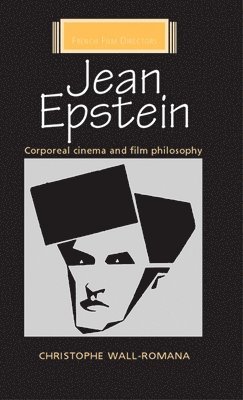
If cinema can be approached as poetry and philosophy, it is because of Jean Epstein. Cocteau, Buñuel (who was his assistant), Hitchcock, Pasolini and Godard, and theoreticians Kracauer, Deleuze and Rancière are directly influenced by Epstein's pioneering film work, writings, and concepts. This book is the first in English to examine his oeuvre comprehensively.An avant-garde artist and an anti-elitist intellectual, Epstein wanted to craft moments of pure transformative cinema. Using familiar genres - melodramas and documentaries - he hoped to heal viewers of all classes and hasten social utopia. A lover of cinema as cognitive and sensorial technology, and a poet of the screen, he pushed cinematography - as photogénie - towards the experimental sublime, through daring close-ups, rhythmic montage, slow motion, even reverse motion. Polish-born, half-Jewish, and the author of a treatise on homosexuality, Epstein has been unfairly relegated to the shadows of film history. This book restores him to the limelight of interwar world cinema, on a par with Renoir, Lang, Capra and Eisenstein.