Christopher Bracken – författare
Visar alla böcker från författaren Christopher Bracken. Handla med fri frakt och snabb leverans.
6 produkter
6 produkter
334 kr
Skickas inom 7-10 vardagar
Variously described as an exchange of gifts, a destruction of property, a system of banking, and a struggle for prestige, the potlatch is one of the founding concepts of anthropology. Some researchers even claim to have discovered traces of the potlatch in all the economies of the world. However, as the author of this text shows in this closely-argued work, the potlatch was in fact invented by the 19th-century Canadian law that sought to destroy it. In addition to giving the world its own potlatch, the law also generated a random collection of "potlatch papers" dating from the 1860s to the 1930s. Bracken analyzes these documents - some canonical, like Franz Boas's ethnographies, others unpublished and little known - to catch a colonialist discourse in the act of constructing fictions about certain "first nations" and then deploying those fictions against them. Rather than referring to objects that already exist, the "potlatch papers" instead gave themselves something to refer to: a mirror in which to observe not "the Indian," but "the European."
786 kr
Tillfälligt slut
Variously described as an exchange of gifts, a destruction of property, a system of banking, and a struggle for prestige, the potlatch is one of the founding concepts of anthropology. Some researchers even claim to have discovered traces of the potlatch in all the economies of the world. However, as the author of this text shows in this closely-argued work, the potlatch was in fact invented by the 19th-century Canadian law that sought to destroy it. In addition to giving the world its own potlatch, the law also generated a random collection of "potlatch papers" dating from the 1860s to the 1930s. Bracken analyzes these documents - some canonical, like Franz Boas's ethnographies, others unpublished and little known - to catch a colonialist discourse in the act of constructing fictions about certain "first nations" and then deploying those fictions against them. Rather than referring to objects that already exist, the "potlatch papers" instead gave themselves something to refer to: a mirror in which to observe not "the Indian," but "the European."
772 kr
Tillfälligt slut
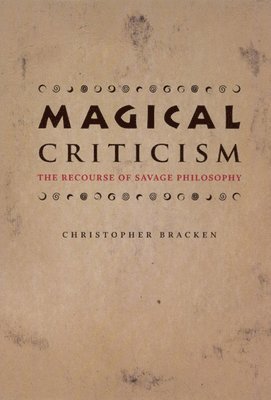
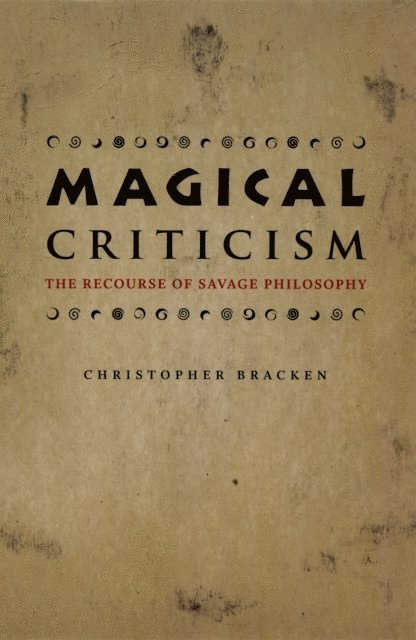
During the Enlightenment, Western scholars racialized ideas, deeming knowledge based on reality superior to that based on ideality. Scholars labeled inquiries into ideality, such as animism and soul migration, "savage philosophy," a clear indicator of the racism motivating the distinction between the real and the ideal. In their view, savage philosophers mistake connections between signs for connections between real objects and believe that discourse can have physical effects - in other words, they believe in magic. Christopher Bracken's "Magical Criticism" brings the unacknowledged history of this racialization to light and shows how, even as we have rejected ethnocentric notions of "the savage," they remain active today in everything from attacks on postmodernism to Native American land disputes. Here Bracken reveals that many of the most influential Western thinkers dabbled in savage philosophy, from Marx, Nietzsche, and Proust to Freud, Charles Sanders Peirce, and Walter Benjamin.For Bracken, this recourse to savage philosophy presents an opportunity to reclaim a magical criticism that can explain the very real effects created by the discourse of historians, anthropologists, philosophers, the media, and governments.
300 kr
Skickas inom 7-10 vardagar
During the Enlightenment, Western scholars racialized ideas, deeming knowledge based on reality superior to that based on ideality. Scholars labeled inquiries into ideality, such as animism and soul migration, "savage philosophy," a clear indicator of the racism motivating the distinction between the real and the ideal. In their view, savage philosophers mistake connections between signs for connections between real objects and believe that discourse can have physical effects - in other words, they believe in magic. Christopher Bracken's "Magical Criticism" brings the unacknowledged history of this racialization to light and shows how, even as we have rejected ethnocentric notions of "the savage," they remain active today in everything from attacks on postmodernism to Native American land disputes. Here Bracken reveals that many of the most influential Western thinkers dabbled in savage philosophy, from Marx, Nietzsche, and Proust to Freud, Charles Sanders Peirce, and Walter Benjamin.For Bracken, this recourse to savage philosophy presents an opportunity to reclaim a magical criticism that can explain the very real effects created by the discourse of historians, anthropologists, philosophers, the media, and governments.
1 343 kr
Kommande
A gripping exploration of belief in the impossible through horror film, informed by philosophy, history, and anthropology.What if aliens crash-landed at an old mine? What if you discovered your spouse is protecting you from witchcraft? What if you received messages from the dead? You wouldn’t believe it, of course—but you might investigate. As Christopher Bracken shows through this gripping exploration of the horror film, this is the first step toward believing the impossible.In Believable Impossibilities, Bracken examines the genre in which we are most frequently called on to believe something seemingly impossible has unsettled our ordinary lives—the horror story. Whether on the page or on screen, horror draws us into narratives in which a community of nonbelievers are suddenly confronted with the challenge of believing in events and experiences that radically break with expectation. As Bracken argues, questions of belief often intersect with issues of race and Indigeneity because, historically, belief in the impossible has been racially coded as a trait of “primitive” thought. Drawing on philosophy, anthropology, and psychoanalysis, Bracken explores the fictional spaces in which the paranormal and supernatural challenge and defy our social bonds.
396 kr
Kommande
A gripping exploration of belief in the impossible through horror film, informed by philosophy, history, and anthropology.What if aliens crash-landed at an old mine? What if you discovered your spouse is protecting you from witchcraft? What if you received messages from the dead? You wouldn’t believe it, of course—but you might investigate. As Christopher Bracken shows through this gripping exploration of the horror film, this is the first step toward believing the impossible.In Believable Impossibilities, Bracken examines the genre in which we are most frequently called on to believe something seemingly impossible has unsettled our ordinary lives—the horror story. Whether on the page or on screen, horror draws us into narratives in which a community of nonbelievers are suddenly confronted with the challenge of believing in events and experiences that radically break with expectation. As Bracken argues, questions of belief often intersect with issues of race and Indigeneity because, historically, belief in the impossible has been racially coded as a trait of “primitive” thought. Drawing on philosophy, anthropology, and psychoanalysis, Bracken explores the fictional spaces in which the paranormal and supernatural challenge and defy our social bonds.