Christopher Collard - Böcker
Visar alla böcker från författaren Christopher Collard. Handla med fri frakt och snabb leverans.
11 produkter
11 produkter
344 kr
Skickas inom 7-10 vardagar
Lost works by ancient Greece’s third great tragedian.Eighteen of the ninety or so plays composed by Euripides between 455 and 406 BC survive in a complete form and are included in the preceding six volumes of the Loeb Euripides. A further fifty-two tragedies and eleven satyr plays, including a few of disputed authorship, are known from ancient quotations and references and from numerous papyri discovered since 1880. No more than one-fifth of any play is represented, but many can be reconstructed with some accuracy in outline, and many of the fragments are striking in themselves. The extant plays and the fragments together make Euripides by far the best known of the classic Greek tragedians. This edition, in a projected two volumes, offers the first complete English translation of the fragments together with a selection of testimonia bearing on the content of the plays. The texts are based on the recent comprehensive edition of R. Kannicht. A general Introduction discusses the evidence for the lost plays. Each play is prefaced by a select bibliography and an introductory discussion of its mythical background, plot, and location of the fragments, general character, chronology, and impact on subsequent literary and artistic traditions.
Del 506 - Loeb Classical Library
Fragments, Volume II
Oedipus–Chrysippus. Other Fragments
Inbunden, Engelska, 2009
344 kr
Skickas inom 7-10 vardagar
Lost works by ancient Greece’s third great tragedian.Eighteen of the ninety or so plays composed by Euripides between 455 and 406 BC survive in a complete form and are included in the preceding six volumes of the Loeb Euripides. A further fifty-two tragedies and eleven satyr plays, including a few of disputed authorship, are known from ancient quotations and references and from numerous papyri discovered since 1880. No more than one-fifth of any play is represented, but many can be reconstructed with some accuracy in outline, and many of the fragments are striking in themselves. The extant plays and the fragments together make Euripides by far the best known of the classic Greek tragedians. This edition, in a projected two volumes, offers the first complete English translation of the fragments together with a selection of testimonia bearing on the content of the plays. The texts are based on the recent comprehensive edition of R. Kannicht. A general Introduction discusses the evidence for the lost plays. Each play is prefaced by a select bibliography and an introductory discussion of its mythical background, plot, and location of the fragments, general character, chronology, and impact on subsequent literary and artistic traditions.
501 kr
Skickas inom 7-10 vardagar
Hecuba, in slavery after Troy's fall, fails to dissuade Odysseus, whose life she once saved, from sacrificing her daughter to honour his dead friend, Achilles; but the girl dies proudly, true to her royal blood in surmounting degradation. Then Hecuba learns of her sons' treacherous murder by a former ally; out of her terrible loss comes determination for revenge, which she claims as a right but how just is her horrific cruelty? How credible against her earlier characterisation? The play has striking effects: the ghost of the murdered son, and his murderer subsequently blinded; poignant lyricism; vivid narratives; above all, a careful pattern of scenes demonstrating the equivocal power of 'Persuasion, man's only sovereign' (v.816). Hecuba is both a study of resilience and weakness, and a typically Euripidean comment on the uncertain, even collapsing, values of his time. Text with facing translation, commentary and notes.
740 kr
Skickas inom 3-6 vardagar
The fragmentary plays of Euripides are a body of texts still regularly increasing in number and extent. They are of very great interest in themselves, apart from the significant aid they give to the fuller appreciation of the surviving complete plays. This two-volume edition brings together for the first time for English readers the more substantial and important of the plays, about fifteen in all. Each play is introduced by a summary bibliography and an appreciative essay which analyses the mythic background and plot: reconstructs the play as far as the fragmentary text and secondary evidence allow; and discusses themes, characterisation, staging, date, reflections of the story in art and other dramatisations. For each play the fragmentary texts are presented as conveniently and succinctly as possible, together with a brief critical apparatus of sources and readings. An English translation stands on the facing page. The text and translation of each play are followed by a short, primarily interpretative commentary. Text with facing translation, commentary and notes.
420 kr
Skickas inom 7-10 vardagar
The fragmentary plays of Euripides are a body of texts still regularly increasing in number and extent. They are of very great interest in themselves, apart from the significant aid they give to the fuller appreciation of the surviving complete plays. This two-volume edition brings together for the first time for English readers the more substantial and important of the plays, about fifteen in all. Each play is introduced by a summary bibliography and an appreciative essay which analyses the mythic background and plot: reconstructs the play as far as the fragmentary text and secondary evidence allow; and discusses themes, characterisation, staging, date, reflections of the story in art and other dramatisations. For each play the fragmentary texts are presented as conveniently and succinctly as possible, together with a brief critical apparatus of sources and readings. An English translation stands on the facing page. The text and translation of each play are followed by a short, primarily interpretative commentary. Text with facing translation, commentary and notes.
545 kr
Skickas inom 7-10 vardagar
The fragmentary plays of Euripides are a body of texts still regularly increasing in number and extent. They are of very great interest in themselves, apart from the significant aid they give to the fuller appreciation of the surviving complete plays. This two-volume edition brings together for the first time for English readers the more substantial and important of the plays, about fifteen in all. Each play is introduced by a summary bibliography and an appreciative essay which analyses the mythic background and plot: reconstructs the play as far as the fragmentary text and secondary evidence allow; and discusses themes, characterisation, staging, date, reflections of the story in art and other dramatisations. For each play the fragmentary texts are presented as conveniently and succinctly as possible, together with a brief critical apparatus of sources and readings. An English translation stands on the facing page. The text and translation of each play are followed by a short, primarily interpretative commentary.This volume contains: Alexandros (together with Palamedes and Sisyphus), Oedipus, Andromeda,Antiope, Hypsipyle, Archelaus (415 to about 407 B.C.).
1 613 kr
Skickas inom 7-10 vardagar
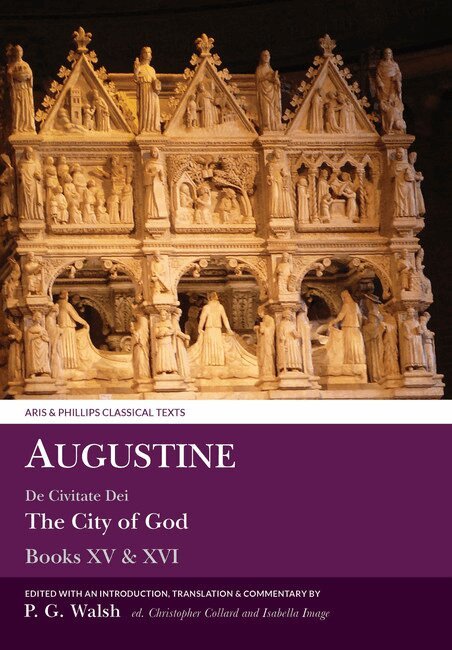
The volume continues P. G. Walsh's admired translation with commentary of Augustine's The City of God Books I-XIV which have been published in eight earlier volumes between 2003 and 2016, and this ninth volume in the collection looks at books XV and XVI. After completing the first ten books of De Civitate Dei, in which Augustine sought to refute the claim that pagan deities had ensured that Rome enjoyed unbroken success and prosperity in this life and guaranteed its citizens a blessed life after death, Augustine devoted the remaining twelve books to discuss the origins, development and destiny of the two cities of Babylon and Jerusalem, with the predominant emphasis on the city of God. This is the only edition of these books in English which provides not only a text but also a detailed commentary on one of the most influential documents in the history of western Christianity. Latin text with facing-page English translation, introduction and commentary.
545 kr
Skickas inom 7-10 vardagar
The volume continues P. G. Walsh's admired translation with commentary of Augustine's The City of God Books I-XIV which have been published in eight earlier volumes between 2003 and 2016, and this ninth volume in the collection looks at books XV and XVI. After completing the first ten books of De Civitate Dei, in which Augustine sought to refute the claim that pagan deities had ensured that Rome enjoyed unbroken success and prosperity in this life and guaranteed its citizens a blessed life after death, Augustine devoted the remaining twelve books to discuss the origins, development and destiny of the two cities of Babylon and Jerusalem, with the predominant emphasis on the city of God. This is the only edition of these books in English which provides not only a text but also a detailed commentary on one of the most influential documents in the history of western Christianity. Latin text with facing-page English translation, introduction and commentary.
2 119 kr
Skickas inom 7-10 vardagar
This volume brings together forty years of scholarship by one of the major scholars of Greek tragedy and of Euripides over several decades. Of the twenty papers collected here, thirteen explore tragedy in general and Euripides in particular, but with emphasis on textual questions – transmission, interpretation, verbal criticism – and dramatic form. The other seven evaluate important Euripidean scholars from the 17th to the 19th centuries including Joshua Barnes, Jeremiah Markland, S. Musgrave, Peter Elmsley and J. H. Monk. The book’s material is divided into three thematic sections: ‘Tragedy’, ‘Euripides’ and ‘Euripideans’. All papers have been corrected and revised, and supplemented with further matter, chiefly a full bibliography of Christopher Collard’s publications (up to 2007).
1 855 kr
Skickas inom 7-10 vardagar
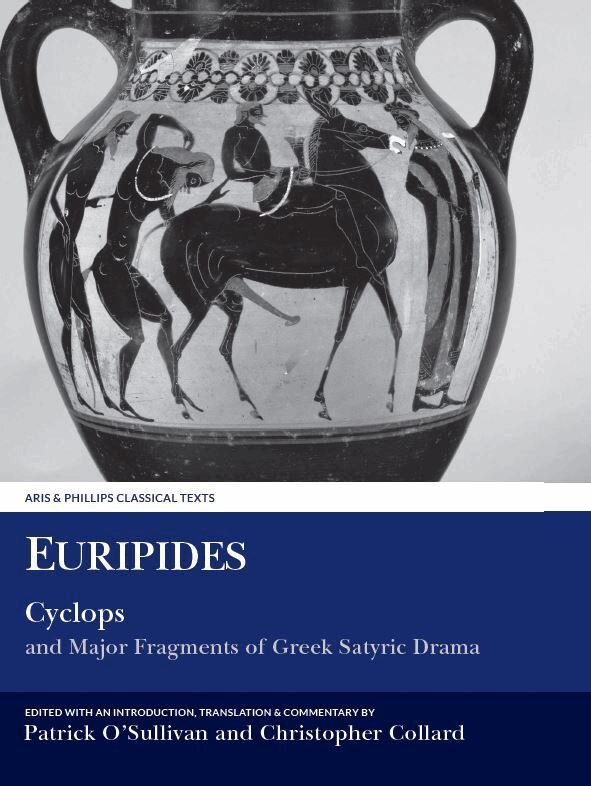
Satyric is the most thinly attested genre of Greek drama, but it appears to have been the oldest and according to Aristotle formative for tragedy. By the 5th Century BC at Athens it shared most of its compositional elements with tragedy, to which it became an adjunct; for at the annual great dramatic festivals, it was performed only together with, and after, the three tragedies which each poet was required to present in competition. It was in contrast with them, aesthetically and emotionally, its plays being considerably shorter and simpler; coarse and half-way to comedy, it burlesqued heroic and tragic myth, frequently that just dramatised and performed in the tragedies.Euripides'Cyclops is the only satyr-play which survives complete. It is generally held to be the poet's late work, but its companion tragedies are not identifiable. Its title alone signals its content, Odysseus' escape from the one-eyed, man-eating monster, familiar from Book 9 of Homer's Odyssey. Because of its uniqueness, Cyclops could afford only a limited idea of satyric drama's range, which the many but brief quotations from other authors and plays barely coloured. Our knowledge and appreciation of the genre have been greatly enlarged, however, by recovery since the early 20th Century of considerable fragments of Aeschylus, Euripides' predecessor, and of Sophocles, his contemporary - but not, so far, of Euripides himself.This volume provides English readers for the first time with all the most important texts of satyric drama, with facing-page translation, substantial introduction and detailed commentary. It includes not only the major papyri, but very many shorter fragments of importance, both on papyrus and in quotation, from the 5th to the 3rd Centuries; there are also one or two texts whose interest lies in their problematic ascription to the genre at all. The intention is to illustrate it as fully as practicable.
501 kr
Skickas inom 7-10 vardagar
Satyric is the most thinly attested genre of Greek drama, but it appears to have been the oldest and according to Aristotle formative for tragedy. By the 5th Century BC at Athens it shared most of its compositional elements with tragedy, to which it became an adjunct; for at the annual great dramatic festivals, it was performed only together with, and after, the three tragedies which each poet was required to present in competition. It was in contrast with them, aesthetically and emotionally, its plays being considerably shorter and simpler; coarse and half-way to comedy, it burlesqued heroic and tragic myth, frequently that just dramatised and performed in the tragedies.Euripides'Cyclops is the only satyr-play which survives complete. It is generally held to be the poet's late work, but its companion tragedies are not identifiable. Its title alone signals its content, Odysseus' escape from the one-eyed, man-eating monster, familiar from Book 9 of Homer's Odyssey. Because of its uniqueness, Cyclops could afford only a limited idea of satyric drama's range, which the many but brief quotations from other authors and plays barely coloured. Our knowledge and appreciation of the genre have been greatly enlarged, however, by recovery since the early 20th Century of considerable fragments of Aeschylus, Euripides' predecessor, and of Sophocles, his contemporary - but not, so far, of Euripides himself.This volume provides English readers for the first time with all the most important texts of satyric drama, with facing-page translation, substantial introduction and detailed commentary. It includes not only the major papyri, but very many shorter fragments of importance, both on papyrus and in quotation, from the 5th to the 3rd Centuries; there are also one or two texts whose interest lies in their problematic ascription to the genre at all. The intention is to illustrate it as fully as practicable.