
Christopher Ferguson – författare
Visar alla böcker från författaren Christopher Ferguson. Handla med fri frakt och snabb leverans.
4 produkter
4 produkter
567 kr
Skickas inom 7-10 vardagar
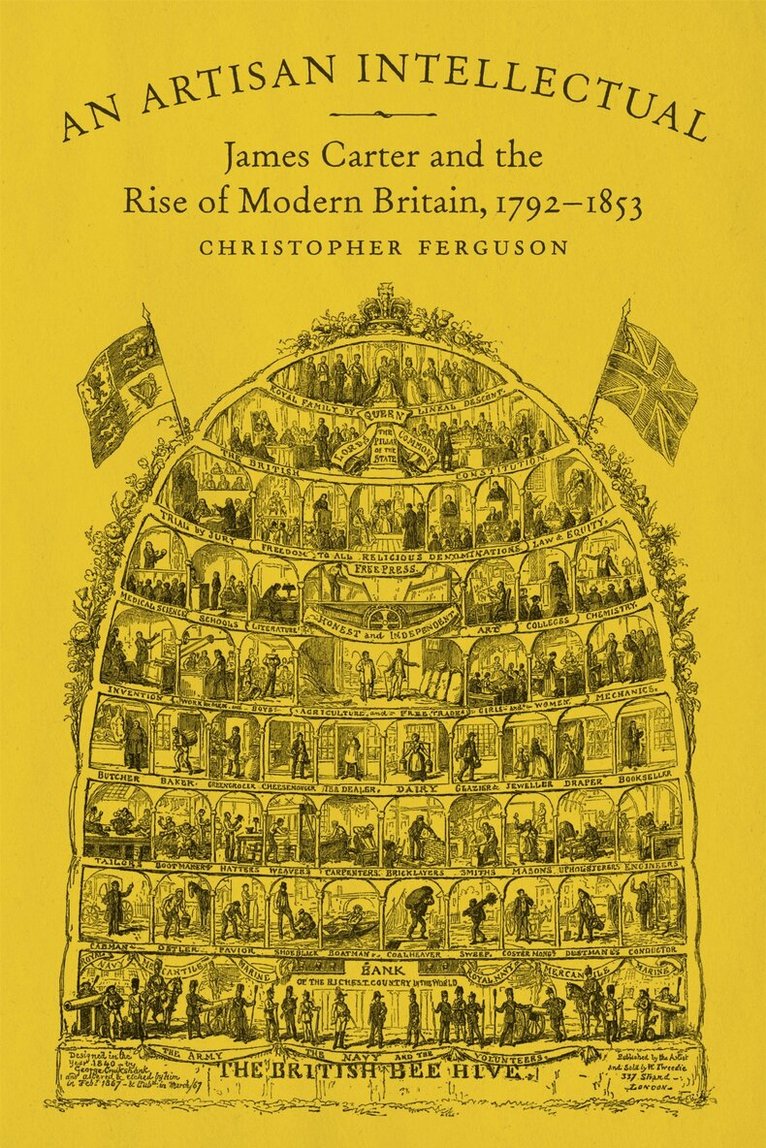
In An Artisan Intellectual, Christopher Ferguson examines the life and ideas of English tailor and writer James Carter, one of countless and largely anonymous citizens whose lives dramatically transformed during Britain's long march to modernity. Carter began his working life at age thirteen as an apprentice and continued to work as a tailor throughout the first half of the nineteenth century, first in Colchester and then in London. As the Industrial Revolution brought innovations to every aspect of British life, Carter took advantage of opportunities to push against the boundaries of his working-class background. He supplemented his income through his writing, publishing often unsigned books, articles, and poems on subjects as diverse as religion, death, nature, aesthetics, and theories of civilization.Carter's words give us a fascinating window into the revolutionary forces that upended the world of ordinary citizens in this era and demonstrate how the changes in daily life impacted personal experiences and intellectual pursuits as well as labor practices and living and working environments. Ferguson deftly explores a forgotten tailor's varied responses to the many transformations that produced the world's first modern society.
436 kr
Skickas inom 5-8 vardagar
"This book provides a thoughtful and balanced look at some of the hot topics generating headlines, such as media violence, body image, social representation and sex in the media.Media Psychology 101 will be a valuable addition to introductory courses and the public as a user-friendly overview of much-discussed issues.-Pamela Rutledge, PsycCRITIQUESThere are few areas of modern social science that are as fiercely debated as media psychology. Written by one of the foremost experts on the topic, this is a concise overview of what is knownóand not knownóabout how individuals are affected by and interact with various forms of mass media. The book critically examines research from cognitive, social, developmental, biological, and evolutionary approaches to psychology and addresses the interplay between media consumption and viewer behavior in such realms as advertising, body image, sex, and violence. Distinguished by its examination of research from a scientifically objective position, the book offers students not only current knowledge of media psychology but also the tools to challenge commonly held assumptions from popular advocacy and ideology.This text cuts across different psychological approaches to studying how individuals are affected by mass media and includes research from criminal justice and sociology. It considers critical debates in media psychology and how debates in science themselves can be influenced by processes such as "moral panic." Written in a lively, accessible manner, the book draws upon engaging examples such as Photoshopped model controversies, dubious advertising practices, and attempts to blame violent crimes on media to illustrate scholarly principles. Throughout, data from research studies are related back to real-world phenomena such as violence rates, advertising dollars spent, or changes in the news media. Written for upper-level undergraduate and graduate students studying media psychology, the text will also be of value to professionals in psychology, sociology, and criminal justice as well as individuals involved in public policy as it relates to media effects.Key Features Offers an objective, interdisciplinary approach to understanding media and behaviorDraws from cognitive, social, developmental, and biological psychology, as well as criminal justice research and sociologyChallenges the conclusions drawn from research to foster critical thinkingWritten in a lively, accessible writing style with engaging examples
How Madness Shaped History
An Eccentric Array of Maniacal Rulers, Raving Narcissists, and Psychotic Visionaries
Inbunden, Engelska, 2020
254 kr
Skickas inom 7-10 vardagar
This book considers the impact of psychology on world events, looking at how mental illness and personality disorders have affected history.How have mental illness and personality disorders influenced history? This lively investigation demonstrates that, when conditions are ripe, one unstable individual can create the best or worst moments of a generation or even a century.Beginning with Alexander the Great, whose megalomania caused widespread bloodshed yet powerfully shaped world history through the spread of Greek culture, the author examines the various forms of mental illness among people of great influence. These includes emperors, like the Romans Caligula and Elagabalus, kings like George III of England and Charles II of Spain, and lesser known rulers such as sixteenth-century Hungarian noblewoman Elizabeth Bathory, who is in the Guinness World Records as the most prolific female serial killer of all time. In more recent times, the author considers the mental instability exhibited by dictators Adolf Hitler, Joseph Stalin, and Idi Amin, as well as female prison guard Irma Grese, whose cruelties at Auschwitz were infamous.He also discusses rumors of cognitive decline among American presidents Woodrow Wilson, Ronald Reagan, and Donald Trump, and the ways in which American democracy copes with the disability of its leaders. And he considers cases where whole societies seem to be gripped by the madness of mob rule.Ferguson concludes with an eye toward the future, considering the power of social media to amplify fringe ideas, giving extremist and outright crazy perspectives greater exposure and influence than ever before.

345 kr
Skickas inom 3-6 vardagar