Claus Nygaard - Böcker
Visar alla böcker från författaren Claus Nygaard. Handla med fri frakt och snabb leverans.
13 produkter
13 produkter
584 kr
Skickas inom 3-6 vardagar
520 kr
Skickas inom 5-8 vardagar
Technology-EnhancedLearning in Higher Education is an anthology produced by theinternational association, Learning in Higher Education (LiHE). LiHE, whose scope includes the activitiesof colleges, universities and other institutions of higher education, has beenone of the leading organisations supporting a shift in the education processfrom a transmission-based philosophy to a student-centred, learning-basedapproach. Traditionally education has been envisaged as a processin which the teacher disseminates knowledge and information to the student,and directs them to perform – instructing, cajoling, encouraging them asappropriate – despite differentstudents’ abilities. Yet higher education is currently experiencing rapidtransformation, with the introduction of a broad range of technologies whichhave the potential to enhance student learning. This anthology draws upon theexperiences of those practitioners who have been pioneering new applicationsof technology in higher education, highlighting not only the technologiesthemselves but also the impact which they have had on student learning.The anthology illustrates how new technologies – whichare increasingly well-known and accepted by today’s ‘digital natives’undertaking higher education – can be adopted and incorporated. One keyconclusion is that learning remains a social process even intechnology-enhanced learning contexts. So the technology-based proxies weconstruct need to retain and reflect the agency of the teacher.Technology-EnhancedLearning in Higher Education showcases some of the latest pedagogicaltechnologies and their most creative, state-of-the-art applications tolearning in higher education from around the world. Each of the chapters explorestechnology-enhanced learning in higher education in terms of either policy orpractice. They contain detailed descriptions of approaches taken in verydifferent curriculum areas, and demonstrate clearly that technology may andcan enhance learning only if it is designed with the learning process ofstudents at its core. So the use of technology in education is more linked topedagogy than it is to bits and bytes.
520 kr
Skickas inom 5-8 vardagar
Assessing Learning in Higher Education addresses whatis probably the most time-consuming part of the work of staff in highereducation, and something to the complexity of which many of the recentdevelopments in higher education have added. Getting assessment ‘right’– thatis, designing and implementing appropriate models and methods, can determinethe future lives and careers of students. But, as Professor Phil Race commentsin his excellent and thought-provoking foreword, students entering highereducation often have little idea about how exactly assessment will work, andoften find that the process is very different from anything they havepreviously encountered. Assessing Learning in Higher Education containsinnovative approaches to assessment drawn from many different cultures anddisciplines. The chapter authors argue the need for changing assessment andfeedback processes so that they embrace online collaboration and discussionbetween students as well as between ‘students’ and ‘faculty’.The chaptersdemonstrate that at some points there is a need to be able to measureindividual achievement, and to do this in ways that are valid, transparent,authentic – and above all fair. Assessment and feedback processes need toensure that students are well prepared for this individual assessment, but alsoto take account of collaboration and interaction. The respective chapters of Assessing Learning in Higher Education allof which are complete in themselves, but with very useful links to ideas inother chapters, provide numerous illustrations of how this can beachieved.
568 kr
Skickas inom 5-8 vardagar
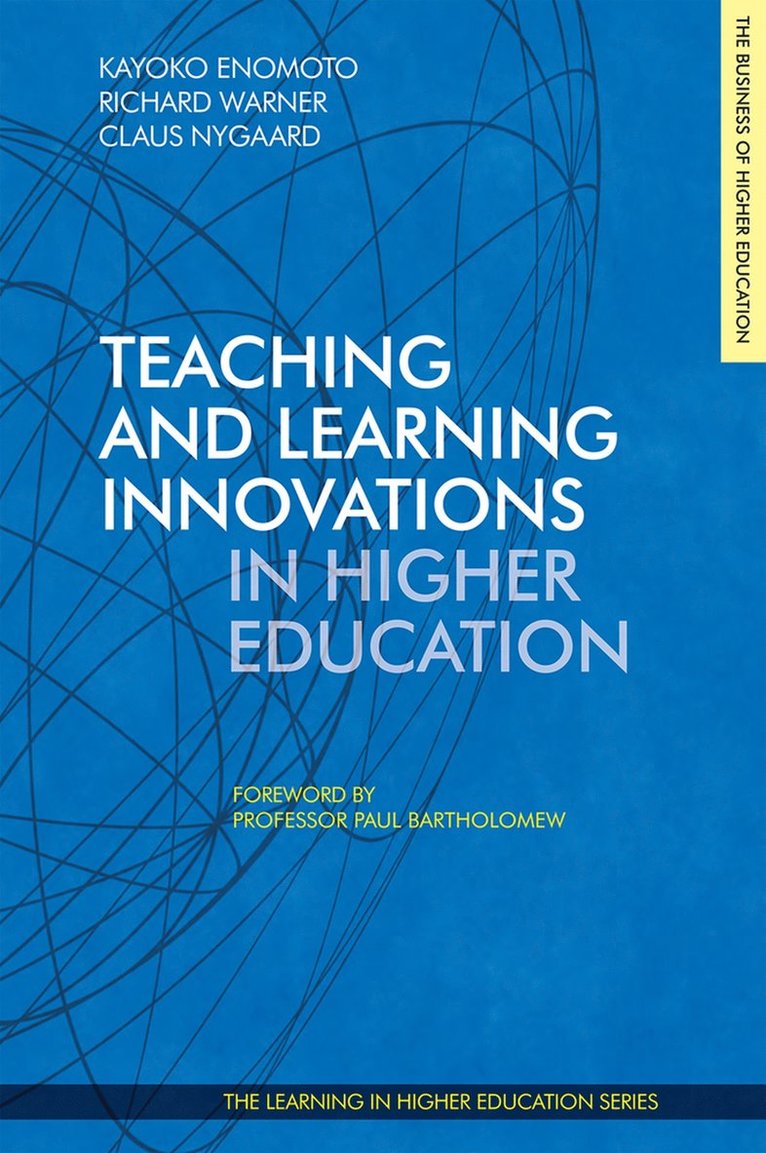
This latest volume in theLearning in Higher Education series, InnovativeTeaching and Learning in Higher Education, brings together examples ofteaching and learning innovations, within the domain of higher education. Theanthology is diverse in nature and showcases concrete examples of innovativeteaching and learning practices in higher education from around the world. Thecontributions come from all scientific disciplines and in all teaching andlearning contexts. The twenty-eight inspiringexamples in this volume show considerable diversity in their approaches toteaching and learning practices; at the same time they improve both studentengagement and student learning outcomes. All the authors argue that theirinnovative approach has helped students to learn differently, better, and more.For those involved in higher education, there is a lot to be gained fromreading these narrative accounts of innovative teaching and learning.
Globalisation of Higher Education
Political, Institutional, Cultural, and Personal Perspectives
Häftad, Engelska, 2017
568 kr
Skickas inom 5-8 vardagar
This latest volumein the Learning in Higher Education series, Globalisation of Higher Education,explores the idea that globalisation is both an opportunity and a challenge tohigher education. Universities open up branches in foreign countries. Neweducational partnerships are being established across borders. We seeglobalisation of higher education on the rise everywhere. Is there a perfect modelof globalisation of higher education? The editors think not. Nevertheless, theybelieve that we can learn a lot from studying excellent contextualglobalisation practices taking place at universities around the world. This book presents 11 cases of globalisation of higher education. Thecases are grouped within four perspectives: 1) politicalperspectives 2) institutional perspectives 3) cultural perspectives 4) personalperspectives.Globalisationof Higher Education examines how universities arecurrently dealing with globalisation. Chapters are written by faculty membersand administrators at universities, who all share the knowledge and practice ofhaving developed international, transnational, or global offerings in form ofeducational programmes and courses. They describe their challenges, and howthey have dealt with those.
568 kr
Skickas inom 5-8 vardagar
For many years, it has been thegeneral view that entrepreneurs are simply born that way – thatentrepreneurship is innate and therefore cannot be taught (or learned), and istherefore a subject unsuited to higher education. The logic seemed to follow:an entrepreneur is just naturally an entrepreneur, and studyingentrepreneurship, therefore, is a meaningless enterprise. Borrowing Nike’sslogan, entrepreneurs just do it.But in recent years, a completereversal of thinking in higher education has occurred. Indeed, entrepreneurs,it is claimed, are made, not born. In other words, entrepreneurship can belearned. Subsequently, institutions of higher education, in most countriesaround the world, have embraced the teaching and learning of entrepreneurshipwith fervour, as demonstrated by the growth of entrepreneurship centres, newventure incubators, and business plan competitions on college and universitycampuses.Teaching andLearning Entrepreneurship in Higher Education embraces this ifto how reversal, by exploring entrepreneurship activities atdifferent universities around the world from three primary perspectives:policy, practice, and mindset. Its twelve chapters demonstrate that there is no‘one-size-fits-all’ model for teaching and learning entrepreneurship in highereducation. Despite their differences, however, the twelve also share a commondesire to develop and nurture entrepreneurship, and will inspire anyone with aninterest in teaching and learning entrepreneurship in higher education.
568 kr
Skickas inom 5-8 vardagar
Thislatest volume in the Learning in Higher Education series, New Innovations inTeaching and Learning in Higher Educationpresents primary examples of innovative teaching and learning practicesin higher education. The authors – scholars of teaching and learning fromuniversities across the globe – all share the ambition to develop educationalprovisions to become much more learning-centred. Such learning-centredness iskey to quality enhancement of contemporary higher education and may be achievedwith a variety of methods. The chapters document innovative teaching andlearning practices within six areas:Engaging Students through Practice – Student-Centred e-Learning –Technology for Learning – Simulation – Effective Transformation – CurriculumInnovationsThe book is trulyinternational, containing contributions from Australia, Denmark, England, HongKong, Switzerland, Qatar, Scotland, South Africa, Tasmania, Vietnam, and theUSA. Although the educational contexts are very different across thesecountries, there appears to be a striking similarity in the approach toinnovative teaching and learning – a similarity which also runs through the sixareas of the book. Whether scholars of teaching and learning engage insimulations, e-learning, transformation or use of modern technologies, theywork to empower students.
568 kr
Skickas inom 5-8 vardagar
Thislatest volume in the Learning in Higher Education series, Learning-Centred Curriculum Design in Higher Education is written to inspire and empower university teachersto engage in curriculum design processes that centre both the learning processand the learning outcomes of students. The book is structured by a centralmodel of curriculum design, which links together learning (how students learn versus whatstudents learn) and curriculum design (theprocess by which we design versus whatwe design). The book holds ten illustrative examples of learning-centredcurriculum design spanning four distinct approaches.The chapter authors are allpioneering learning-centred activities in their respective curricula. The bookis truly international, with authors from Denmark, England, Northern Ireland,South Africa, Turkey, and the USA.The beauty of this book isthat it was written by reflective curriculum design practitioners, as they haveexperienced personal success with their curriculum (re)design processes. Allchapters have been written with a “Yes, we did it!” attitude. The book aims toinspire university teachers and encourage investment in designing a morelearning-centred curriculum. As the evidence from these examples shows, thereare great benefits for students’ engagement, motivation, self-efficacy,learning outcomes, and employability.
568 kr
Skickas inom 5-8 vardagar
This book has acompletely new take on e-learning in higher education, introducing a novelframework which distinguishes between e-learning 1.0 (distribution), e-learning2.0 (dialogue), and e-learning 3.0 (construction). Through this framework, theuse of e-learning is actively linked to three theoretical perceptions of learning:1.0 (behavioural learning theory), 2.0 (cognitive learning theory), and 3.0(social learning theory).E-learning 1.0, 2.0, and 3.0 guides the reader through the design and use ofe-learning by the central framework. Readers are invited to reflect on thelearning theories underlying their own e-learning design practices. The book introduceseight practical examples of e-learning design considerations and e-learningimplementations as academic colleagues from around the world present theirconcrete use-cases of e-learning technologies.E-learning 1.0, 2.0, and 3.0 will enable readers to use the framework fore-learning and its link to associated learning theories to inform their owndesign and use of e-learning technologies – for the benefit not only of teachers,but also the engagement and learning of students.
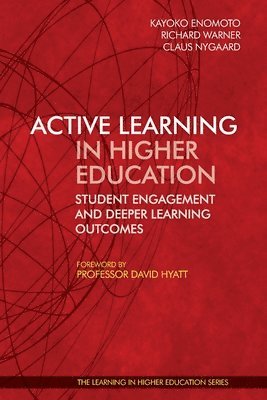
Active Learning in Higher Education:
Student Engagement and Deeper Learning Outcomes
Häftad, Engelska, 2022
560 kr
Skickas
This is the latest volume in the Learning in Higher Education series. Active Learning has at least two major benefits: 1) it engages students in their learning, and 2) it enhances their deeper learning outcomes. In this book, authors from universities in Australia, Canada, Italy, New Zealand, Romania, Turkey, the UK and the USA show how they have used active learning to engage their students and improve their deeper learning outcomes. Reading the book, you will gain insight into how the authors designed and carried out their teaching, using one of these eleven active learning methods: authentic project-based learning; case-based learning; experience-based learning; flipped and peer learning; inquiry-based learning; learning space design; project-based learning; research-based learning; students as partners framework; technology-enhanced learning; and virtual exchange co-design.The deeper learning outcomes documented by surveying or interviewing students include: a sense of belonging for improving retention; development of graduate attributes; digital pedagogy and professional skills; engaged and enhanced learning experiences; enhanced well-being; graduate employability; interpersonal and leadership skills; reflective practitioners; research communication competencies; and retention and employability. All the chapters in the book are underpinned by contemporary learning theories and methodologies on active learning. Yet, they are written in a direct and accessible language to inspire the reader to engage in teaching practices that enhance active learning in higher education.
568 kr
Skickas inom 5-8 vardagar
A collection of expert essays on innovative teaching and learning in higher education.
551 kr
Skickas inom 3-6 vardagar
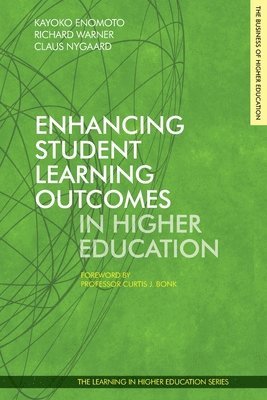
In the evolving landscape of higher education, this book is a vital resource which addresses a fundamental concern: how to effectively enhance student learning outcomes and adequately prepare students for their professional futures. The book presents a central model for enhancing student learning outcomes, the ESLO model, which is a meticulously crafted framework designed to optimise the academic experience and outcomes for students in higher education. Each stage represents a critical step in the instructional journey, ensuring that teaching and learning methodologies are tailored to students’ unique needs, effectively implemented, and subsequently assessed for their impact. The development of the ESLO model is a response to the growing demand for a more systematic, evidence-based approach in education – one that prioritises student learning outcomes and prepares students effectively for their future careers.Comprising 15 chapters, the book presents a wide range of perspectives from university educators spanning four continents: Australia, Asia, Europe, and North America. Their contributions detail their systematic approaches to designing, enacting, and assessing teaching and learning activities to enhance specific learning outcomes. Enhancing Student Learning Outcomes in Higher Education is an inspiring read for educators dedicated to advancing their pedagogical techniques and optimising student success.
699 kr
Skickas inom 5-8 vardagar
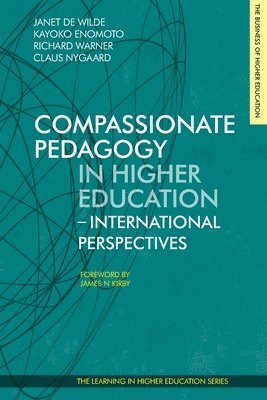
What if compassion were notan optional extra in higher education, but the organising principle of how weteach, learn, and lead?Compassionate Pedagogy inHigher Education — International Perspectives offers a bold and timely response. Bringingtogether scholars and practitioners from Australia, Europe, and North America,this volume presents a rich, global exploration of how compassion can transformlearning environments, strengthen academic communities, and support studentwellbeing.The core of the book is thenovel Five-Petal Compassionate Pedagogy Model, a research-basedframework that emphasises the emotional, relational, and ethical facets ofteaching. Each chapter demonstrates how this model can be implemented inpractice, providing engaging examples from various disciplines andinstitutional settings.More than just atheoretical discussion, this book offers educators practical strategies,reflective insights, and inspiring stories that demonstrate the power ofcompassion to enhance both academic achievement and human flourishing. Whetheryou are a university lecturer, academic developer, institutional leader, orpedagogy researcher, this volume presents a transformative vision of whathigher education can become when compassion is central.Compassion is not a luxuryin higher education — it is essential. This book explains why, and how, it canbe realised.