Clement Salaman - Böcker
Visar alla böcker från författaren Clement Salaman. Handla med fri frakt och snabb leverans.
4 produkter
4 produkter
311 kr
Skickas inom 7-10 vardagar
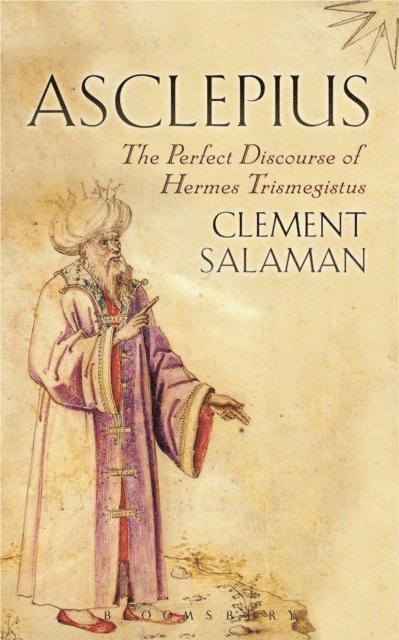
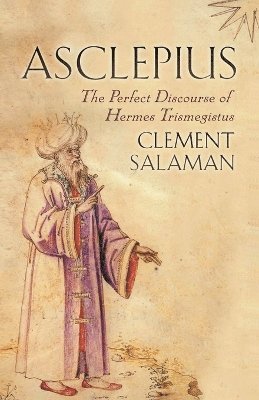
"The Asclepius" is one of two philosophical books ascribed to the legendary sage of Ancient Egypt, Hermes Trismegistus, who was believed in classical and renaissance times to have lived shortly after Moses. The Greek original, lost since classical times, is thought to date from the 2nd or 3rd century AD. However, a Latin version survived, of which this volume is a translation. Like its companion, the "Corpus Hermeticum" (also published by Duckworth as "The Way of Hermes"), the "Asclepius" describes the most profound philosophical questions in the form of a conversation about secrets: the nature of the One, the role of the gods, and the stature of the human being. Not only does this work offer spiritual guidance, but it is also a valuable insight into the minds and emotions of the Egyptians in ancient and classical times. Many of the views expressed also reflect Gnostic beliefs which passed into early Christianity.
370 kr
Tillfälligt slut
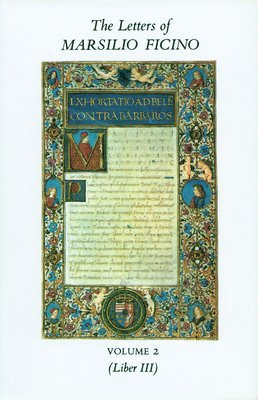
Chronologically, this translation comprises the third book of Ficino's letters ("Liber III"), as published during his lifetime, and dates from August 1476 to May 1477. They follow volume 1 and are therefore published as volume 2. Both book two and three of Ficino's Letters were dedicated to King Matthias of Hungary whom Ficino regarded as a model of the philosopher king referred to in Plato's "Republic". Indeed, Matthias was no ordinary king. He became one of the very few Christian leaders to defeat the Ottoman Turks decisively during the period of their empire's almost continuous growth from the early 1300s to the death of Suleiman I in 1566. King Matthias was also a devotee of philosophy, keenly interested in the practical study of Plato. Members of Ficino's Academy dwelt at this court, and an invitation to visit his court was extended to Ficino himself. Ficino's Academy was consciously modelled on the philosophical schools of antiquity. It was not merely an institute of learning. The bond between Ficino and the other members of the Academy was their mutual love, based on the love of the Self in each, a love capable of expression in all fields of human activity.It was because such love was the basis of his School that Ficnio could write (letter 21) - "the desire of him, who strives for anything other than love, is often totally frustrated by the event. But he alone who loves nothing more than love itself, by desiring immediately attains, and in always attaining continues to desire." It is the principle of unity to which Ficnio repeatedly returns in this volume. He returns to it not just as a philosophical concept, but as an immediate perception. In his letter to Paul of Middelburg ("distinguished scientist and astronomer"), Ficino observes - "If any age can be called a golden one it is undoubtedly the one that produces minds of gold in abundance. And no one who considers the wonderful discoveries of our age will doubt that it is a golden one. For this golden age has restored to the light the liberal arts that were almost extinct: grammar, poetry, rhetoric, painting, sculpture, architecture, music and the ancient art of singing to the Orphic lyre."
426 kr
Tillfälligt slut
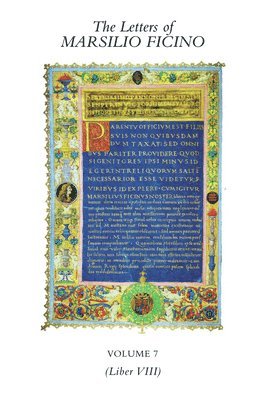
As leader of the Platonic Academy in Florence, Marsilio Ficino was teacher and guide to a remarkable circle of men. He inspired leading statesmen, scholars and churchmen throughout Europe, who travelled to meet him or conducted an extensive correspondence with him. The ideas they discussed appeared again and again and in the works of literature and art that followed: in Spenser, Shakespeare and Donne, in Botticelli, Michelangelo, Raphael, Durer and many more. Volume 7 (Book VIII of the Latin edition) is dedicated to one of Ficino's correspondents, King Matthias Corvinus of Hungary. Most of the dated letters are from June 1487 to October 1488, part of Florence's "golden decade", when Lorenzo de' Medici's astute politicking made him not only the peacemaker of the warring states of Italy, but also virtually controller of papal foreign policy. Ficino made good use of his time. Between 1482 and 1484 his major works were published: the "Platonic Theology", the "Christian Religion" and his translation from Greek into Latin of Plato's "Dialogues". He then turned to the translation of Plotinus.Important letters in this volume include his oration "God is Love", delivered to the clergy and people of Florence on the occasion of his installation as a canon of the cathedral in 1487. There are also letters comparing Moses with Plato and Socrates with Christ.
275 kr
Tillfälligt slut
The problems that taxed the minds of people during the Renaissance were much the same as those confronting us today. In their perplexity many deep-thinking people sought the advice of Marsilio Ficino, the leader of the Platonic Academy in Florence, and through his letters he advised them, encouraged them, and sometimes reproved them. Ficino was utterly fearless in expressing what he knew to be true. His letters cover the widest range of topics, mixing philosophy and humor, compassion and advice, and offering a profound glimpse into the soul of the Renaissance.This is the only accessible collection of Ficino's writings available in English.