Colin H. Simonds - Böcker
Visar alla böcker från författaren Colin H. Simonds. Handla med fri frakt och snabb leverans.
3 produkter
3 produkter
2 186 kr
Kommande
This book offers the first systematic philosophical account of animal ethics grounded in Buddhist thought. While Buddhist vegetarianism and compassion are often discussed in historical and popular contexts, no scholarly work has yet articulated a comprehensive Buddhist ethical theory that addresses contemporary questions about our treatment of nonhuman animals. Colin H. Simonds fills this critical gap, drawing on Tibetan Mahāyāna traditions to argue that the alleviation of duḥkha—suffering—logically extends to all sentient beings.The book develops a robust Buddhist animal ethic by examining the tradition’s epistemological foundation, ethical centring of the sentient being, concepts of compassion and human exceptionalism, and notions of rebirth, kinship, interdependence, and moral phenomenology. Simonds then applies this framework to urgent ethical issues including eating animals, industrial agriculture, animal testing, ritual animal release, and animal captivity. The result is a groundbreaking intervention that challenges human‑centred assumptions and reframes Buddhist ethics for a more‑than‑human world. Bridging Buddhist studies, philosophy, and animal ethics, this book will be essential reading for scholars, students, and practitioners engaged in Buddhist ethics, religion and animals, environmental humanities, and applied ethics.
1 193 kr
Skickas
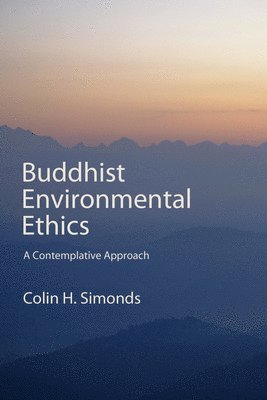
Brings Tibetan Buddhist philosophy, contemplative practice, and contemporary environmental ethics together to present a novel way of approaching the pressing issues facing our more-than-human world.In Buddhist Environmental Ethics, Colin H. Simonds presents a compelling case for using a contemplative register to approach some of our most pressing issues surrounding climate change, ecological collapse, and the exploitation of nonhuman animals. Simonds develops an emerging theory of Buddhist ethics—moral phenomenology—by engaging it with the Tibetan framework of view, meditation, action and providing a practical means by which individuals can ethically develop through contemplative practice. He then applies this theory and practical framework to the ethical and material problems facing the more-than-human world to show how a Tibetan Buddhist response to these issues offers a cogent, adaptable way to address environmental problems. In doing so, Buddhist Environmental Ethics forwards the first book-length constructive argument for an eco-Buddhist ethic in over a decade, articulates the first environmental ethic based on Tibetan Buddhist sources, and offers a timely framework for how we can experience the more-than-human world anew through contemplative practice.
360 kr
Kommande
Brings Tibetan Buddhist philosophy, contemplative practice, and contemporary environmental ethics together to present a novel way of approaching the pressing issues facing our more-than-human world.In Buddhist Environmental Ethics, Colin H. Simonds presents a compelling case for using a contemplative register to approach some of our most pressing issues surrounding climate change, ecological collapse, and the exploitation of nonhuman animals. Simonds develops an emerging theory of Buddhist ethics—moral phenomenology—by engaging it with the Tibetan framework of view, meditation, action and providing a practical means by which individuals can ethically develop through contemplative practice. He then applies this theory and practical framework to the ethical and material problems facing the more-than-human world to show how a Tibetan Buddhist response to these issues offers a cogent, adaptable way to address environmental problems. In doing so, Buddhist Environmental Ethics forwards the first book-length constructive argument for an eco-Buddhist ethic in over a decade, articulates the first environmental ethic based on Tibetan Buddhist sources, and offers a timely framework for how we can experience the more-than-human world anew through contemplative practice.