Colwell - Böcker
Visar alla böcker från författaren Colwell. Handla med fri frakt och snabb leverans.
4 produkter
4 produkter
580 kr
Skickas inom 5-8 vardagar
With thorough coverage of the most important research schemata, this book represents the most comprehensive material on research in music education that has been published. The top researchers in the fields present an up-to-date and exhaustive guide to music education research that belongs on the shelves of every student and instructor in music education. Sponsored by the National Association of Music Education (MENC), this book provides the most thorough coverage to date of such topics as: * The role of research in music education * Philosophical method * Qualitative research * Quantitative research * Historical methods * Assessment and its relationship to research This collection will prove essential for students and scholars of music education.
1 989 kr
Skickas inom 5-8 vardagar
The MENC Handbook of Research on Music Learning, Volume 1: Strategies brings together the best and most current research on methods for music learning, focusing squarely on the profession's empirical and conceptual knowledge of how students gain competence in music at various ages and in different contexts. The collection of chapters, written by the foremost figures active in the field, takes a broad theoretical perspective on current, critical areas of research, including music development, music listening and reading, motivation and self-regulated learning in music, music perception, and movement. The book's companion volume, Applications, builds an extensive and solid position of practice upon the frameworks and research presented here.Throughout both volumes in this essential set, focus is placed on the musical knowledge and musical skills needed to perform, create, understand, reflect on, enjoy, value, and respond to music. A key point of emphasis rests on the relationship between music learning and finding meaning in music, and as music technology plays an increasingly important role in learning today, chapters move beyond exclusively formal classroom instruction into other forms of systematic learning and informal instruction. Either individually or paired with its companion Volume 2: Applications, this indispensable overview of this growing area of inquiry will appeal to students and scholars in Music Education, as well as front-line music educators in the classroom.
1 064 kr
Skickas inom 10-15 vardagar
Twenty years ago the discovery that Vibrio cholerae does not "die off" in the environment was made. We hypothesized that this gram-negative, rod-shaped bac- terium possessed the capacity to survive for very long periods of time, i. e. , months or years, under conditions adverse to active growth and reproduction. The term "somnicell" was proposed in 1987 to describe this state of being. Subsequently a series of experiments showed that this phenomenon was not unique to Vibrio chol- erae. Many other gram-negative bacteria were found to undergo the "viable but not culturable" state in response to adverse environmental conditions. Such bac- terial species included Escherichia coli, Salmonella enteriditis, Campylobacter je- juni, Legionella pneumophila, and Shigella sonnei, among others. Clearly, the ability to tolerate the vicissitudes of the environment, notably changes that accom- pany climate and season, is part of a strategy for survival that is pervasive among bacterial species that are both aquatic in natural habitat and opportunistic human pathogens.It raises a question as to whether the pathogenicity manifested by these bacteria is opportunism, or simply metabolic functions of bacteria that are naturally occurring in the environment and contributing to the stability and sustainability of the environment, with the inadvertent host, the human, suffering because of mis- placed consequences of those metabolic functions. It is an interesting question to ponder. Throughout the pages that follow, invited authors describe, from each of their perspectives, the significance and consequences of the viable but nonculturable state.
322 kr
Skickas inom 7-10 vardagar
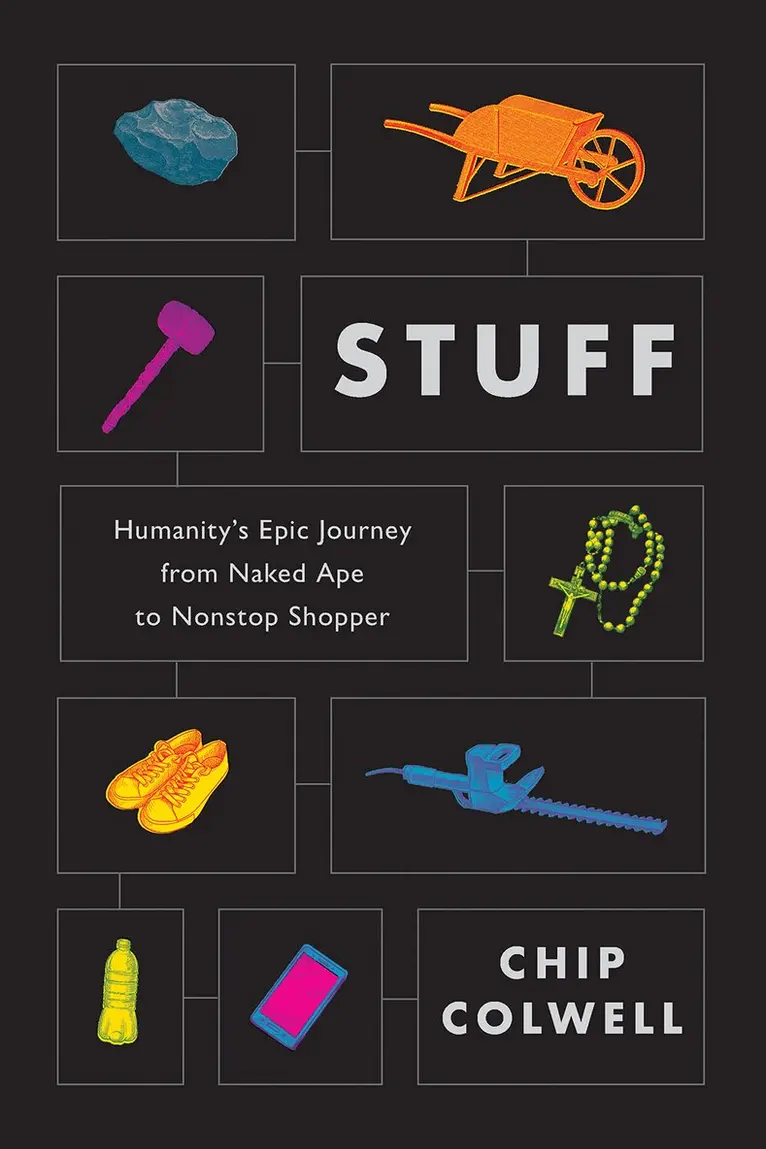
The fascinating tale of humankind’s journey from owning nothing to being owned—by our stuff. Why, when and how did our needs become world-destroying addictions? Over 3 million years ago, our ancestors realised they could break apart rocks for sharp edges to cut meat. That discovery changed the fate of our species and our planet. This lively, learned book charts three great leaps in humans’ relationship with objects and belongings, from the discovery of tools to the production of endless commodities. How did we go from primates who needed nothing to people who need everything? With colourful characters, astonishing archaeological discoveries, and reflections on philosophy and culture, Chip Colwell’s quest for answers takes readers to places both spectacular and strange: the Italian cave housing the world’s first painted art; a Hong Kong skyscraper where a priestess channels the gods; a trash mountain whose height rivals Big Ben or the Statue of Liberty. Humans make stuff, but our stuff makes us human—and this love affair may be our downfall. With landfills and oceans drowning in plastic, it’s time for a fourth and final leap for humanity: to reevaluate our relationship with the things that make, and could break, our world.