Cressida Heyes - Böcker
Visar alla böcker från författaren Cressida Heyes. Handla med fri frakt och snabb leverans.
5 produkter
5 produkter
13 709 kr
Tillfälligt slut
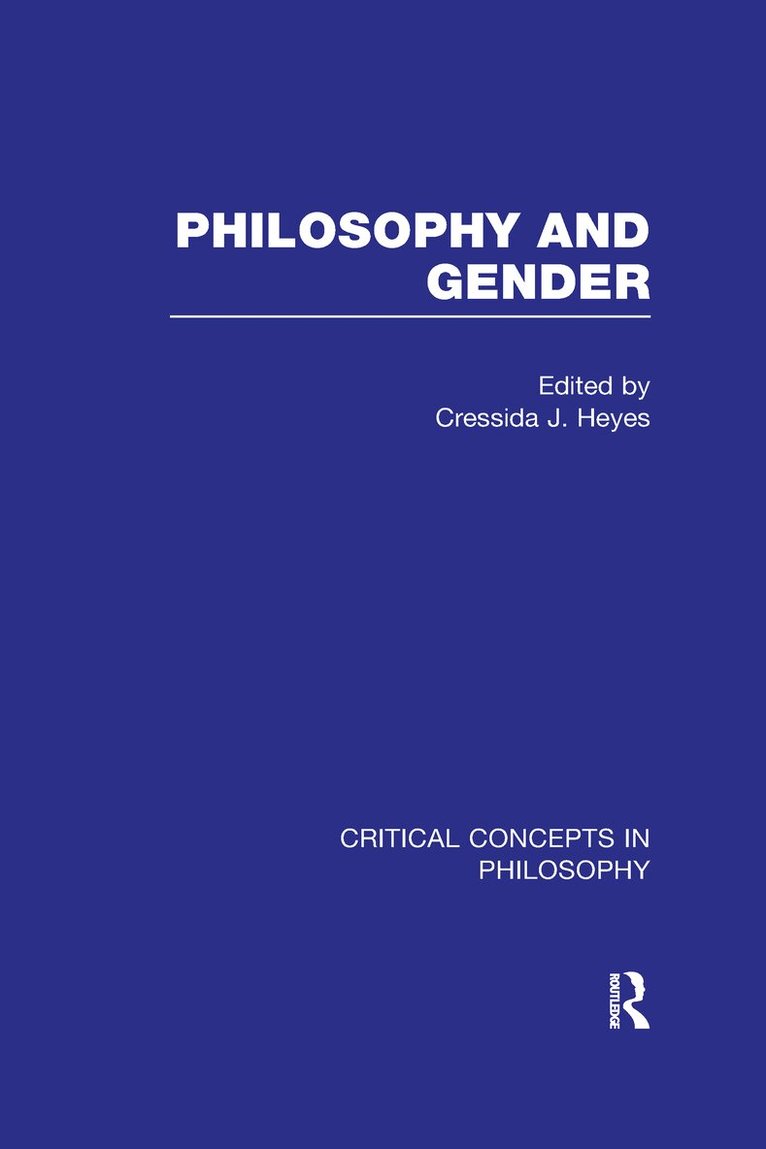
How are ‘philosophy’ and ‘gender’ implicated? Throughout history, philosophers—mostly men, though with more women among their number than is sometimes supposed—have often sought to specify and justify the proper roles of women and men, and to explore the political consequences of sexual difference. The last forty years, however, have seen a dramatic explosion of critical thinking about how philosophy is a gendered discipline; there has also been an abundance of philosophical work that uses gender as a central analytic category. In particular, feminist philosophy has become established as a major field of inquiry, and it is now complemented by related emerging areas, including the philosophy of race and the philosophy of sex and love.For those working in Philosophy and Gender dizzying questions such as the following arise: What justifications were used historically for the exclusion or inclusion of women in political life, and what is their contemporary resonance? How is what counts as knowledge shaped by gender norms? What metaphysical questions about identity are raised by sex change? How might some feminist philosophies risk reproducing racist assumptions about what it means to be a woman, while some critical philosophies of race assume a masculine subject? What does it mean to say that moral theories are gendered?Addressing the need for an authoritative and comprehensive reference work to enable users to answer these and other questions, and to make sense of—and to navigate around—an ever more complex corpus of scholarly literature, Philosophy and Gender is a new title in Routledge’s acclaimed Critical Concepts in Philosophy series. Edited by Cressida J. Heyes, it is a four-volume collection of foundational and the very best cutting-edge scholarship. It features critical analysis of gender as it relates to philosophy of mind and language, epistemology, metaphysics, logic, ethics, social and political thought, aesthetics, and philosophy of science; it is also distinctive in showing how feminist thought has been intertwined in both analytic and continental traditions. The collection reconfigures ‘gender and philosophy’ into an integrated field of inquiry while providing an invaluable resource for scholars in all disciplines who need to know how to think critically about gender. In so doing it responds to recent curriculum developments, while providing a crucial reference guide for theoretically minded scholars across the humanities and social sciences.Supplemented with a full index, and including an introduction, newly written by the editor, which places the assembled materials in their historical and intellectual context, Philosophy and Gender is destined to be valued by scholars and students as a vital research resource.
1 558 kr
Skickas inom 10-15 vardagar
At the heart of feminist theory lies the seemingly intractable issue of essentialism. Feminism has thus far failed to transcend critiques of essentialism and currently offers only two inadequate positions against it. One response reifies the category "women," representing the experience of oppression of privileged women as archetypal for feminism, and the other denies the category because it unjustly overgeneralizes, thus undercutting the possibility of a robust theory of gender oppression. To spur anti-essentialist methods and practice around such issues as sexual violence, feminist theory crucially needs a constructive and politically powerful strategy for defining women.Cressida J. Heyes deftly elucidates and then travels beyond the essentialism debates to rescue the efficacy of feminist theory for activism and research. She offers a genealogy of essentialism, specifically as it applies to the work of Carol Gilligan and Catharine MacKinnon, and employs a Wittgensteinian approach to feminism that understands similarities between women as family resemblances and political decisions about inclusion and exclusion as contextual and purposive. Line Drawings argues for an anti-essentialist method that enables generalizing feminist discourse but insists on paying close attention to the operations of power in constructing claims about women. This is a fresh and vitally important step past stymied debate on what is arguably the most pressing issue in cross-disciplinary feminist theory.
1 558 kr
Skickas inom 10-15 vardagar
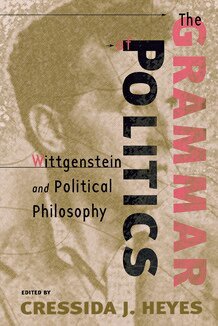
Ludwig Wittgenstein's work has been widely interpreted and appropriated by subsequent philosophers, as well as by scholars from areas as diverse as anthropology, cultural studies, literary theory, sociology, law, and medicine. The Grammar of Politics demonstrates the variety of ways political philosophers understand Wittgenstein's importance to their discipline and apply Wittgensteinian methods to their own projects.In her introduction, Cressida J. Heyes notes that Wittgenstein himself was skeptical of political theory, and that his philosophy does not lead naturally or inexorably toward any particular political position. Instead, she says, his ideas motivate certain attitudes toward the "game of politics" that the essays in this volume share: some contributors argue that political theory should use Wittgensteinian methods, others apply Wittgenstein's philosophy of language to figures and debates in areas of political theory (such as post-Kantian genealogy or Habermas's foundationalism), and still others reveal the ways Wittgenstein's concepts inform political foci as diverse as anthropomorphism, defining social group membership, and the nature of liberty. "All the contributors," Heyes writes, "take their lead from Wittgenstein's attempts to break the hold of certain pictures that tacitly direct our language and thus our forms of life. Making these pictures visible as pictures reveals the hitherto concealed structure and the contingency of certain ways of thinking about politics."
341 kr
Skickas inom 10-15 vardagar
At the heart of feminist theory lies the seemingly intractable issue of essentialism. Feminism has thus far failed to transcend critiques of essentialism and currently offers only two inadequate positions against it. One response reifies the category "women," representing the experience of oppression of privileged women as archetypal for feminism, and the other denies the category because it unjustly overgeneralizes, thus undercutting the possibility of a robust theory of gender oppression. To spur anti-essentialist methods and practice around such issues as sexual violence, feminist theory crucially needs a constructive and politically powerful strategy for defining women.Cressida J. Heyes deftly elucidates and then travels beyond the essentialism debates to rescue the efficacy of feminist theory for activism and research. She offers a genealogy of essentialism, specifically as it applies to the work of Carol Gilligan and Catharine MacKinnon, and employs a Wittgensteinian approach to feminism that understands similarities between women as family resemblances and political decisions about inclusion and exclusion as contextual and purposive. Line Drawings argues for an anti-essentialist method that enables generalizing feminist discourse but insists on paying close attention to the operations of power in constructing claims about women. This is a fresh and vitally important step past stymied debate on what is arguably the most pressing issue in cross-disciplinary feminist theory.
475 kr
Skickas inom 10-15 vardagar
Ludwig Wittgenstein's work has been widely interpreted and appropriated by subsequent philosophers, as well as by scholars from areas as diverse as anthropology, cultural studies, literary theory, sociology, law, and medicine. The Grammar of Politics demonstrates the variety of ways political philosophers understand Wittgenstein's importance to their discipline and apply Wittgensteinian methods to their own projects.In her introduction, Cressida J. Heyes notes that Wittgenstein himself was skeptical of political theory, and that his philosophy does not lead naturally or inexorably toward any particular political position. Instead, she says, his ideas motivate certain attitudes toward the "game of politics" that the essays in this volume share: some contributors argue that political theory should use Wittgensteinian methods, others apply Wittgenstein's philosophy of language to figures and debates in areas of political theory (such as post-Kantian genealogy or Habermas's foundationalism), and still others reveal the ways Wittgenstein's concepts inform political foci as diverse as anthropomorphism, defining social group membership, and the nature of liberty. "All the contributors," Heyes writes, "take their lead from Wittgenstein's attempts to break the hold of certain pictures that tacitly direct our language and thus our forms of life. Making these pictures visible as pictures reveals the hitherto concealed structure and the contingency of certain ways of thinking about politics."