Cristian Lorenz - Böcker
Visar alla böcker från författaren Cristian Lorenz. Handla med fri frakt och snabb leverans.
3 produkter
3 produkter
Biomedical Image Registration
4th International Workshop, WBIR 2010, Lübeck, July 11-13, 2010, Proceedings
Häftad, Engelska, 2010
556 kr
Skickas inom 7-10 vardagar
Welcome to the proceedings of the 4th Workshop on Biomedical Image R- istration (WBIR). Previous WBIRs took place in Bled, Slovenia (1999), at the UniversityofPennsylvania,USA(2003)andinUtrecht,TheNetherlands(2006). This year, WBIR was hosted by the Institute Mathematics and Image Proce- ing and the Fraunhofer Project Group on Image Registration and it was held in Lub ¨ eck, Germany. It provided the opportunity to bring together researchers from all over the world to discuss some of the most recent advances in image registration and its applications. We had an excellent collection of papers that were reviewed by at least three reviewers each from a 35-member Program Committee assembled from a wor- wide community of registration experts. This year 17 papers were accepted for oral presentation, while another 7 papers were accepted as poster papers. We believe all of the conference papers were of excellent quality. Registration is a fundamental task in image processing used to match two or more pictures taken, for example, at di?erent times, from di?erent sensors, or from di?erent viewpoints. Establishing the correspondence of structures within medical images is fundamental to diagnosis, treatment planning, and surgical guidance. The conference papers address state-of-the-art techniques for prov- ing reliable and e?cient registration techniques, thereby imposing relationships between speci?c application areas and appropriate registration schemes. We are grateful to all those who contributed to the success of WBIR 2010.
1 638 kr
Skickas inom 10-15 vardagar
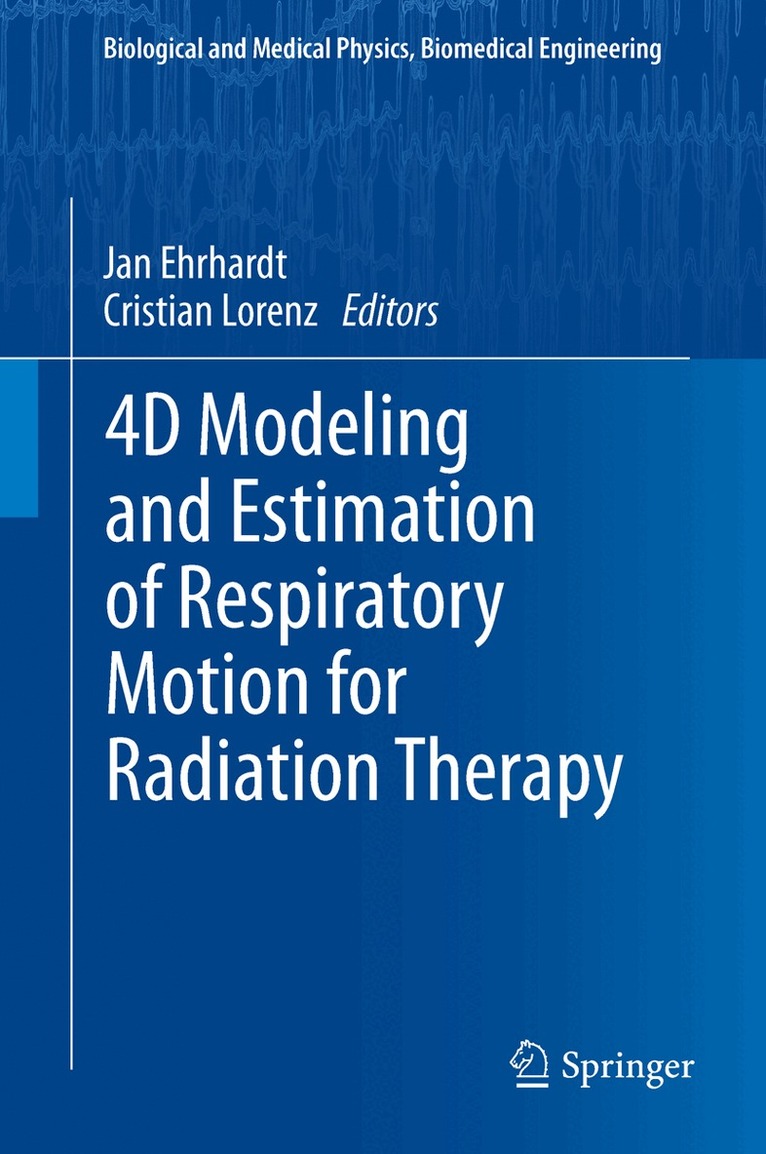
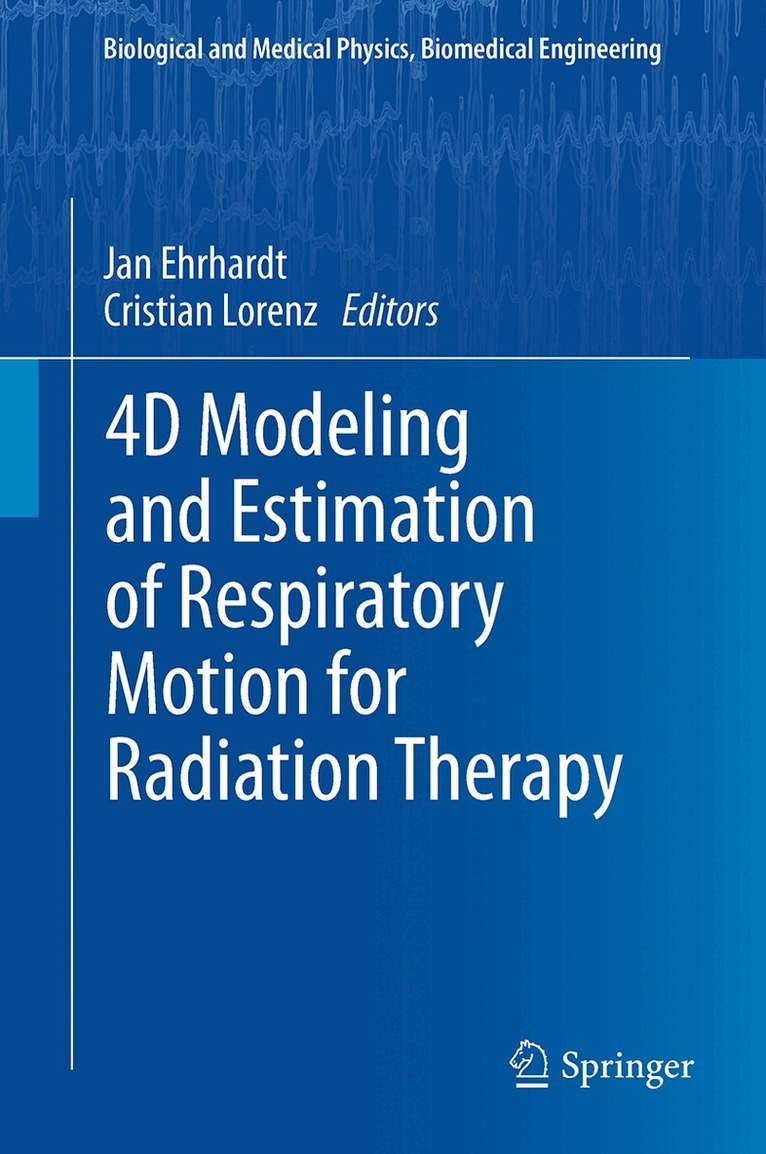
Respiratory motion causes an important uncertainty in radiotherapy planning of the thorax and upper abdomen. The main objective of radiation therapy is to eradicate or shrink tumor cells without damaging the surrounding tissue by delivering a high radiation dose to the tumor region and a dose as low as possible to healthy organ tissues. Meeting this demand remains a challenge especially in case of lung tumors due to breathing-induced tumor and organ motion where motion amplitudes can measure up to several centimeters. Therefore, modeling of respiratory motion has become increasingly important in radiation therapy. With 4D imaging techniques spatiotemporal image sequences can be acquired to investigate dynamic processes in the patient’s body. Furthermore, image registration enables the estimation of the breathing-induced motion and the description of the temporal change in position and shape of the structures of interest by establishing the correspondence between images acquired at different phases of the breathing cycle. In radiation therapy these motion estimations are used to define accurate treatment margins, e.g. to calculate dose distributions and to develop prediction models for gated or robotic radiotherapy. In this book, the increasing role of image registration and motion estimation algorithms for the interpretation of complex 4D medical image sequences is illustrated. Different 4D CT image acquisition techniques and conceptually different motion estimation algorithms are presented. The clinical relevance is demonstrated by means of example applications which are related to the radiation therapy of thoracic and abdominal tumors. The state of the art and perspectives are shown by an insight into the current field of research. The book is addressed to biomedical engineers, medical physicists, researchers and physicians working in the fields of medical image analysis, radiology and radiation therapy.
1 638 kr
Skickas inom 10-15 vardagar
Respiratory motion causes an important uncertainty in radiotherapy planning of the thorax and upper abdomen. The main objective of radiation therapy is to eradicate or shrink tumor cells without damaging the surrounding tissue by delivering a high radiation dose to the tumor region and a dose as low as possible to healthy organ tissues. Meeting this demand remains a challenge especially in case of lung tumors due to breathing-induced tumor and organ motion where motion amplitudes can measure up to several centimeters. Therefore, modeling of respiratory motion has become increasingly important in radiation therapy. With 4D imaging techniques spatiotemporal image sequences can be acquired to investigate dynamic processes in the patient’s body. Furthermore, image registration enables the estimation of the breathing-induced motion and the description of the temporal change in position and shape of the structures of interest by establishing the correspondence between images acquired at different phases of the breathing cycle. In radiation therapy these motion estimations are used to define accurate treatment margins, e.g. to calculate dose distributions and to develop prediction models for gated or robotic radiotherapy. In this book, the increasing role of image registration and motion estimation algorithms for the interpretation of complex 4D medical image sequences is illustrated. Different 4D CT image acquisition techniques and conceptually different motion estimation algorithms are presented. The clinical relevance is demonstrated by means of example applications which are related to the radiation therapy of thoracic and abdominal tumors. The state of the art and perspectives are shown by an insight into the current field of research. The book is addressed to biomedical engineers, medical physicists, researchers and physicians working in the fields of medical image analysis, radiology and radiation therapy.